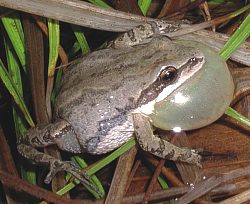
| Appearance | - The frog is typically reddish-brown or gray, although green and pinkish color forms also occur. English Wikipedia
- Its upper body usually has a broken longitudinal stripe or spots extending from the nose along the sides. English Wikipedia
- The upper lip has a distinct light-colored line. English Wikipedia
- Many individuals have a faint triangular marking on the top of the head. English Wikipedia
- The belly is pure white, and yellow spots are usually present in front of the hind legs. English Wikipedia
- The frog has a stout body and can be reddish brown, tan, grayish, or green. ncwildlife.gov
- A bold black stripe extends from each eye to the shoulder, accompanied by dark spots on the sides, lower back, and near the groin. ncwildlife.gov
- The groin and underside of each thigh have bright yellow spots. ncwildlife.gov
| - Adults have smooth skin and coloration ranging from greenish-grey, reddish, olive, to brown. English Wikipedia
- Adults typically have three dark longitudinal stripes running down their backs. English Wikipedia
- The dorsal stripes may be broken, reduced, or absent in some individuals. English Wikipedia
- The underside is generally white or cream-colored with scattered dark flecks. English Wikipedia
- A white stripe runs along the upper lip, while a dark stripe extends from the snout across the eye and along each side. English Wikipedia
- Some individuals have a dark triangular marking on the head. English Wikipedia
- Tadpoles have rounded gray or brown bodies, transparent tail fins, and dark flecks. English Wikipedia
|
|---|
| Size | - Adults measure 25–38 mm in head-body length, with a recorded maximum size of 4 cm. English Wikipedia
| |
|---|
| Habitat | - The species is most commonly found in the Southern Coastal Plain. English Wikipedia
- Its terrestrial habitats include pine stands, sandhills, and pine savannahs. English Wikipedia
- Woodland ponds, flooded fields, and roadside ditches can provide breeding habitat. English Wikipedia
- Breeding is especially common in ponds within sandhills, pine forests, and pine plantations. English Wikipedia
- Breeding sites commonly have open canopies and herbaceous vegetation. English Wikipedia
- Tadpole development requires seasonally flooded wetlands without fish for three to four months. English Wikipedia
- The species lives in pine stands and pine savannas in the southern Coastal Plain. ncwildlife.gov
| - Adults inhabit open, damp environments including marshes, meadows, forest edges, fallow fields, bottomland swamps, and floodplains. animaldiversity.org
- The species can occupy rural, urban, and agricultural environments. macalester.edu
- Tadpoles and froglets occur in shallow ponds, temporary pools, ditches, marshes, swamps, river backwaters, and lake edges. macalester.edu
|
|---|
| Diet | - The species is insectivorous and consumes small insects, insect larvae, worms, and other small invertebrates. English Wikipedia
| - Adults consume small invertebrates including flies, mosquitoes, ants, beetles, moths, caterpillars, grasshoppers, and spiders. English Wikipedia
- Young froglets feed on small prey including mites, midges, and springtails. English Wikipedia
- Tadpoles feed on periphyton, filamentous algae, diatoms, and pollen. English Wikipedia
- Tadpoles can scavenge when food is available. English Wikipedia
|
|---|
| Behaviour | - Adults are nocturnal and are rarely observed outside the mating season. English Wikipedia
- Activity increases as temperatures decrease, when individuals begin migrating toward water for mating. English Wikipedia
- Most observations occur on winter nights during or after rainfall. English Wikipedia
- During spring and summer, individuals shelter in burrows, beneath logs, or under sandy soil. English Wikipedia
- Individuals sometimes produce mating calls while completely buried underground. English Wikipedia
- The species burrows using its forelimbs to move into the substrate. English Wikipedia
- Individuals prefer easily penetrated sandy soils for burrowing. English Wikipedia
- Individuals sometimes communicate through vocalizations while underground. English Wikipedia
- The species is primarily nocturnal and is seldom encountered outside its breeding season. ncwildlife.gov
- Its call is a shrill, bird-like peep that is faster, more metallic, and more monotonic than the call of a spring peeper. ncwildlife.gov
| - Males and occasionally females produce calls in large choruses. English Wikipedia
- Male calls attract potential mates to breeding sites. English Wikipedia
- The call can be heard from approximately half a mile away. English Wikipedia
- Individual calling bouts typically last 0.5 to 2 seconds. English Wikipedia
- When disturbed, individuals stop calling and retreat underwater or into nearby terrestrial cover. English Wikipedia
- Individuals use leaf litter, logs, rocks, and loose soil as winter hibernation shelters. English Wikipedia
- The species rarely climbs despite belonging to the treefrog family. animaldiversity.org
- Individuals are largely solitary outside breeding gatherings. animaldiversity.org
- Individuals can tolerate partial freezing of their body water during winter. animaldiversity.org
- The species has an average home range of approximately 2,116 square metres, including its breeding pond. animaldiversity.org
|
|---|
| Reproduction | | - The breeding season generally extends from March through May, depending on geographic location. macalester.edu
- Females produce approximately 500 to 1,500 eggs per breeding season. English Wikipedia
- Individual egg clusters generally contain between 20 and 300 eggs. English Wikipedia
- Females attach gelatinous egg clusters to submerged weeds or grasses near the edges of shallow water bodies. English Wikipedia
- Eggs generally hatch within 3 to 14 days after being laid. animaldiversity.org
- Tadpoles generally metamorphose within 40 to 90 days after hatching. animaldiversity.org
- Males fertilize eggs externally while females lay them. animaldiversity.org
- There is no known parental involvement after females have deposited their eggs. animaldiversity.org
- Females generally reach sexual maturity during their second or third year. macalester.edu
|
|---|
| Distribution | - The species is endemic to the Southeastern United States. English Wikipedia
- Its documented range extends from North Carolina westward to the far eastern part of Louisiana and southward into northern Florida. English Wikipedia
- The species is restricted to the southeastern Coastal Plain. amphibiaweb.org
| - The species occurs in Canada and the United States. English Wikipedia
- The documented range extends from Canada to the Gulf of Mexico and from New Jersey to central Arizona. English Wikipedia
|
|---|
| Conservation | - The species is classified as Least Concern by the IUCN. English Wikipedia
- More than 36% of historical populations may have been extirpated or may be experiencing declines with low persistence probabilities. English Wikipedia
- Extirpated populations have been recorded in every state within the species' distribution, particularly near range margins. English Wikipedia
- Populations in protected areas or locations with high habitat suitability have greater probabilities of persistence. English Wikipedia
- Habitat loss and degradation are associated with declines in the species across many parts of its range. auth1.dpr.ncparks.gov
- The species is listed as endangered in North Carolina. ncwildlife.gov
- Destruction of temporary wetlands in longleaf pine ecosystems is contributing to population losses in North Carolina. ncwildlife.gov
- Collection or taking of the species in North Carolina requires a special permit issued by the Wildlife Commission's Executive Director. ncwildlife.gov
| - The species is classified as Least Concern on the IUCN list. English Wikipedia
- The species is listed as threatened in the Great Lakes/St. Lawrence–Canadian Shield region under Canada's Species at Risk Act. English Wikipedia
- Populations are declining in certain areas despite the species' adaptability to human activity. English Wikipedia
|
|---|
| Uses | No checked fact yet | - The species serves as an indicator of environmental pollution and ecosystem health. English Wikipedia
- Changes in morphology or reproductive success can indicate environmental pollution or toxic substances. English Wikipedia
- The species helps control populations of small insects and other prey organisms. animaldiversity.org
|
|---|