Comparison
Osedax roseus vs Osedax priapus
Osedax roseus (Osedax roseus) and Osedax priapus (Osedax priapus) both belong to the genus Osedax (boneworms) and part ways below it. Both are recorded in 1 country.
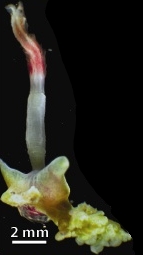
Osedax roseus
Robert C. Vrijenhoek, Shannon B. Johnson & Greg W. Rouse, CC BY 2.0, via Wikimedia Commons

Side by side
| Osedax roseus | Osedax priapus | |
|---|---|---|
| Scientific name | Osedax roseus Rouse, Worsaae, Johnson, Jones & Vrijenhoek, 2008 | Osedax priapus Rouse, Wilson, Worsaae & Vrijenhoek, 2015 |
| Group | Other invertebrates | Other invertebrates |
| Class | Polychaeta | Polychaeta |
| Order | Sabellida | Sabellida |
| Family | Siboglinidae Beard Worms | Siboglinidae Beard Worms |
| Genus | Osedax Boneworms | Osedax Boneworms |
| Named in | 2008 | 2015 |
| Environment | marine | marine |
| Countries on record | 2 countries | 1 country |
| GBIF occurrence records | 44 records | 60 records |
Rows where the two agree are shown in grey.
Where each is found
Both recorded in 1 country
Only Osedax roseus (1)
From Catalogue of Life checklists and GBIF occurrence records. A country missing from a list means no record is held, which is not proof of absence.
Checked facts
| Osedax roseus | Osedax priapus | |
|---|---|---|
| Appearance |
|
|
| Habitat |
|
|
| Diet |
|
|
| Behaviour |
|
|
| Reproduction |
|
|
| Distribution |
| No checked fact yet |
| Other | No checked fact yet |
|
In brief
Osedax roseus
The species inhabits abyssal depths and is recorded from the northeastern Pacific Ocean. Females have a branching root-like network containing symbiotic bacteria, while microscopic males inhabit parchment-like tubes produced by females. Full profile
Osedax priapus
Osedax priapus exploits relatively small bones on the seafloor. It exhibits a reversal of the sexual size dimorphism found in other Osedax species because males grow to full size and feed independently. Full profile
Compare something else
Page built on 27 November 2026 from the data on the two species pages, where every source is listed.
Cite this page
ScientificNames.org. (2026). Osedax roseus vs Osedax priapus. Retrieved November 27, 2026, from https://scientificnames.org/compare/osedax-roseus-vs-osedax-priapus
“Osedax roseus vs Osedax priapus.” ScientificNames.org, 2026, scientificnames.org/compare/osedax-roseus-vs-osedax-priapus. Accessed 27 Nov. 2026.
ScientificNames.org. “Osedax roseus vs Osedax priapus.” Accessed November 27, 2026. https://scientificnames.org/compare/osedax-roseus-vs-osedax-priapus.
@misc{scientificnames_osedax_roseus_vs_osedax_priapus,
  author = {{ScientificNames.org}},
  title = {Osedax roseus vs Osedax priapus},
  year = {2026},
  url = {https://scientificnames.org/compare/osedax-roseus-vs-osedax-priapus},
  note = {Accessed 2026-11-27}
}