Comparison
Acorn Anobiid vs Common Furniture Beetle
Acorn Anobiid (Ozognathus cornutus) and Common Furniture Beetle (Anobium punctatum) both belong to the family Ptinidae (spider beetles) and part ways below it. Both are recorded in 1 country.


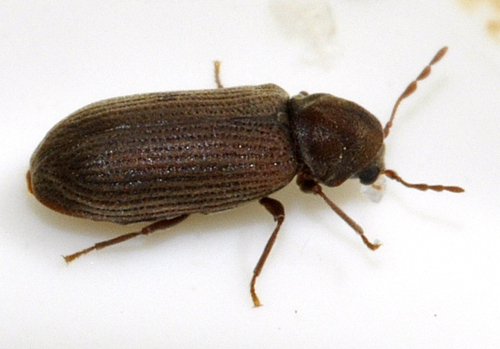
Common Furniture Beetle
Anobium punctatum
Francisco Welter-Schultes, no known copyright restrictions (public domain), Public domain, via iNaturalist
Side by side
| Acorn Anobiid | Common Furniture Beetle | |
|---|---|---|
| Scientific name | Ozognathus cornutus (LeConte, 1859) | Anobium punctatum (De Geer, 1774) |
| English name | Acorn Anobiid | Common Furniture Beetle |
| Group | Insects | Insects |
| Class | Insecta Insect | Insecta Insect |
| Order | Coleoptera Beetle | Coleoptera Beetle |
| Family | Ptinidae Spider Beetles | Ptinidae Spider Beetles |
| Genus | Ozognathus | Anobium Furniture Beetle |
| Named in | 1859 | 1774 |
| Countries on record | 1 country | 26 countries |
| GBIF occurrence records | 289 records | 7,101 records |
Rows where the two agree are shown in grey.
Where each is found
Both recorded in 1 country
Only Common Furniture Beetle (25)
- Austria
- Belgium
- Canada
- Denmark
- Estonia
- Finland
- France
- Germany
- Hungary
- Isle of Man
- Italy
- Latvia
- Lithuania
- New Zealand
- Norway
- Poland
- Portugal
- Russia
- Saint Pierre and Miquelon
- Spain
- Sweden
- Switzerland
- The Netherlands
- Ukraine
- United Kingdom
From Catalogue of Life checklists and GBIF occurrence records. A country missing from a list means no record is held, which is not proof of absence.
Checked facts
| Acorn Anobiid | Common Furniture Beetle | |
|---|---|---|
| Appearance |
|
|
| Size |
|
|
| Habitat |
|
|
| Diet |
|
|
| Behaviour | No checked fact yet |
|
| Reproduction |
|
|
| Distribution |
|
|
| Other | No checked fact yet |
|
In brief
Acorn Anobiid
Ozognathus cornutus is associated with dead wood and is native to North America, having spread to Europe, North Africa, New Zealand, and South America. It feeds on dead wood, including insect-induced galls and the feces of other wood-eating insects, as well as dried fruits and vegetables. Full profile
Common Furniture Beetle
Anobium punctatum inhabits dry wood and wooden structures and furniture in houses, stores and warehouses in Europe. Its larvae bore irregular tunnels through timber for three to four years. Full profile
Compare something else
Page built on 27 November 2026 from the data on the two species pages, where every source is listed.
Cite this page
ScientificNames.org. (2026). Acorn Anobiid vs Common Furniture Beetle. Retrieved November 27, 2026, from https://scientificnames.org/compare/acorn-anobiid-vs-common-furniture-beetle
“Acorn Anobiid vs Common Furniture Beetle.” ScientificNames.org, 2026, scientificnames.org/compare/acorn-anobiid-vs-common-furniture-beetle. Accessed 27 Nov. 2026.
ScientificNames.org. “Acorn Anobiid vs Common Furniture Beetle.” Accessed November 27, 2026. https://scientificnames.org/compare/acorn-anobiid-vs-common-furniture-beetle.
@misc{scientificnames_acorn_anobiid_vs_common_furniture_beetle,
  author = {{ScientificNames.org}},
  title = {Acorn Anobiid vs Common Furniture Beetle},
  year = {2026},
  url = {https://scientificnames.org/compare/acorn-anobiid-vs-common-furniture-beetle},
  note = {Accessed 2026-11-27}
}