Comparison

Blue King Crab vs Brown King Crab

Blue King Crab (Paralithodes platypus) and Brown King Crab (Paralithodes brevipes) both belong to the genus Paralithodes and part ways below it. Both are recorded in 1 country.

Blue King Crab

Blue King Crab

Paralithodes platypus

Andrey Butko, CC BY-SA 3.0, via Wikimedia Commons

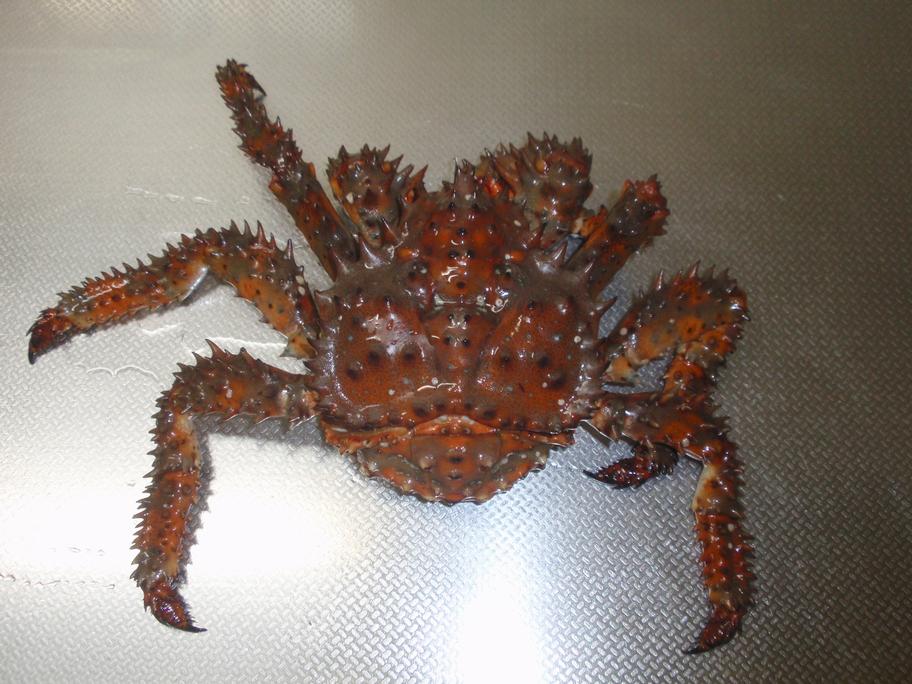
Brown King Crab

Brown King Crab

Paralithodes brevipes

Craford at Japanese Wikipedia, CC BY-SA 3.0, via Wikimedia Commons

Side by side

Blue King CrabBrown King Crab
Scientific nameParalithodes platypus (Brandt, 1850)Paralithodes brevipes (H. Milne-Edwards & Lucas, 1841)
English nameBlue King CrabBrown King Crab
GroupCrustaceansCrustaceans
ClassMalacostracaMalacostraca
OrderDecapodaDecapoda
FamilyLithodidae King CrabLithodidae King Crab
GenusParalithodesParalithodes
Named in18501841
Environmentmarinemarine
Countries on record1 country4 countries
GBIF occurrence records852 records64 records

Rows where the two agree are shown in grey.

Where each is found

Both recorded in 1 country

Only Brown King Crab (3)

From Catalogue of Life checklists and GBIF occurrence records. A country missing from a list means no record is held, which is not proof of absence.

Checked facts

Blue King CrabBrown King Crab
Appearance
  • Adults have five pairs of legs, with the first pair bearing claws and the fifth pair normally tucked beneath the rear of the carapace. adfg.alaska.gov
  • The abdomen is fan-shaped and tucked underneath the rear of the shell. adfg.alaska.gov
  • The right claw is usually larger than the left in adults. adfg.alaska.gov
  • The fifth pair of legs is small and normally positioned beneath the rear portion of the carapace. newsrelease.adfg.alaska.gov
  • Blue king crabs resemble red king crabs in size and general appearance but differ in color. adfg.alaska.gov
No checked fact yet
Habitat
  • The species inhabits cold waters of the North Pacific Ocean and adjacent seas. English Wikipedia
  • Adult females with eggs migrate to depths of 6–10 metres. English Wikipedia
  • Female blue king crabs without eggs migrate to depths of 50–80 metres. English Wikipedia
  • Female blue king crabs occupy depths of 130–180 metres during winter. English Wikipedia
No checked fact yet
Diet
  • Blue king crab larvae consume phytoplankton, particularly diatoms of the genus Thalassiosira, and zooplankton. adfg.alaska.gov
  • King crabs consume worms, clams, mussels, snails, brittle stars, sea stars, sea urchins, sand dollars, barnacles, other crabs, crustaceans, fish parts, sponges and algae. adfg.alaska.gov
No checked fact yet
Behaviour
  • Adult blue king crabs undertake annual migrations between shallow nearshore waters and deeper offshore waters. adfg.alaska.gov
  • Adult females and some adult males molt and mate before migrating offshore to feed. adfg.alaska.gov
  • Adult blue king crabs tend to segregate by sex away from mating and molting grounds. adfg.alaska.gov
  • Juvenile blue king crabs molt frequently and gain several millimetres in size with each molt. adfg.alaska.gov
  • Juvenile blue king crabs are not known to form pods. adfg.alaska.gov
  • Adult females use their specialized fifth pair of legs to clean their embryos. adfg.alaska.gov
  • Blue king crabs are seldom found co-existing with red and golden king crabs. adfg.alaska.gov
No checked fact yet
Reproduction
  • Pribilof Island blue king crabs mate and produce eggs between late March and early May. English Wikipedia
  • Females generally carry their eggs externally for 12–14 months. English Wikipedia
  • Blue king crab females generally produce eggs every other year. English Wikipedia
  • Female blue king crabs release larvae around the middle of April in the Pribilof Islands. English Wikipedia
  • Females release an average of approximately 110,000 larvae. adfg.alaska.gov
  • Female crabs require an average of 29 days to release their larvae. adfg.alaska.gov
  • Larvae pass through four zoeal stages, each lasting approximately 10 days. adfg.alaska.gov
  • The larval stage lasts approximately 2.5–4 months. adfg.alaska.gov
  • Larvae metamorphose and settle between July and early September. adfg.alaska.gov
  • Female king crabs typically reach sexual maturity at approximately five years of age. adfg.alaska.gov
  • Male king crabs may reach sexual maturity at approximately six years of age. adfg.alaska.gov
DistributionNo checked fact yet
  • The species occurs in cold, shallow waters extending from the coast of Hokkaido in the south to the southwest Bering Sea in the north. English Wikipedia
Conservation
  • The Pribilof Islands stock was declared overfished in 2002. uaf.edu
  • The 2015 stock assessment estimated Pribilof Islands blue king crab biomass at 8% of maximum sustainable yield biomass. uaf.edu
  • The Pribilof Islands population is too depleted to support a directed commercial fishery. adfg.alaska.gov
  • The St. Matthew Island population has been increasing following a period of low abundance. adfg.alaska.gov
  • The Pribilof Islands stock remains a concern despite the absence of directed commercial harvesting since 1999. adfg.alaska.gov
  • Male-only fishing along the coast of Hokkaido has damaged the species' reproductive success. English Wikipedia
Uses
  • Blue king crabs from the Diomede population support a subsistence fishery for the Native Village of Diomede, Alaska. English Wikipedia
  • Commercial blue king crab fisheries around the eastern Bering Sea began in the mid-1960s. English Wikipedia
  • The Pribilof Island commercial fishery was closed in 1988 because of population decline. English Wikipedia
No checked fact yet
Similar species
  • The red king crab (Paralithodes camtschaticus) is a similar but more widely distributed species. adfg.alaska.gov
  • The golden or brown king crab (Lithodes aequispinus) belongs to the same family as the blue king crab. adfg.alaska.gov
No checked fact yet
OtherNo checked fact yet

In brief

Blue King Crab

The blue king crab is a crustacean in the family Lithodidae, order Decapoda and class Malacostraca, with the scientific name Paralithodes platypus. It inhabits cold waters of the North Pacific Ocean and adjacent seas. It resembles the red king crab in size and general appearance but differs in color. Full profile

Brown King Crab

The Brown king crab (Paralithodes brevipes) is a king crab in the family Lithodidae, order Decapoda and class Malacostraca. It occurs in cold, shallow waters extending from the coast of Hokkaido in the south to the southwest Bering Sea in the north. Its reproductive success is strongly affected by the proportion of males to females. Full profile

Compare something else

Page built on 27 November 2026 from the data on the two species pages, where every source is listed.

Cite this page

ScientificNames.org. (2026). Blue King Crab vs Brown King Crab. Retrieved November 27, 2026, from https://scientificnames.org/compare/blue-king-crab-vs-brown-king-crab