Comparison
White-dotted Cattleheart vs Pink-spotted Cattleheart
White-dotted Cattleheart (Parides alopius) and Pink-spotted Cattleheart (Parides photinus) both belong to the genus Parides (cattlehearts) and part ways below it. Both are recorded in 1 country.
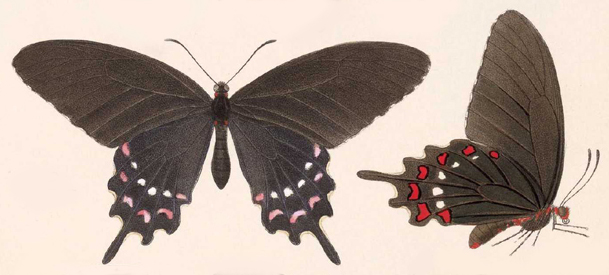
White-dotted Cattleheart
Parides alopius
Frederick DuCane Godman and Osbert Salvin, Public domain, via Wikimedia Commons


Pink-spotted Cattleheart
Parides photinus
D. Gordon E. Robertson, CC BY-SA 3.0, via Wikimedia Commons

Side by side
| White-dotted Cattleheart | Pink-spotted Cattleheart | |
|---|---|---|
| Scientific name | Parides alopius (Godman & Salvin, 1890) | Parides photinus (Doubleday, 1844) |
| English name | White-dotted Cattleheart | Pink-spotted Cattleheart |
| Group | Insects | Insects |
| Class | Insecta Insect | Insecta Insect |
| Order | Lepidoptera | Lepidoptera |
| Family | Papilionidae Swallowtail Butterfly | Papilionidae Swallowtail Butterfly |
| Genus | Parides Cattlehearts | Parides Cattlehearts |
| Named in | 1890 | 1844 |
| Countries on record | 1 country | 8 countries |
| GBIF occurrence records | 343 records | 3,557 records |
Rows where the two agree are shown in grey.
Where each is found
Both recorded in 1 country
Only Pink-spotted Cattleheart (7)
From Catalogue of Life checklists and GBIF occurrence records. A country missing from a list means no record is held, which is not proof of absence.
Checked facts
| White-dotted Cattleheart | Pink-spotted Cattleheart | |
|---|---|---|
| Appearance |
|
|
| Size |
|
|
| Habitat |
|
|
| Diet |
|
|
| Behaviour |
| No checked fact yet |
| Reproduction |
| No checked fact yet |
| Distribution | No checked fact yet |
|
| Conservation |
| No checked fact yet |
| Similar species |
| No checked fact yet |
| Other | No checked fact yet |
|
In brief
White-dotted Cattleheart
Parides alopius has black upper wing surfaces and two rows of submarginal hindwing spots, with white spots in the first row and pink spots in the second. Full profile
Pink-spotted Cattleheart
The Pink-spotted Cattleheart is a species in the ascanius species group. It inhabits forests from Mexico to Costa Rica, including Nicaragua and Honduras. It has black wings with a blue-green metallic sheen on the hindwings and two rows of red spots along their margins. Full profile
Compare something else
Page built on 28 November 2026 from the data on the two species pages, where every source is listed.
Cite this page
ScientificNames.org. (2026). White-dotted Cattleheart vs Pink-spotted Cattleheart. Retrieved November 28, 2026, from https://scientificnames.org/compare/white-dotted-cattleheart-vs-pink-spotted-cattleheart
“White-dotted Cattleheart vs Pink-spotted Cattleheart.” ScientificNames.org, 2026, scientificnames.org/compare/white-dotted-cattleheart-vs-pink-spotted-cattleheart. Accessed 28 Nov. 2026.
ScientificNames.org. “White-dotted Cattleheart vs Pink-spotted Cattleheart.” Accessed November 28, 2026. https://scientificnames.org/compare/white-dotted-cattleheart-vs-pink-spotted-cattleheart.
@misc{scientificnames_white_dotted_cattleheart_vs_pink_spotted_cattleheart,
  author = {{ScientificNames.org}},
  title = {White-dotted Cattleheart vs Pink-spotted Cattleheart},
  year = {2026},
  url = {https://scientificnames.org/compare/white-dotted-cattleheart-vs-pink-spotted-cattleheart},
  note = {Accessed 2026-11-28}
}