Comparison
Goldsaddle Goatfish vs Dash-and-dot Goatfish
Goldsaddle Goatfish (Parupeneus cyclostomus) and Dash-and-dot Goatfish (Parupeneus barberinus) both belong to the genus Parupeneus and part ways below it. Both are recorded in 44 countries.
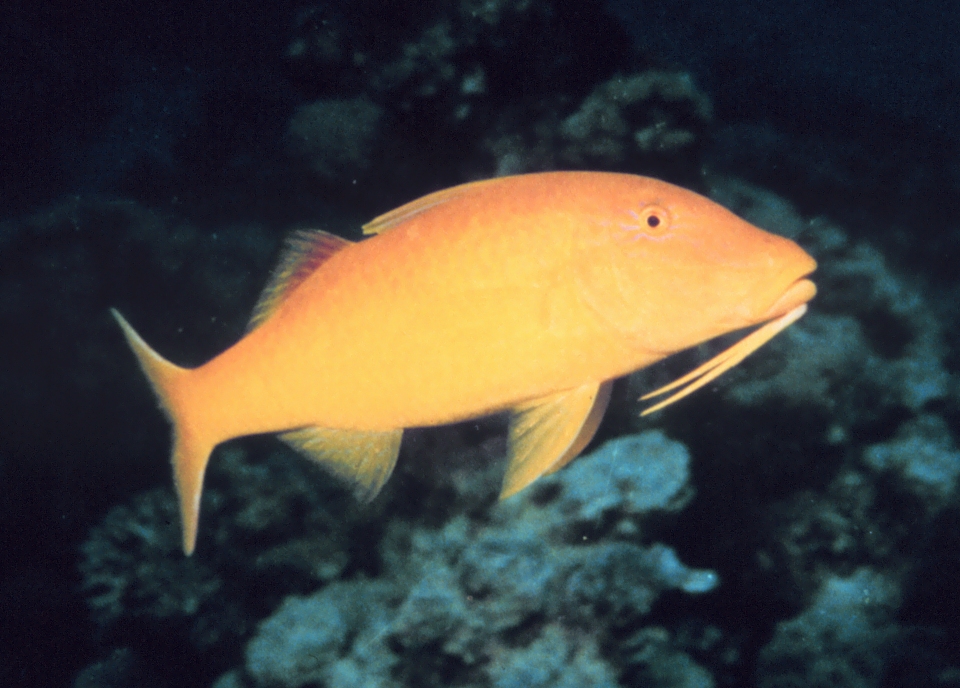
Goldsaddle Goatfish
Parupeneus cyclostomus
Mr. Mohammed Al Momany, Aqaba, Jordan, Public domain, via Wikimedia Commons


Side by side
| Goldsaddle Goatfish | Dash-and-dot Goatfish | |
|---|---|---|
| Scientific name | Parupeneus cyclostomus (Lacepède, 1801) | Parupeneus barberinus (Lacepède, 1801) |
| English name | Goldsaddle Goatfish | Dash-and-dot Goatfish |
| Group | Fishes | Fishes |
| Class | Teleostei Teleost | Teleostei Teleost |
| Order | Mulliformes | Mulliformes |
| Family | Mullidae Goatfish | Mullidae Goatfish |
| Genus | Parupeneus | Parupeneus |
| Named in | 1801 | 1801 |
| Red List category | Least Concern | Least Concern |
| Environment | marine | marine |
| Countries on record | 51 countries | 46 countries |
| GBIF occurrence records | 8,503 records | 6,173 records |
Rows where the two agree are shown in grey.
Where each is found
Both recorded in 44 countries
- American Samoa
- Australia
- British Indian Ocean Territory
- China
- Cocos Islands
- Cook Islands
- Egypt
- Fiji
- French Polynesia
- Guam
- India
- Indonesia
- Japan
- Kenya
- Kiribati
- Madagascar
- Malaysia
- Maldives
- Marshall Islands
- Mauritius
- Mayotte
- Micronesia
- Mozambique
- New Caledonia
- Northern Mariana Islands
- Palau
- Papua New Guinea
- Philippines
- Reunion
- Samoa
- Seychelles
- Solomon Islands
- South Africa
- Taiwan
- Tanzania
- Thailand
- Timor Leste
- Tonga
- Tuvalu
- United States Minor Outlying Islands
- Vanuatu
- Vietnam
- Wallis and Futuna
- Yemen
Only Goldsaddle Goatfish (7)
Only Dash-and-dot Goatfish (2)
From Catalogue of Life checklists and GBIF occurrence records. A country missing from a list means no record is held, which is not proof of absence.
Checked facts
| Goldsaddle Goatfish | Dash-and-dot Goatfish | |
|---|---|---|
| Appearance |
|
|
| Size |
| No checked fact yet |
| Habitat |
|
|
| Diet |
|
|
| Behaviour |
|
|
| Reproduction |
| No checked fact yet |
| Distribution | No checked fact yet |
|
| Conservation |
|
|
| Uses |
| No checked fact yet |
| Other |
| No checked fact yet |
In brief
Goldsaddle Goatfish
The goldsaddle goatfish inhabits coral reefs and detrital-bottom environments at depths of 1–95 metres. It is distinguished by a yellow patch on the upper part of its caudal peduncle. Full profile
Dash-and-dot Goatfish
Dash-and-dot Goatfish is a fish in the goatfish group, characterized by two chin barbels. It inhabits reef flats and lagoons with sandy bottoms and occurs at depths reaching 100 m. It has a white body with a dark stripe extending from the upper lip through the eye to a black spot near the caudal fin base. Full profile
Compare something else
Page built on 29 November 2026 from the data on the two species pages, where every source is listed.
Cite this page
ScientificNames.org. (2026). Goldsaddle Goatfish vs Dash-and-dot Goatfish. Retrieved November 29, 2026, from https://scientificnames.org/compare/goldsaddle-goatfish-vs-dash-and-dot-goatfish
“Goldsaddle Goatfish vs Dash-and-dot Goatfish.” ScientificNames.org, 2026, scientificnames.org/compare/goldsaddle-goatfish-vs-dash-and-dot-goatfish. Accessed 29 Nov. 2026.
ScientificNames.org. “Goldsaddle Goatfish vs Dash-and-dot Goatfish.” Accessed November 29, 2026. https://scientificnames.org/compare/goldsaddle-goatfish-vs-dash-and-dot-goatfish.
@misc{scientificnames_goldsaddle_goatfish_vs_dash_and_dot_goatfish,
  author = {{ScientificNames.org}},
  title = {Goldsaddle Goatfish vs Dash-and-dot Goatfish},
  year = {2026},
  url = {https://scientificnames.org/compare/goldsaddle-goatfish-vs-dash-and-dot-goatfish},
  note = {Accessed 2026-11-29}
}