Comparison

Melon-headed Whale vs False Killer Whale

Melon-headed Whale (Peponocephala electra) and False Killer Whale (Pseudorca crassidens) both belong to the family Delphinidae (oceanic dolphin) and part ways below it. Both are recorded in 16 countries.

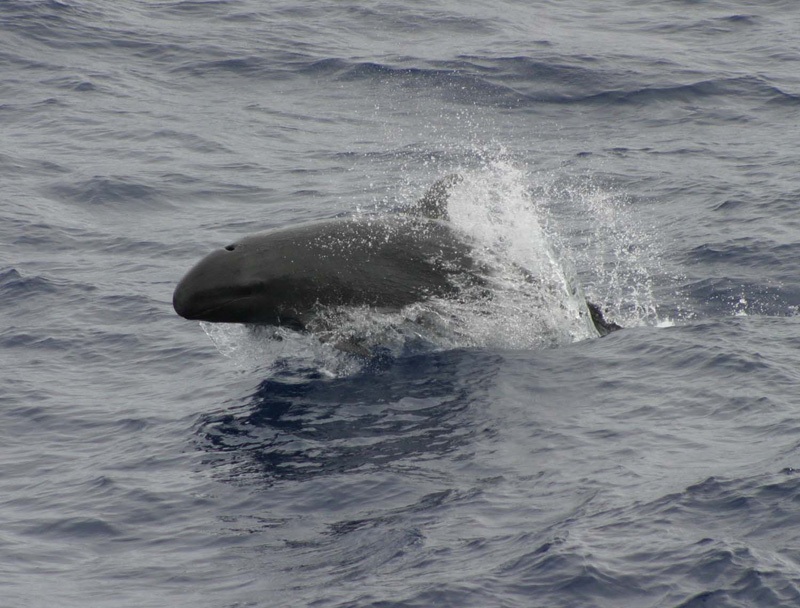
Melon-headed Whale

Melon-headed Whale

Peponocephala electra

Cyril di Bisceglie, CC BY-SA 4.0, via Wikimedia Commons

False Killer Whale

False Killer Whale

Pseudorca crassidens

Unknown author, Public domain, via Wikimedia Commons

Side by side

Melon-headed WhaleFalse Killer Whale
Scientific namePeponocephala electra (Gray, 1846)Pseudorca crassidens (Owen, 1846)
English nameMelon-headed WhaleFalse Killer Whale
GroupMammalsMammals
ClassMammalia MammalMammalia Mammal
OrderCetacea CetaceanCetacea Cetacean
FamilyDelphinidae Oceanic DolphinDelphinidae Oceanic Dolphin
GenusPeponocephala Melon-headed WhalesPseudorca False Killer Whales
Named in18461846
Red List categoryLeast ConcernNear Threatened
Environmentmarinemarine
Countries on record40 countries32 countries
GBIF occurrence records1,591 records9,197 records

Rows where the two agree are shown in grey.

Where each is found

Both recorded in 16 countries

Only Melon-headed Whale (24)

Only False Killer Whale (16)

From Catalogue of Life checklists and GBIF occurrence records. A country missing from a list means no record is held, which is not proof of absence.

Checked facts

Melon-headed WhaleFalse Killer Whale
Appearance
  • The species has a robust, dolphin-like body and a tapering conical head without a discernible beak. English Wikipedia
  • Its body coloration ranges from charcoal-gray to dark gray. English Wikipedia
  • The species has a dark facial mask extending from around the eye toward the front of the melon. English Wikipedia
  • Its dorsal fin is relatively tall, sickle-shaped, and positioned near the middle of the back. English Wikipedia
  • Adult males have longer flippers and taller dorsal fins than females. English Wikipedia
  • The species has 20–25 pairs of slender teeth in each jaw. English Wikipedia
  • The false killer whale has a slender, dark gray or black body with a slightly lighter underside. English Wikipedia
  • The species has an elongated, tapered head without a distinct beak. English Wikipedia
  • Its dorsal fin is sickle-shaped. English Wikipedia
  • Its flippers are narrow, short and pointed, with a distinctive bulge along their leading edges. English Wikipedia
  • Its teeth are conical, with 14–21 teeth in the upper jaw and 16–24 in the lower jaw. English Wikipedia
  • The melon organ in its forehead is larger in males than in females. English Wikipedia
SizeNo checked fact yet
Habitat
  • The species inhabits deep tropical and subtropical oceanic waters. English Wikipedia
  • Individuals can occur close to shore around oceanic islands and archipelagos. English Wikipedia
  • The species is primarily found in equatorial and subtropical waters beyond continental shelves. animaldiversity.org
  • The species inhabits tropical and subtropical marine waters. English Wikipedia
  • It generally inhabits open-ocean and deep-water environments but sometimes occurs near oceanic islands. English Wikipedia
  • The species prefers deep water in the open ocean away from land. australian.museum
Diet
  • The species feeds primarily on pelagic and mesopelagic squid and small fish. English Wikipedia
  • Crustaceans, including shrimp, have been identified in stomach contents. English Wikipedia
  • Individuals forage at night when their prey occupies the upper 400 metres of the water column. English Wikipedia
  • The species also consumes cuttlefish. fisheries.noaa.gov
Behaviour
  • Individuals usually travel in groups of 100–500 animals. English Wikipedia
  • Some observed herds contain as many as 1,000–2,000 individuals. English Wikipedia
  • Larger groups consist of smaller subgroups that aggregate together. English Wikipedia
  • The species frequently associates with Fraser's dolphins. English Wikipedia
  • Individuals may associate in mixed groups with spinner dolphins and bottlenose dolphins. English Wikipedia
  • Individuals may approach boats and ride their bow waves in some regions. English Wikipedia
  • The species can experience mass strandings involving hundreds of individuals. English Wikipedia
  • The species is highly social and commonly travels in groups of 10–20 individuals. English Wikipedia
  • Large groups can contain more than 500 individuals. English Wikipedia
  • Feeding groups may divide into smaller family groups containing four to six individuals. English Wikipedia
  • Individuals have been recorded remaining with the same pod for as long as 15 years. English Wikipedia
  • It can interact sexually with bottlenose dolphins and pilot whales. English Wikipedia
  • The species uses echolocation to navigate and locate prey. English Wikipedia
  • The species is an efficient pack hunter. australian.museum
Reproduction
Distribution
  • The species occurs in tropical and subtropical waters between 40° north and 35° south. English Wikipedia
  • Its range includes the Hawaiian Islands, the Philippines, and French Polynesia. English Wikipedia
No checked fact yet
Conservation
  • The IUCN classifies the species as Near Threatened. English Wikipedia
  • The Hawaiian population was recognized as endangered by the United States National Oceanic and Atmospheric Administration in November 2012. English Wikipedia
  • Incidental deaths associated with fishing operations are a threat to the species. australian.museum
  • Some populations, particularly those off Japan and parts of Asia, are deliberately hunted. australian.museum
  • The species is captured for the oceanarium trade. australian.museum
  • Fishing-gear entanglement can cause drowning, restricted circulation and impaired hunting ability. English Wikipedia
  • The species is covered by the Agreement on the Conservation of Small Cetaceans of the Baltic, North East Atlantic, Irish and North Seas. English Wikipedia
UsesNo checked fact yet
  • False killer whales have been kept in public aquariums in Japan, the United States, the Netherlands, Hong Kong and Australia. English Wikipedia
Similar species
  • The species can be confused with pygmy killer whales because of their similar appearance and overlapping habitat and range. English Wikipedia
  • The pointed flipper tips of melon-headed whales distinguish them from the rounded flipper tips of pygmy killer whales. English Wikipedia
  • The false killer whale's closest living relatives include Risso's dolphin, the melon-headed whale, the pygmy killer whale and pilot whales. English Wikipedia
  • The species can hybridize with the common bottlenose dolphin to produce fertile offspring known as wholphins. English Wikipedia
Name origin
  • The common name refers to the characteristic shape of the animal's head. English Wikipedia
  • The common name refers to the resemblance between the species' skull and that of the killer whale. English Wikipedia

In brief

Melon-headed Whale

Peponocephala electra inhabits tropical and subtropical waters between 40° north and 35° south, including the Hawaiian Islands, the Philippines, and French Polynesia. It has a robust, dolphin-like body, a tapering conical head without a discernible beak, and charcoal-gray to dark gray coloration. Full profile

False Killer Whale

Pseudorca crassidens inhabits tropical and subtropical marine waters, primarily in open-ocean and deep-water environments. It has a slender, dark gray or black body, an elongated tapered head without a distinct beak and a sickle-shaped dorsal fin. Full profile

Compare something else

Page built on 28 November 2026 from the data on the two species pages, where every source is listed.

Cite this page

ScientificNames.org. (2026). Melon-headed Whale vs False Killer Whale. Retrieved November 28, 2026, from https://scientificnames.org/compare/melon-headed-whale-vs-false-killer-whale