Comparison
East African Potto vs Bangka Slow Loris
East African Potto (Perodicticus ibeanus) and Bangka Slow Loris (Nycticebus bancanus) both belong to the family Lorisidae (pottos) and part ways below it.

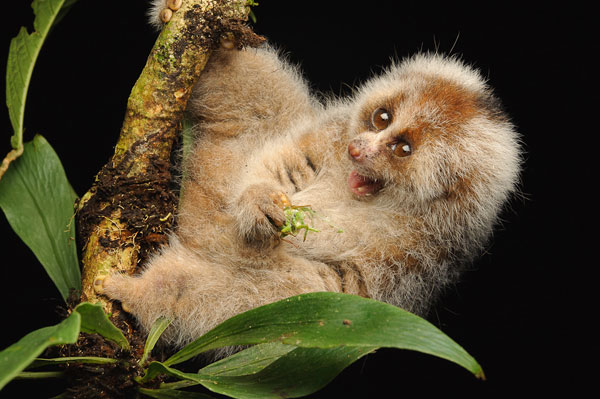


Side by side
| East African Potto | Bangka Slow Loris | |
|---|---|---|
| Scientific name | Perodicticus ibeanus Thomas, 1910 | Nycticebus bancanus Lyon, 1906 |
| English name | East African Potto | Bangka Slow Loris |
| Group | Mammals | Mammals |
| Class | Mammalia Mammal | Mammalia Mammal |
| Order | Primates Primate | Primates Primate |
| Family | Lorisidae Pottos | Lorisidae Pottos |
| Genus | Perodicticus Pottos | Nycticebus Slow Loris |
| Named in | 1910 | 1906 |
| Red List category | Least Concern | Critically Endangered |
| Countries on record | 4 countries | Not recorded |
| GBIF occurrence records | 132 records | Not recorded |
Rows where the two agree are shown in grey.
Where each is found
Only East African Potto (4)
From Catalogue of Life checklists and GBIF occurrence records. A country missing from a list means no record is held, which is not proof of absence.
Checked facts
| East African Potto | Bangka Slow Loris | |
|---|---|---|
| Appearance |
|
|
| Size | No checked fact yet |
|
| Habitat |
|
|
| Diet | No checked fact yet |
|
| Behaviour |
|
|
| Distribution |
|
|
| Conservation |
|
|
| Similar species | No checked fact yet |
|
| Name origin | No checked fact yet |
|
| Other | No checked fact yet |
|
In brief
East African Potto
The East African Potto is a strepsirrhine primate. It occurs from the Central African Republic and the Democratic Republic of the Congo eastward to western Kenya. Its subspecies Perodicticus ibeanus stockleyi is endemic to the slopes of Mount Kenya and represents the easternmost population of any potto. Full profile
Bangka Slow Loris
The Bangka Slow Loris belongs to the family Lorisidae. It occurs in southwestern Borneo and on Bangka Island. It has a toxic bite, a distinctive characteristic among primates. Full profile
Compare something else
Page built on 27 November 2026 from the data on the two species pages, where every source is listed.
Cite this page
ScientificNames.org. (2026). East African Potto vs Bangka Slow Loris. Retrieved November 27, 2026, from https://scientificnames.org/compare/east-african-potto-vs-bangka-slow-loris
“East African Potto vs Bangka Slow Loris.” ScientificNames.org, 2026, scientificnames.org/compare/east-african-potto-vs-bangka-slow-loris. Accessed 27 Nov. 2026.
ScientificNames.org. “East African Potto vs Bangka Slow Loris.” Accessed November 27, 2026. https://scientificnames.org/compare/east-african-potto-vs-bangka-slow-loris.
@misc{scientificnames_east_african_potto_vs_bangka_slow_loris,
  author = {{ScientificNames.org}},
  title = {East African Potto vs Bangka Slow Loris},
  year = {2026},
  url = {https://scientificnames.org/compare/east-african-potto-vs-bangka-slow-loris},
  note = {Accessed 2026-11-27}
}