Comparison

Peruvian Martin vs Purple Martin

Peruvian Martin (Progne murphyi) and Purple Martin (Progne subis) both belong to the genus Progne (martin) and part ways below it.

Peruvian Martin

Peruvian Martin

Progne murphyi

iNaturalist user: thibaudaronson, CC BY-SA 4.0, via Wikimedia Commons
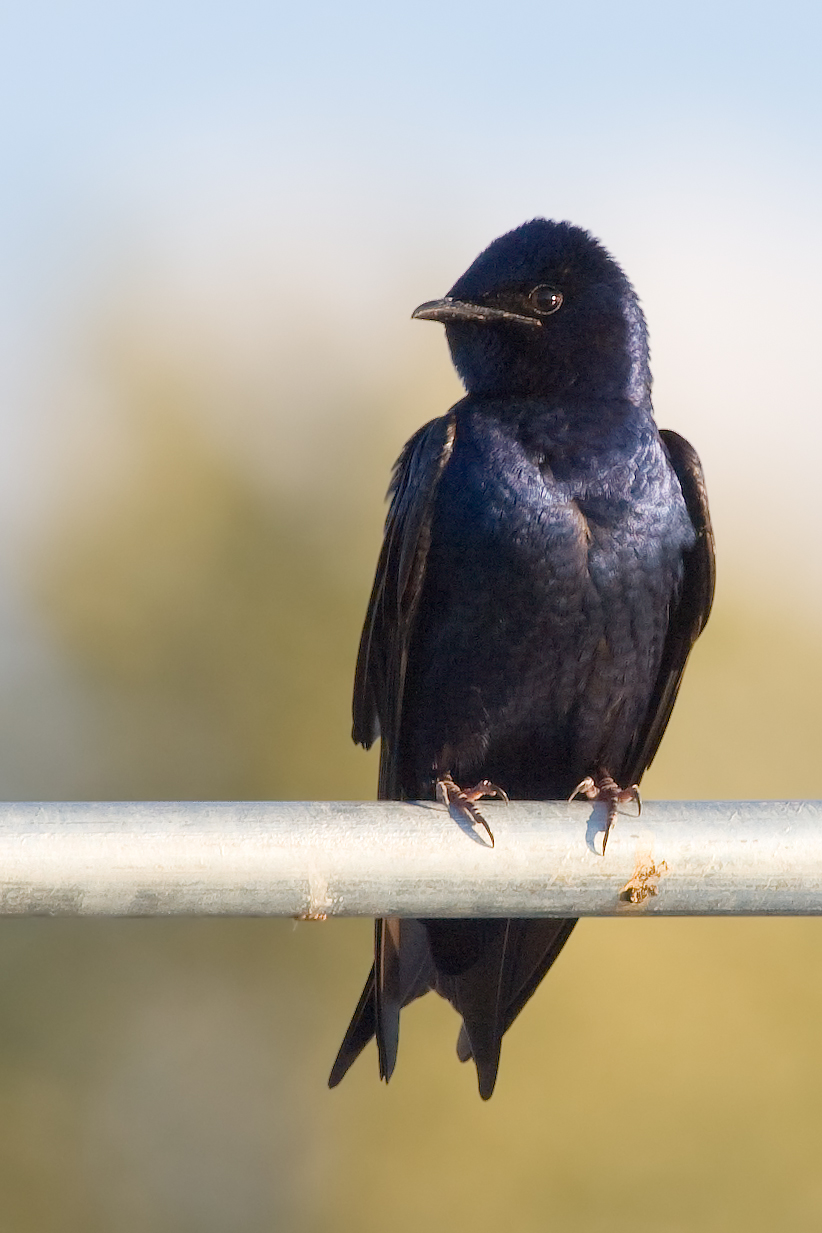
Purple Martin

Purple Martin

Progne subis

JJ Cadiz, Cajay, CC BY 3.0, via Wikimedia Commons

Side by side

Peruvian MartinPurple Martin
Scientific nameProgne murphyi Chapman, 1925Progne subis (Linnaeus, 1758)
English namePeruvian MartinPurple Martin
GroupBirdsBirds
ClassAves BirdAves Bird
OrderPasseriformes PasserinePasseriformes Passerine
FamilyHirundinidae SwallowHirundinidae Swallow
GenusProgne MartinProgne Martin
Named in19251758
Red List categoryNear ThreatenedLeast Concern
EnvironmentNot recordedterrestrial
Countries on record2 countries25 countries
GBIF occurrence records465 records2,079,443 records

Rows where the two agree are shown in grey.

Where each is found

Only Peruvian Martin (2)

Only Purple Martin (25)

From Catalogue of Life checklists and GBIF occurrence records. A country missing from a list means no record is held, which is not proof of absence.

Checked facts

Peruvian MartinPurple Martin
Appearance
  • Adult males have entirely black plumage with a glossy steel-blue sheen. English Wikipedia
  • Adult females have dark upperparts with some steel-blue sheen and lighter underparts. English Wikipedia
  • Adult purple martins have slightly forked tails. English Wikipedia
  • Adult plumage develops over a period of two years in both sexes. English Wikipedia
  • Subadult males develop randomly distributed black chest feathers while moulting into adult plumage. English Wikipedia
Size
Habitat
  • The Peruvian Martin inhabits semi-open and open landscapes. English Wikipedia
  • Its habitats include offshore islands and coastal cliffs. English Wikipedia
  • The species also inhabits pastures, agricultural areas, and scrublands. English Wikipedia
  • The Peruvian Martin is associated with lowland deserts and coastal areas. ebird.org
  • Purple martins breed in open areas throughout eastern North America and at some western coastal locations between British Columbia and Mexico. English Wikipedia
  • Western populations use natural nesting cavities, including old woodpecker holes and cavities in saguaro cacti. English Wikipedia
  • Purple martins in Missouri and the eastern United States depend on artificial nesting sites. extension.missouri.edu
  • Purple martins prefer nesting boxes situated near bodies of water. extension.missouri.edu
  • Purple martins prefer nesting sites near human activity. extension.missouri.edu
Diet
  • Purple martins are insectivores that primarily catch insects while flying. English Wikipedia
  • Their diet includes beetles, moths, dragonflies, butterflies, horseflies, leafhoppers and wasps. extension.missouri.edu
  • Mosquitoes account for less than one percent of the purple martin's diet. extension.missouri.edu
  • Purple martins have been documented feeding on invasive fire ants. English Wikipedia
Behaviour
  • The Peruvian Martin is not considered a conventional migrant. English Wikipedia
  • Outside northern Peru, the species is known only from non-breeding individuals. English Wikipedia
  • Purple martins are known for fast and agile flight involving both rapid flapping and gliding. English Wikipedia
  • When approaching nesting sites, purple martins dive at high speed with their wings tucked. English Wikipedia
  • Purple martins produce chirping, chortling, rattling and croaking vocalizations. English Wikipedia
  • Outside the breeding season, purple martins form large flocks and roost together. English Wikipedia
  • Purple martins generally migrate over land through Mexico and Central America. English Wikipedia
  • Purple martins exhibit strong fidelity to successful nesting locations and often return annually. English Wikipedia
  • Adult male purple martins arrive at breeding sites before females and establish territories. English Wikipedia
Reproduction
Distribution
  • The species breeds in the Peruvian departments of Piura and La Libertad. English Wikipedia
  • Non-breeding individuals occur intermittently along the Peruvian coast and into extreme northwestern Chile. English Wikipedia
  • The breeding range includes the eastern United States and southeastern Canada. English Wikipedia
  • The breeding range also includes the coastal Pacific Northwest, Baja California, Arizona and New Mexico. English Wikipedia
  • Purple martins winter in Brazil, Bolivia and parts of Peru. English Wikipedia
  • Purple martins migrate to North America in spring to breed. English Wikipedia
Conservation
  • The Peruvian Martin has been classified as Near Threatened since 2020. English Wikipedia
  • The species was originally assessed as Vulnerable by the IUCN in 2005. English Wikipedia
  • The estimated population comprises between 2,500 and 10,000 mature individuals. English Wikipedia
  • The population of mature individuals is believed to be declining. English Wikipedia
  • The species has a very limited geographical range. English Wikipedia
  • The species is considered uncommon within its small range. datazone.birdlife.org
  • The Peruvian Martin is considered scarce and poorly known. ebird.org
  • The threats affecting the Peruvian Martin have not been established. English Wikipedia
  • Competition with seabirds for nesting sites and nest predation have been proposed as possible threats. English Wikipedia
  • Agricultural intensification and subsequent pesticide use have also been proposed as potential threats. English Wikipedia
  • Purple martins are classified as a species of least concern by the IUCN. English Wikipedia
  • Purple martin populations experienced a severe decline during the twentieth century. English Wikipedia
  • Competition for nesting cavities from European starlings and house sparrows is a threat to purple martins. English Wikipedia
OtherNo checked fact yet
  • The California breeding range of the purple martin is highly localized. nrm.dfg.ca.gov

In brief

Peruvian Martin

Progne murphyi breeds in the Peruvian departments of Piura and La Libertad and occurs along the Peruvian coast and into extreme northwestern Chile outside its breeding range. Adult males have glossy blue-black upperparts, while females have mouse-gray heads and a shiny steel-blue band across the back. Full profile

Purple Martin

Progne subis breeds in eastern North America, southeastern Canada and specified western coastal locations, and winters in Brazil, Bolivia and parts of Peru. It is the largest swallow species in North America and has adult plumage that develops over two years. Full profile

Compare something else

Page built on 27 November 2026 from the data on the two species pages, where every source is listed.

Cite this page

ScientificNames.org. (2026). Peruvian Martin vs Purple Martin. Retrieved November 27, 2026, from https://scientificnames.org/compare/peruvian-martin-vs-purple-martin