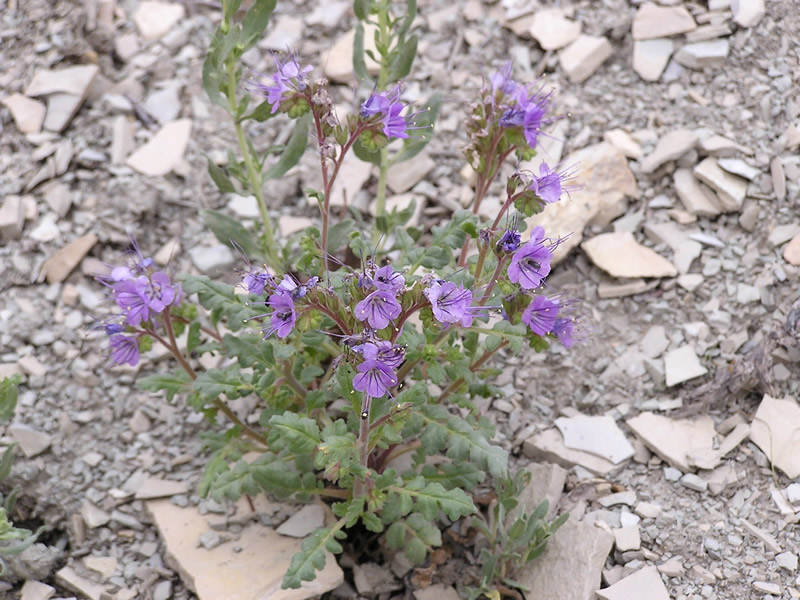
| Appearance | - The plant has a basal rosette of leaves with oblong blades bearing deep marginal lobes. English Wikipedia
- Its inflorescence is a branched, curled cyme covered in hairs and glands. English Wikipedia
- Its flowers have purple-blue, bell-shaped corollas approximately 0.5 centimeters long and wide. English Wikipedia
- The flowers have stamens and a style that extend beyond the corolla opening. English Wikipedia
- The plant produces capsules approximately 0.25 centimeters long. English Wikipedia
| - The plant has several upright or ascending stems growing from a woody base. English Wikipedia
- Its leaves have pinnatifid divisions with either cleft or entire segments. English Wikipedia
- The basal leaves are larger and more persistent than the upper stem leaves. English Wikipedia
- Its leaves and stems are generally covered in silvery silky hairs and have few glandular structures. English Wikipedia
- Its flowers grow in several short, densely packed panicles at the ends of stems. English Wikipedia
- Its bell-shaped corollas are dark blue to purple. English Wikipedia
- The corollas are hairy both internally and externally but are not glandular. English Wikipedia
- Its filaments are two to three times the length of the corolla and give the inflorescence a fuzzy appearance. English Wikipedia
- Its anthers are bright yellow or orange. English Wikipedia
- The subspecies P. sericea subsp. sericea is shorter than 0.3 metres and has denser hairs and relatively narrow, blunt leaf segments. English Wikipedia
- Its flowers are arranged in vertical cylinders on one or several flower stalks. colorado.edu
- Its blue stamens and yellow anthers extend beyond the petals, forming a colorful fringe around the flowers. colorado.edu
|
|---|
| Size | | |
|---|
| Habitat | - The species grows on steep slopes composed of clay and broken shale derived from the Green River Formation. English Wikipedia
- Its habitat is pinyon-juniper woodland dominated by Colorado pinyon and Utah juniper. English Wikipedia
- The species occupies sparsely vegetated slopes of the Green River shale formation at approximately 6,600 feet elevation. fs.usda.gov
- The species grows on fragile, barren soils on steep hillsides. fs.usda.gov
| - It grows in open, well-drained subalpine and alpine slopes. English Wikipedia
- It usually occurs above 1,500 metres elevation. English Wikipedia
- It commonly grows in forest openings or among rocks and sand above treeline. English Wikipedia
- Where the two subspecies overlap, subsp. ciliosa occurs at lower elevations than subsp. sericea. English Wikipedia
- It can be cultivated outside its native range in places with sufficiently cool temperatures for germination. fs.usda.gov
- In Colorado's Front Range, it commonly occurs in small clusters in subalpine and alpine environments rather than dense stands. colorado.edu
- It also occurs in sagebrush shrublands and deserts. colorado.edu
- It frequently occurs on soils at and near gold mines. colorado.edu
|
|---|
| Behaviour | | |
|---|
| Reproduction | - The species generally flowers in July, although flowering can begin in May or June and continue into October. English Wikipedia
- An individual plant can produce as many as 8,000 seeds. English Wikipedia
- The species produced 11,000 seeds from 53 cultivated plants during an early propagation effort. fs.usda.gov
- Initial germination procedures conducted in 2005 produced 53 potted plants. fs.usda.gov
| - Its fruits are two-chambered capsules containing 8 to 18 seeds. English Wikipedia
- Its flowering period generally runs from late May through late August. English Wikipedia
- Its flowers are arranged in short clusters or fascicles that are often coiled. fs.usda.gov
|
|---|
| Lifespan | No checked fact yet | - It is a long-lived perennial that grows from a woody base. fs.usda.gov
|
|---|
| Distribution | - The species is endemic to Utah in the United States. English Wikipedia
- The species is known only from Spanish Fork Canyon in central Utah. English Wikipedia
- The species is currently known from two small populations on privately owned land. fs.usda.gov
| - It occurs in the mountains of Vancouver Island and the southern British Columbia Pacific Ranges. English Wikipedia
- Its Rocky Mountain distribution extends from Banff National Park to southern Colorado. English Wikipedia
- It occurs in Olympic National Park and Washington's Cascade Range. English Wikipedia
- Its range includes the mountains of eastern Oregon and the northernmost counties of California. English Wikipedia
- It also occurs in the mountains of Idaho, Nevada and Utah. English Wikipedia
- The subspecies Phacelia sericea subsp. ciliosa ranges from Oregon and California eastward to Wyoming and Colorado. English Wikipedia
- The subspecies Phacelia sericea subsp. sericea is restricted to the Rocky Mountains, Alaska, British Columbia and Washington. English Wikipedia
- Its native range extends across western North America from New Mexico to Alaska. colorado.edu
|
|---|
| Conservation | - The species has been federally listed as endangered in the United States since 1978. English Wikipedia
- Only nine individuals were known when the species was listed in 1978. English Wikipedia
- The known population declined to four plants within two years of its endangered listing. English Wikipedia
- Discovery of a second population in 1980 brought the estimated global population to approximately 200 plants. English Wikipedia
- Sheep grazing at the main locality in 1987 left only one surviving plant. English Wikipedia
- Twenty to thirty new plants germinated the year after the 1987 grazing incident. English Wikipedia
- Drought, predation, and other natural and weather-related factors contributed to low plant numbers recorded in 2001. fs.usda.gov
- The species faces extinction risk because of its small population size. English Wikipedia
- Sheep, mule deer, and rock squirrels are identified as potential consumers of the plant. English Wikipedia
- Railroad construction and maintenance have disturbed habitat at one occurrence. English Wikipedia
- Highway 6 passes directly through another occurrence, where road maintenance can disturb the plants and pollinator-supporting habitat. English Wikipedia
- Introduced horehound and houndstongue may compete with the species. English Wikipedia
- Seed collection began in 2004 with funding from the U.S. Fish and Wildlife Service. fs.usda.gov
- Collected seeds were intended for off-site testing, propagation, and seed banking. fs.usda.gov
- The recovery program aims to establish up to thirteen new populations on federal land. fs.usda.gov
- The planned federal-land populations are intended to receive greater legal protection and improve the species' chances of surviving in the wild. fs.usda.gov
| No checked fact yet |
|---|
| Uses | No checked fact yet | - It is listed by the Federal Highway Administration as a native plant suitable for roadside landscaping in Colorado. English Wikipedia
- It is frequently sought for cultivation in home gardens. fs.usda.gov
|
|---|
| Similar species | - The species is closely related to Phacelia glandulosa and has sometimes been mistaken for it. English Wikipedia
| No checked fact yet |
|---|
| Other | - The U.S. Forest Service conducted surveys of suitable federal-land habitat adjacent to occupied sites but found no additional populations. fs.usda.gov
| - Two subspecies are recognized within the species. English Wikipedia
- Its long flower hairs have been reported to irritate skin, so the plant should be handled carefully. English Wikipedia
- It can tolerate arsenic in soils associated with gold deposits. colorado.edu
|
|---|