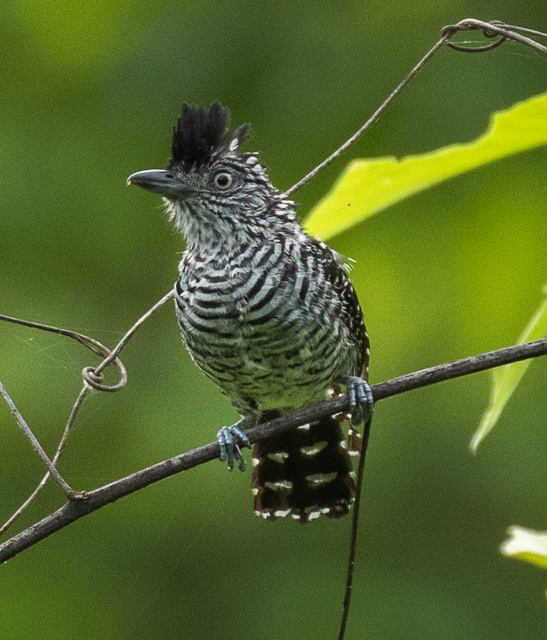
| Appearance | - Adults have a brown-gray crown, a rufous-brown nape, bright blue bare skin around the eyes, and black cheeks and throat. English Wikipedia
- Its back feathers and wing coverts are black with narrow rufous-brown edges that create a scaly appearance. English Wikipedia
- Its rump is greenish brown, its flight feathers are dark brown, and its tail is black. English Wikipedia
- Its breast is rufous-brown, while its belly feathers are black with wider rufous-brown edges and its vent is reddish brown. English Wikipedia
- Immature birds have a darker cap and a less sharply defined pattern on their back and belly than adults. English Wikipedia
- The species has electric-blue facial skin, a rufous body, and a black throat. ebird.org
| - Both sexes possess a bushy crest and exhibit pronounced sexual dimorphism. English Wikipedia
- Adult males of the nominate subspecies have predominantly black-and-white barred plumage. English Wikipedia
- Adult females of the nominate subspecies have cinnamon-rufous crests and upperparts. English Wikipedia
- Adults of both sexes have pale yellow irises, black upper mandibles, bluish-gray lower mandibles, and lead-gray legs and feet. English Wikipedia
- Juvenile males have black and light yellowish-brown barring. English Wikipedia
|
|---|
| Size | | |
|---|
| Habitat | - The species inhabits lowland and foothill evergreen forests, favoring old-growth primary forest but also occurring in mature secondary forest. English Wikipedia
- The species spends almost all its time in forest undergrowth. English Wikipedia
- Its habitat includes the understory of moist lowland forests. inaturalist.org
- In much of Central America, the species occurs at elevations up to 1,250 m. English Wikipedia
- In Costa Rica, the species occurs at elevations up to 1,200 m. English Wikipedia
- In Colombia, the species occurs below 900 m elevation. English Wikipedia
- In Ecuador, the species occurs mostly below 400 m but locally reaches 700 m elevation. English Wikipedia
| - The Coiba Island subspecies inhabits tropical deciduous forest. English Wikipedia
- The Tobago subspecies inhabits mature humid forest. English Wikipedia
- The eastern Brazilian subspecies T. d. capistratus primarily inhabits caatinga and restinga. English Wikipedia
- In eastern Colombia, the species frequently occurs on river islands. English Wikipedia
- In Ecuador, northern Peru, and much of Brazilian Amazonia, the species occurs almost exclusively on river islands. English Wikipedia
- In southern Bolivia, Paraguay, and Argentina, its habitats include savanna, scrub, secondary forest, and riverine belts. English Wikipedia
- In Mexico, Central America, and Colombia, the species occurs from sea level to approximately 1,500 m elevation. English Wikipedia
- In Venezuela, the species reaches elevations of 2,000 m, although most records are below 1,250 m. English Wikipedia
- In Ecuador, the species occurs only below 250 m elevation. English Wikipedia
|
|---|
| Diet | - The species feeds on arthropods fleeing from foraging army-ant swarms. English Wikipedia
- Its feeding activity is associated with army-ant swarms of Eciton burchellii. English Wikipedia
| - Its diet consists primarily of mature and larval insects, supplemented by other arthropods, small lizards, fruit, and seeds. English Wikipedia
- The species also feeds on prey escaping army ant swarms. English Wikipedia
|
|---|
| Behaviour | - The species is an obligate follower of army ants. English Wikipedia
- It typically forages in pairs or family groups. English Wikipedia
- While foraging, it perches approximately one metre above the ground, often near the front of an ant swarm, and makes sallies after prey. English Wikipedia
- The species does not join conventional mixed-species foraging flocks. English Wikipedia
- It is often the dominant bird species among birds attending the same army-ant swarms. English Wikipedia
- The species seldom enters or crosses open areas unless the army ants it follows also cross them. English Wikipedia
- The species is resident throughout its geographical range year-round. English Wikipedia
- Its primary song consists of a loud series of thin, high whistles that first rise and then fall in pitch. English Wikipedia
- The species gives nasal calls described as dzurrr or dzeerr at army-ant swarms. English Wikipedia
| - The species remains resident throughout its geographical range year-round. English Wikipedia
- Individuals typically forage in closely associated pairs within dense foliage from ground level to approximately 3 m, occasionally reaching 10 m. English Wikipedia
- The species almost never participates in mixed-species feeding flocks. English Wikipedia
- It captures prey by rapidly stabbing at leaves, stems, branches, and trunks. English Wikipedia
- Both sexes sing while stretching their necks, bowing forward, and pumping their tails up and down. English Wikipedia
|
|---|
| Reproduction | - Breeding pairs form the nucleus of social groups that include their male offspring and the offspring's mates. English Wikipedia
- Social clans cooperate to defend nesting territories against rival groups. English Wikipedia
- The nest is a cup constructed from twigs, vine fragments, and leaves held together by fungal rhizomorphs. English Wikipedia
- The nest is typically placed on the ground between the buttresses of a tree. English Wikipedia
- The typical clutch contains two eggs. English Wikipedia
- Both parents incubate the eggs and provide food for the young. English Wikipedia
| - The species is monogamous, and breeding pairs vigorously defend territories throughout the year. English Wikipedia
- Territory sizes measured in one study ranged from approximately 2,500 to 4,200 square metres. English Wikipedia
- Breeding has been recorded in every month of the year somewhere within the species' range. English Wikipedia
- In Trinidad and Tobago, the species apparently breeds throughout the year. English Wikipedia
- The nest is an open, tightly woven cup with thin walls constructed from fungal and vegetable fibers, vines, grasses, and twigs. English Wikipedia
- The nest is generally suspended by its rim from a branch fork at heights reaching 10 m above the ground. English Wikipedia
- Both sexes participate in nest construction. English Wikipedia
- The usual clutch contains two eggs, although clutches of three have been reported in Trinidad. English Wikipedia
- Both parents incubate eggs during daylight, while only the female incubates at night. English Wikipedia
- A Costa Rican study recorded an incubation period of 13 days after the second egg was laid. English Wikipedia
- Studies in multiple countries recorded a period of 10–13 days between hatching and fledging. English Wikipedia
- Both parents brood and feed the nestlings. English Wikipedia
|
|---|
| Distribution | - The species occurs in Colombia, Costa Rica, Ecuador, Honduras, Nicaragua, and Panama. English Wikipedia
- The overall geographical range extends from Honduras to Ecuador. English Wikipedia
- The subspecies P. m. saturatus occurs from northern and eastern Honduras through Nicaragua and Costa Rica to Bocas del Toro Province in western Panama. English Wikipedia
- The nominate subspecies occurs in central and eastern Panama and extends into northwestern and western Colombia as far as Valle del Cauca Department. English Wikipedia
- The subspecies P. m. pacificus occurs in southwestern Colombia and northwestern Ecuador's Esmeraldas Province. English Wikipedia
| - The species occurs in Mexico, every Central American country, Trinidad and Tobago, and all mainland South American countries except Chile and Uruguay. English Wikipedia
- One accepted occurrence record exists from southern Texas. English Wikipedia
- The subspecies T. d. intermedius occurs from San Luis Potosí and Tamaulipas in east-central Mexico south through Central America to Costa Rica and possibly Panama. English Wikipedia
- The subspecies T. d. nesiotes occurs on the Pearl Islands in the Gulf of Panama. English Wikipedia
- The subspecies T. d. eremnus occurs on Coiba Island off western Panama. English Wikipedia
|
|---|
| Conservation | - The IUCN classifies the species as Least Concern. English Wikipedia
- The species has a very large geographical range, but its population size is unknown and believed to be decreasing. English Wikipedia
- No immediate threats to the species have been identified. English Wikipedia
- The species is highly sensitive to forest fragmentation. English Wikipedia
- Its large feeding-range requirements contribute to its sensitivity to habitat fragmentation. English Wikipedia
| - The IUCN classifies the species as Least Concern. English Wikipedia
- The estimated population comprises at least 50 million mature individuals and is considered stable. English Wikipedia
- Deforestation, habitat destruction, and habitat fragmentation are identified as challenges to the species' survival. English Wikipedia
|
|---|
| Similar species | - Molecular phylogenetic studies place the species in tribe Pithyini and identify members of the genus Pithys as its closest relatives. English Wikipedia
| No checked fact yet |
|---|
| Name origin | No checked fact yet | - The specific epithet doliatus derives from Neo-Latin and means barred. English Wikipedia
|
|---|
| Other | | No checked fact yet |
|---|