Comparison

Anderson's Four-eyed Opossum vs Gray Four-eyed Opossum

Anderson's Four-eyed Opossum (Philander andersoni) and Gray Four-eyed Opossum (Philander opossum) both belong to the genus Philander (gray and black four-eyed opossum) and part ways below it. Both are recorded in 5 countries.
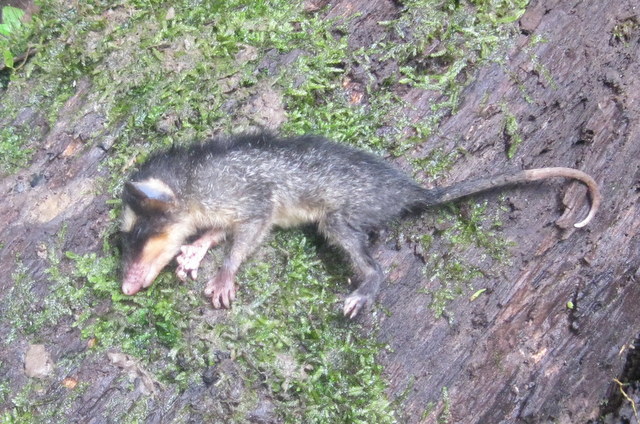
Anderson's Four-eyed Opossum

Anderson's Four-eyed Opossum

Philander andersoni

Rob d1968, CC BY-SA 3.0, via Wikimedia Commons

Gray Four-eyed Opossum

Gray Four-eyed Opossum

Philander opossum

André de Souza Pereira, CC BY-SA 3.0, via Wikimedia Commons

Side by side

Anderson's Four-eyed OpossumGray Four-eyed Opossum
Scientific namePhilander andersoni (Osgood, 1913)Philander opossum (Linnaeus, 1758)
English nameAnderson's Four-eyed OpossumGray Four-eyed Opossum
GroupMammalsMammals
ClassMammalia MammalMammalia Mammal
OrderDidelphimorphia American MarsupialsDidelphimorphia American Marsupials
FamilyDidelphidae OpossomsDidelphidae Opossoms
GenusPhilander Gray and Black Four-eyed OpossumPhilander Gray and Black Four-eyed Opossum
Named in19131758
Red List categoryLeast ConcernLeast Concern
Countries on record5 countries19 countries
GBIF occurrence records320 records8,358 records

Rows where the two agree are shown in grey.

Where each is found

Both recorded in 5 countries

Only Gray Four-eyed Opossum (14)

From Catalogue of Life checklists and GBIF occurrence records. A country missing from a list means no record is held, which is not proof of absence.

Checked facts

Anderson's Four-eyed OpossumGray Four-eyed Opossum
Appearance
  • The species has dark dorsal fur with a black stripe running vertically along the middle of its back. English Wikipedia
  • The dorsal fur is approximately 10 mm long. English Wikipedia
  • The ventral fur is dark gray and lighter than the fur on the sides and back. English Wikipedia
  • The species has lighter spots above its eyes that create the appearance of having four eyes. animaldiversity.org
  • The species has a slim body, a relatively large head, and a long, conical muzzle. animaldiversity.org
  • Its prehensile tail is slim, partially furred, and at least as long as its body. animaldiversity.org
  • The species has opposable pollex digits on its forefeet and opposable hallux digits on its hindfeet. animaldiversity.org
  • The species has short gray hair on its sides and a black dorsal band approximately 3–4 cm wide extending from the head to the tail base. animaldiversity.org
  • The venter, cheek spots, and eye spots range in color from cream to creamy gray. animaldiversity.org
  • Approximately 18% of the tail is furred from the base, while the remainder is bare. animaldiversity.org
  • Approximately half of the tail is brown or black, while the other half is unpigmented. animaldiversity.org
  • The ears are black and often have a cream-colored dot at the base of the pinna. animaldiversity.org
  • The species has a sharply defined white spot above each eye. English Wikipedia
  • Its dorsal fur is gray, while its ventral fur, throat, and cheeks are cream-colored. English Wikipedia
  • Adults have black ears except at their bases. English Wikipedia
  • Its short, straight, soft fur is gray dorsally and off-white to yellow ventrally. animaldiversity.org
  • Its dorsal fur coloration varies geographically, with pale gray individuals in Mexico, dark gray individuals in Central America, and dark brown to blackish individuals in Colombia. animaldiversity.org
  • Its prehensile tail has grayish fur covering the first 50 to 60 mm from its base, while its narrowing tip is naked and pale. animaldiversity.org
  • Its hind limbs are longer and more muscular than its forelimbs. animaldiversity.org
SizeNo checked fact yet
  • Females are slightly smaller than males and have seven mammae in their pouch. animaldiversity.org
Habitat
  • The species inhabits primary and secondary lowland forests as well as gallery forests near wetlands and rivers. animaldiversity.org
  • Individuals prefer dense vegetation but occasionally occur in heavily disturbed areas such as agricultural land. animaldiversity.org
  • In Ecuador, the species occurs at elevations between 200 and 1,600 metres above sea level, most frequently below 600 metres. animaldiversity.org
  • The species inhabits primary, secondary, and disturbed forests. English Wikipedia
  • It generally inhabits moist areas near streams. English Wikipedia
  • It occurs mainly in tropical evergreen forests, secondary growth forests, and gallery forests. animaldiversity.org
  • It generally prefers damp areas near swamps and streams that receive more than 1,000 mm of annual rainfall. animaldiversity.org
  • It can inhabit disturbed environments near human structures and agricultural areas such as orchards and sugar cane fields. animaldiversity.org
  • It generally prefers lowland habitats below 1,000 metres in elevation. animaldiversity.org
  • Its nests are commonly constructed in lower tree branches approximately 8 to 10 metres above the ground. animaldiversity.org
Diet
  • The species is omnivorous and eats leaves, seeds, and fruits as well as small animals. English Wikipedia
  • Its animal prey includes insects, earthworms, birds, lizards, eggs, frogs, crustaceans, snails, and small mammals. animaldiversity.org
  • Its plant diet includes leaves, bark, seeds, nuts, nectar, papayas, bananas, sweet lemons, and jobo plums. animaldiversity.org
  • Its diet becomes more plant-based during the wet season and more insect-based during the dry season. animaldiversity.org
Behaviour
  • Philander andersoni is predominantly terrestrial but is also known to climb trees. animaldiversity.org
  • Philander andersoni is solitary and nocturnal, and spends most of its time on the ground. animaldiversity.org
  • Most captured individuals released at two rainforest sites in Peru chose terrestrial rather than arboreal escape routes. animaldiversity.org
  • Species in the genus Philander respond aggressively to threats by opening their mouths, hissing, and fighting. animaldiversity.org
Reproduction
Distribution
  • Philander andersoni occurs in Brazil, Colombia, Ecuador, Peru, and Venezuela. English Wikipedia
  • The species ranges from south-central Venezuela and northwestern Brazil through southern Colombia to eastern Ecuador and northern Peru. animaldiversity.org
  • The species occurs in Guyana, Suriname, French Guiana, and Brazil. English Wikipedia
  • Its distribution extends from northeastern Mexico to southeastern Brazil. animaldiversity.org
  • Its range includes Central America, Peru, Argentina, and the Amazon and Parana basins. animaldiversity.org
ConservationNo checked fact yet
Similar species
  • Philander andersoni resembles Metachirus nudicaudatus in appearance. animaldiversity.org
  • Philander andersoni females have fully developed pouches, whereas Metachirus nudicaudatus females do not. animaldiversity.org
  • Metachirus nudicaudatus differs from Philander andersoni in having an entirely bare tail. animaldiversity.org
No checked fact yet
Other
  • The species may act as a seed disperser because it consumes fruit, lives mostly on the ground, and moves frequently. animaldiversity.org
No checked fact yet

In brief

Anderson's Four-eyed Opossum

Philander andersoni occurs in Brazil, Colombia, Ecuador, Peru, and Venezuela. It has dark dorsal fur, a black stripe along the middle of its back, and lighter spots above its eyes that create the appearance of having four eyes. Full profile

Gray Four-eyed Opossum

Philander opossum occurs from northeastern Mexico to southeastern Brazil, including Central America, Peru, and Argentina. It is distinguished by a sharply defined white spot above each eye. Full profile

Compare something else

Page built on 28 November 2026 from the data on the two species pages, where every source is listed.

Cite this page

ScientificNames.org. (2026). Anderson's Four-eyed Opossum vs Gray Four-eyed Opossum. Retrieved November 28, 2026, from https://scientificnames.org/compare/andersons-four-eyed-opossum-vs-gray-four-eyed-opossum