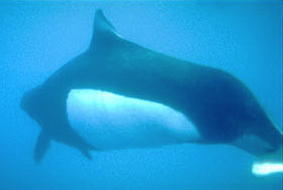
| Appearance | - Live individuals are typically dark grey. English Wikipedia
- The underside is usually lighter grey than the rest of the body. English Wikipedia
- Individuals turn black within minutes after death. English Wikipedia
- The species has a shallow indentation at the blowhole immediately in front of the eyes. English Wikipedia
- Its dorsal fin is triangular rather than curved and points more backwards than upwards. English Wikipedia
- The dorsal fin is positioned approximately three-quarters of the way along the back. English Wikipedia
| - The species has a small head without a distinct beak. adfg.alaska.gov
- Its flippers are small, pointed, and positioned near the head. adfg.alaska.gov
- The species has a small mouth with a slight underbite. adfg.alaska.gov
- Its teeth are small and spade-shaped rather than cone-shaped. nps.gov
- It has rigid protruding growths between its teeth that are thought to help it grasp slippery prey. nps.gov
- The western Pacific truei color morph has a white belly marking that extends farther forward than the marking of the dalli morph. English Wikipedia
|
|---|
| Size | | |
|---|
| Habitat | - The species frequently inhabits inshore bays, channels and fjords. English Wikipedia
- Individuals have been recorded up to 50 km offshore. English Wikipedia
- The species has been recorded in the freshwater Valdivia River in southern Chile. English Wikipedia
- Although it normally occupies continental shelf waters, the species has been recorded at depths of up to 1,000 m. English Wikipedia
| - The species generally inhabits cold waters with temperatures below 18 °C. English Wikipedia
- Although primarily offshore, the species also inhabits deeper coastal waters, submarine canyons, and fjords. English Wikipedia
- The species can inhabit sounds and inland passages as well as offshore and onshore waters. adfg.alaska.gov
- The species prefers deep water and uses underwater canyons and deep channels to approach coastlines. adfg.alaska.gov
- Some populations remain near shore throughout the year in Japan, the Kamchatka Peninsula, Puget Sound, British Columbia, the Aleutians, and Alaska's inside waters. nps.gov
|
|---|
| Diet | - The species feeds on pelagic fish, including anchovies, hake and mackerel. English Wikipedia
| - The species commonly consumes mesopelagic fish, including myctophids, and gonatid squid. English Wikipedia
- Its diet can include krill and shrimp, although crustaceans are not considered an important food source. English Wikipedia
- Depending on the region, the species feeds on capelin, lantern fish, herring, and squid. adfg.alaska.gov
- The species commonly consumes herring, anchovies, squid, and crustaceans. nps.gov
- The species commonly feeds on animals living at depths greater than 590 feet. nps.gov
- The species has been observed feeding on salmon alongside resident killer whales. nps.gov
|
|---|
| Behaviour | | - The species generally forages at night. adfg.alaska.gov
- The species can dive to depths of up to 94 metres. English Wikipedia
- Individuals typically form groups of two to ten, although aggregations numbering hundreds have been recorded. English Wikipedia
- The species generally travels in groups of approximately 10 to 20 individuals. adfg.alaska.gov
- Rapid swimming near the surface produces a characteristic spray known as a rooster tail. English Wikipedia
- The species frequently approaches boats to ride their bow waves. English Wikipedia
- The species can swim at speeds exceeding 30 knots. adfg.alaska.gov
- The species has been observed swimming alongside harbour porpoises and grey whales. adfg.alaska.gov
|
|---|
| Reproduction | No checked fact yet | - The species has a polygynous mating system in which males compete for females. English Wikipedia
- Gestation lasts approximately 11 to 12 months. English Wikipedia
- Females generally give birth once every three years. English Wikipedia
- Females give birth to a single calf, usually in mid-summer. adfg.alaska.gov
- Female sexual maturity occurs between three and six years of age. adfg.alaska.gov
- Male sexual maturity occurs at approximately five to eight years of age. adfg.alaska.gov
- Lactation lasts approximately two to four months. adfg.alaska.gov
- Calves and their mothers remain separate from the main porpoise herds for a period after birth. adfg.alaska.gov
|
|---|
| Distribution | - Burmeister's porpoise is endemic to the coast of South America. English Wikipedia
- Its coastal range extends from northern Peru in the Pacific Ocean around Tierra del Fuego to southern Brazil in the Atlantic Ocean. English Wikipedia
| - The species occurs throughout the North Pacific, ranging from California to the Bering Sea and Sea of Okhotsk in the east and the Sea of Japan in the west. English Wikipedia
|
|---|
| Conservation | - Burmeister's porpoise is vulnerable to accidental capture in fishing nets. English Wikipedia
- Accidental capture in fishing nets is common in Uruguay, Peru and Chile. English Wikipedia
- The estimated annual bycatch is highest in Peru, at approximately 2,000 individuals. English Wikipedia
- Severe El Niño events can disrupt the Humboldt Current ecosystem and reduce the availability of anchovies. English Wikipedia
- During El Niño events, Burmeister's porpoises may need alternative food sources or risk starvation. English Wikipedia
- Burmeister's porpoises were found stranded on Peruvian beaches during the 1997 El Niño event. English Wikipedia
- The species is classified as Near Threatened on the IUCN Red List. English Wikipedia
- The long-term conservation outlook for the species is unknown. English Wikipedia
- The species is listed in Appendix II of the Convention on the Conservation of Migratory Species of Wild Animals. English Wikipedia
- Its Appendix II listing reflects its unfavourable conservation status or the potential benefits of international cooperation through tailored agreements. English Wikipedia
| - The species is classified as Least Concern on the IUCN Red List. English Wikipedia
- The species is listed in Appendix II of the Convention on the Conservation of Migratory Species of Wild Animals. English Wikipedia
- The species is protected in the United States under the Marine Mammal Protection Act. English Wikipedia
- The species is vulnerable to accidental capture in fishing operations. English Wikipedia
- Commercial driftnet fisheries killed thousands of individuals before a United Nations moratorium was introduced in the 1990s. English Wikipedia
|
|---|
| Uses | - In Peruvian waters, individuals caught as bycatch are primarily used for human consumption. English Wikipedia
- Until the late 1990s, individuals were deliberately harpooned for food and use as crab bait. English Wikipedia
- The species is used for meat in areas where individuals are frequently caught in fishing nets. animaldiversity.org
- Meat from individuals caught in fishing nets is used as food. animaldiversity.org
| - The species' meat has been used as food in Japanese fisheries. nps.gov
- The species' blubber has been used as a source of oil. nps.gov
- The species' bones have been ground into fertilizer. nps.gov
- The species contributes to marine ecotourism in some regions. adfg.alaska.gov
|
|---|