Comparison
Bladderseed vs Anise
Bladderseed (Physospermum cornubiense) and Anise (Pimpinella anisum) both belong to the subfamily Apioideae and part ways below it. Both are recorded in 18 countries.


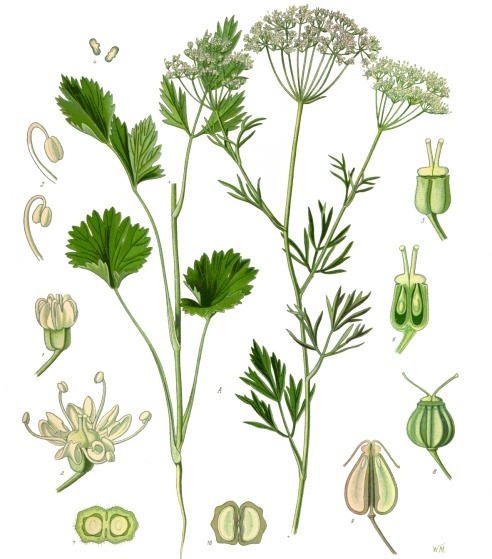
Anise
Pimpinella anisum
Franz Eugen Köhler, Köhler's Medizinal-Pflanzen, Public domain, via Wikimedia Commons

Side by side
| Bladderseed | Anise | |
|---|---|---|
| Scientific name | Physospermum cornubiense (L.) DC. | Pimpinella anisum L. |
| English name | Bladderseed | Anise |
| Group | Flowering plants | Flowering plants |
| Class | Magnoliopsida | Magnoliopsida |
| Order | Apiales | Apiales |
| Family | Apiaceae Umbellifer | Apiaceae Umbellifer |
| Genus | Physospermum | Pimpinella Burnet |
| Countries on record | 27 countries | 66 countries |
| GBIF occurrence records | 4,396 records | 793 records |
Rows where the two agree are shown in grey.
Where each is found
Both recorded in 18 countries
- Albania
- Bulgaria
- Croatia
- Cyprus
- France
- Germany
- Greece
- Hungary
- Iran
- Italy
- Portugal
- Romania
- Russia
- Spain
- Syria
- Turkey
- Ukraine
- United Kingdom
Only Bladderseed (9)
Only Anise (48)
- Algeria
- Argentina
- Austria
- Bangladesh
- Belgium
- Bolivia
- Brazil
- Canada
- Chile
- China
- Colombia
- Czechia
- Denmark
- Ecuador
- Egypt
- El Salvador
- Estonia
- Finland
- Guadeloupe
- Guatemala
- India
- Israel
- Kazakhstan
- Kyrgyzstan
- Laos
- Martinique
- Mexico
- Morocco
- Myanmar
- Nepal
- Nicaragua
- Norway
- Palestinian Territory
- Poland
- Saudi Arabia
- Slovakia
- Sweden
- Switzerland
- Tajikistan
- Tanzania
- The Netherlands
- Trinidad and Tobago
- Tunisia
- Turkmenistan
- United States
- Uzbekistan
- Vietnam
- Yemen
From Catalogue of Life checklists and GBIF occurrence records. A country missing from a list means no record is held, which is not proof of absence.
Checked facts
| Bladderseed | Anise | |
|---|---|---|
| Appearance | No checked fact yet |
|
| Size | No checked fact yet |
|
| Habitat | No checked fact yet |
|
| Behaviour | No checked fact yet |
|
| Reproduction | No checked fact yet |
|
| Distribution | No checked fact yet |
|
| Uses | No checked fact yet |
|
| Similar species | No checked fact yet |
|
| Name origin |
| No checked fact yet |
| Other |
| No checked fact yet |
In brief
Bladderseed
Physospermum aquilegiifolium is listed as a synonym of Bladderseed. Full profile
Anise
Anise (Pimpinella anisum L.) is a herbaceous annual flowering plant in the family Apiaceae, order Apiales and class Magnoliopsida. The species is native to the Mediterranean region, Southwest Asia and the Middle East. Anise is distinguished by its feathery upper leaves, dense umbels of small flowers and dry, curved fruits. Full profile
Compare something else
Page built on 28 November 2026 from the data on the two species pages, where every source is listed.
Cite this page
ScientificNames.org. (2026). Bladderseed vs Anise. Retrieved November 28, 2026, from https://scientificnames.org/compare/bladderseed-vs-anise
“Bladderseed vs Anise.” ScientificNames.org, 2026, scientificnames.org/compare/bladderseed-vs-anise. Accessed 28 Nov. 2026.
ScientificNames.org. “Bladderseed vs Anise.” Accessed November 28, 2026. https://scientificnames.org/compare/bladderseed-vs-anise.
@misc{scientificnames_bladderseed_vs_anise,
  author = {{ScientificNames.org}},
  title = {Bladderseed vs Anise},
  year = {2026},
  url = {https://scientificnames.org/compare/bladderseed-vs-anise},
  note = {Accessed 2026-11-28}
}