Comparison
Italian Freshwater Crab vs Aegean Freshwater Crab
Italian Freshwater Crab (Potamon fluviatile) and Aegean Freshwater Crab (Potamon potamios) both belong to the genus Potamon and part ways below it. Both are recorded in 1 country.
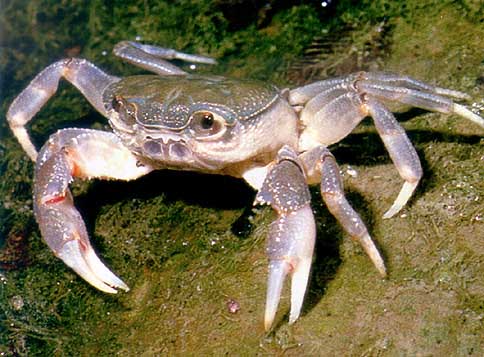
Italian Freshwater Crab
Potamon fluviatile
Photo by Fabio Liverani (http://www.fabioliverani.com) uploaded by Esculapio, CC BY-SA 2.5, via Wikimedia Commons


Side by side
| Italian Freshwater Crab | Aegean Freshwater Crab | |
|---|---|---|
| Scientific name | Potamon fluviatile (Herbst, 1785) | Potamon potamios (Olivier, 1804) |
| English name | Italian Freshwater Crab | Aegean Freshwater Crab |
| Group | Crustaceans | Crustaceans |
| Class | Malacostraca | Malacostraca |
| Order | Decapoda | Decapoda |
| Family | Potamidae Freshwater Crabs | Potamidae Freshwater Crabs |
| Genus | Potamon | Potamon |
| Named in | 1785 | 1804 |
| Red List category | Near Threatened | Near Threatened |
| Environment | freshwater | freshwater |
| Countries on record | 7 countries | 9 countries |
| GBIF occurrence records | 675 records | 565 records |
Rows where the two agree are shown in grey.
Where each is found
Both recorded in 1 country
Only Italian Freshwater Crab (6)
Only Aegean Freshwater Crab (8)
From Catalogue of Life checklists and GBIF occurrence records. A country missing from a list means no record is held, which is not proof of absence.
Checked facts
| Italian Freshwater Crab | Aegean Freshwater Crab | |
|---|---|---|
| Appearance |
|
|
| Size |
|
|
| Habitat |
|
|
| Diet |
|
|
| Behaviour |
|
|
| Reproduction |
| No checked fact yet |
| Lifespan |
| No checked fact yet |
| Distribution |
| No checked fact yet |
| Conservation |
| No checked fact yet |
In brief
Italian Freshwater Crab
Potamon fluviatile inhabits wooded streams, rivers and lakes in Southern Europe. It has a roughly square body, large claws on its first pair of legs and a typical lifespan of 10–12 years. Full profile
Aegean Freshwater Crab
Potamon potamios usually inhabits streams, rivers and lakes and occupies both aquatic and terrestrial environments. It has a smooth, slightly arched, concave carapace and two large claws that differ in size. Full profile
Compare something else
Page built on 26 November 2026 from the data on the two species pages, where every source is listed.
Cite this page
ScientificNames.org. (2026). Italian Freshwater Crab vs Aegean Freshwater Crab. Retrieved November 26, 2026, from https://scientificnames.org/compare/italian-freshwater-crab-vs-aegean-freshwater-crab
“Italian Freshwater Crab vs Aegean Freshwater Crab.” ScientificNames.org, 2026, scientificnames.org/compare/italian-freshwater-crab-vs-aegean-freshwater-crab. Accessed 26 Nov. 2026.
ScientificNames.org. “Italian Freshwater Crab vs Aegean Freshwater Crab.” Accessed November 26, 2026. https://scientificnames.org/compare/italian-freshwater-crab-vs-aegean-freshwater-crab.
@misc{scientificnames_italian_freshwater_crab_vs_aegean_freshwater_crab,
  author = {{ScientificNames.org}},
  title = {Italian Freshwater Crab vs Aegean Freshwater Crab},
  year = {2026},
  url = {https://scientificnames.org/compare/italian-freshwater-crab-vs-aegean-freshwater-crab},
  note = {Accessed 2026-11-26}
}