Comparison
Rhodes Freshwater Crab vs Italian Freshwater Crab
Rhodes Freshwater Crab (Potamon rhodium) and Italian Freshwater Crab (Potamon fluviatile) both belong to the genus Potamon and part ways below it. Both are recorded in 1 country.


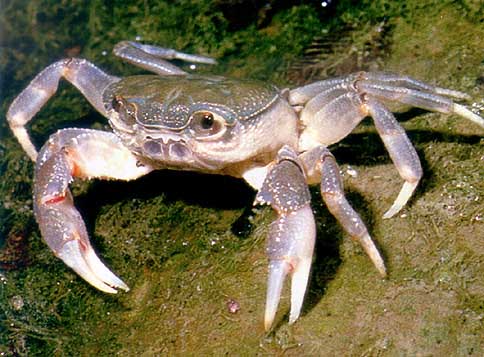
Italian Freshwater Crab
Potamon fluviatile
Photo by Fabio Liverani (http://www.fabioliverani.com) uploaded by Esculapio, CC BY-SA 2.5, via Wikimedia Commons

Side by side
| Rhodes Freshwater Crab | Italian Freshwater Crab | |
|---|---|---|
| Scientific name | Potamon rhodium Parisi, 1913 | Potamon fluviatile (Herbst, 1785) |
| English name | Rhodes Freshwater Crab | Italian Freshwater Crab |
| Group | Crustaceans | Crustaceans |
| Class | Malacostraca | Malacostraca |
| Order | Decapoda | Decapoda |
| Family | Potamidae Freshwater Crabs | Potamidae Freshwater Crabs |
| Genus | Potamon | Potamon |
| Named in | 1913 | 1785 |
| Red List category | Near Threatened | Near Threatened |
| Environment | freshwater | freshwater |
| Countries on record | 1 country | 7 countries |
| GBIF occurrence records | 194 records | 675 records |
Rows where the two agree are shown in grey.
Where each is found
Both recorded in 1 country
Only Italian Freshwater Crab (6)
From Catalogue of Life checklists and GBIF occurrence records. A country missing from a list means no record is held, which is not proof of absence.
Checked facts
| Rhodes Freshwater Crab | Italian Freshwater Crab | |
|---|---|---|
| Appearance |
|
|
| Size |
|
|
| Habitat |
|
|
| Diet |
|
|
| Behaviour | No checked fact yet |
|
| Reproduction | No checked fact yet |
|
| Lifespan | No checked fact yet |
|
| Distribution |
|
|
| Conservation | No checked fact yet |
|
In brief
Rhodes Freshwater Crab
Potamon rhodium is endemic to the island of Rhodes in Greece. Its carapace has a distinctive pattern that appears to mimic a moth. Full profile
Italian Freshwater Crab
Potamon fluviatile inhabits wooded streams, rivers and lakes in Southern Europe. It has a roughly square body, large claws on its first pair of legs and a typical lifespan of 10–12 years. Full profile
Compare something else
Page built on 28 November 2026 from the data on the two species pages, where every source is listed.
Cite this page
ScientificNames.org. (2026). Rhodes Freshwater Crab vs Italian Freshwater Crab. Retrieved November 28, 2026, from https://scientificnames.org/compare/rhodes-freshwater-crab-vs-italian-freshwater-crab
“Rhodes Freshwater Crab vs Italian Freshwater Crab.” ScientificNames.org, 2026, scientificnames.org/compare/rhodes-freshwater-crab-vs-italian-freshwater-crab. Accessed 28 Nov. 2026.
ScientificNames.org. “Rhodes Freshwater Crab vs Italian Freshwater Crab.” Accessed November 28, 2026. https://scientificnames.org/compare/rhodes-freshwater-crab-vs-italian-freshwater-crab.
@misc{scientificnames_rhodes_freshwater_crab_vs_italian_freshwater_crab,
  author = {{ScientificNames.org}},
  title = {Rhodes Freshwater Crab vs Italian Freshwater Crab},
  year = {2026},
  url = {https://scientificnames.org/compare/rhodes-freshwater-crab-vs-italian-freshwater-crab},
  note = {Accessed 2026-11-28}
}