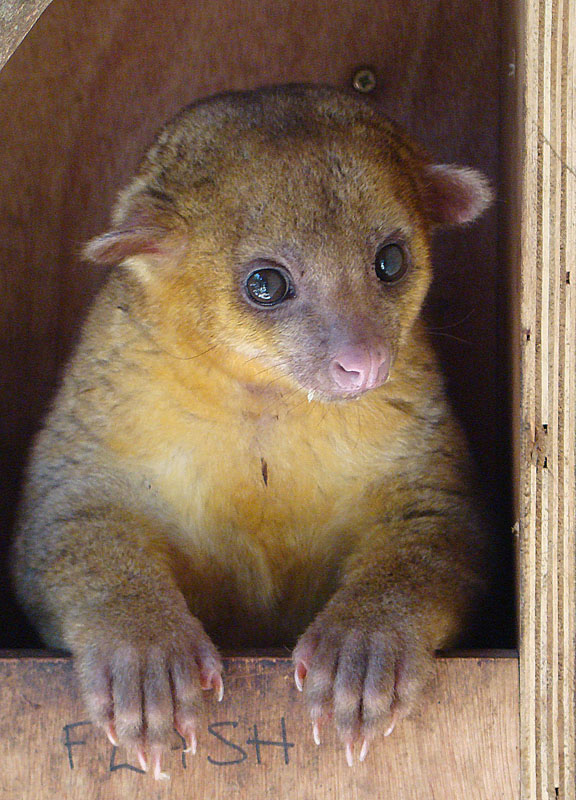
| Appearance | | - The kinkajou has a rounded head, large eyes, a short pointed snout, short limbs, and a long prehensile tail. English Wikipedia
- Its fur is short, woolly, and dense. English Wikipedia
- Its coat can have tawny olive, wood brown, and yellowish tawny shades on the upper body. English Wikipedia
- The kinkajou has a long, thick, highly extensible tongue. English Wikipedia
- Its claws are short and sharp. English Wikipedia
- Its eyes reflect green or bright yellow when exposed to light. English Wikipedia
- The kinkajou has small, rounded ears that distinguish it from other procyonids. English Wikipedia
- Its coat is generally thick, woolly, and honey-brown. animaldiversity.org
|
|---|
| Size | | |
|---|
| Habitat | - The species inhabits marshy and jungle environments in Central and South America. English Wikipedia
- The species occupies habitats including primary and secondary growth forests. animaldiversity.org
- Its habitats include llanos forests, xeric Chaco vegetation, and Amazon rainforests. animaldiversity.org
- The species occupies areas around swamps, lakes, lagoons, and ocean beaches. animaldiversity.org
- The species generally occurs at lower elevations. animaldiversity.org
- Where its range overlaps with that of the northern raccoon, it primarily occupies land surrounding inland rivers. animaldiversity.org
| - Kinkajous inhabit closed-canopy tropical forests, including lowland rainforests, montane forests, dry forests, gallery forests, and secondary forests. English Wikipedia
- Kinkajous occupy tropical dry forests, secondary forests, Amazonian rainforests, Atlantic coastal forests, tropical evergreen forests, and savannah-region forests in Suriname. animaldiversity.org
- Kinkajous are rarely found in palm jungles, cloud forests, or thorn forests. animaldiversity.org
- Kinkajous spend their daytime resting in tree hollows or shaded foliage. English Wikipedia
- Kinkajous usually sleep in tree crotches or holes, often alongside members of their social group. animaldiversity.org
- Kinkajous generally occupy the rainforest canopy and rarely descend to the forest floor. lamar.edu
|
|---|
| Diet | - The species consumes crabs, lobsters, crayfish, and other crustaceans. English Wikipedia
- Its diet includes shellfish such as oysters and clams. English Wikipedia
- The species is omnivorous and also eats small amphibians, fish, insects, small turtles, and turtle eggs. English Wikipedia
- Plant foods consumed by the species include fruits, nuts, and vegetables. English Wikipedia
| - Approximately 90% of the kinkajou's diet consists primarily of fruit. English Wikipedia
- Figs are a particularly important food for kinkajous. English Wikipedia
- Kinkajous also consume leaves, flowers, nectar, and various herbs. English Wikipedia
- Kinkajous sometimes eat ants and other insects. English Wikipedia
- Kinkajous occasionally consume bird eggs and small vertebrates. English Wikipedia
- The kinkajou uses its extensible tongue to obtain nectar from flowers. English Wikipedia
- Kinkajous have been documented eating figs, grapes, bananas, melons, apples, and mangoes. lamar.edu
- Kinkajous obtain water from fruit and from water collected in tree notches and on leaves. lamar.edu
|
|---|
| Behaviour | | - Kinkajous use their prehensile tails as an additional limb when climbing. English Wikipedia
- Kinkajous can rotate their ankles and feet by 180 degrees, enabling them to climb down trees headfirst. English Wikipedia
- Kinkajous mark their territories and travel routes using scent glands near their mouths, throats, and bellies. English Wikipedia
- Kinkajous sleep in family units and groom one another. English Wikipedia
- Kinkajous generally forage alone but sometimes feed in large groups. English Wikipedia
- Kinkajous are capable of hanging upside down while feeding, supporting themselves with their tails and hind legs. animaldiversity.org
- Kinkajous exhibit complex social groups that commonly contain two males, one female, and offspring. animaldiversity.org
- Kinkajous maintain territorial boundaries through scent marking. animaldiversity.org
|
|---|
| Reproduction | - Breeding generally takes place between July and September. English Wikipedia
- Gestation lasts approximately 60 to 73 days. English Wikipedia
- Litters contain between two and seven offspring, with three being the average. English Wikipedia
- Females give birth in crevices, hollow trees, or abandoned nests belonging to other animals. English Wikipedia
- Females may mate again and produce a second litter if they lose all their offspring early in the breeding season. English Wikipedia
- Females provide parental care, while males do not participate in raising the young. English Wikipedia
- Both sexes reach sexual maturity after approximately one year. animaldiversity.org
- Young individuals open their eyes approximately three weeks after birth. animaldiversity.org
- Young individuals are weaned between seven weeks and four months of age. animaldiversity.org
- Young individuals become independent at approximately eight months of age. animaldiversity.org
- Females provide all parental care for their offspring. animaldiversity.org
| |
|---|
| Distribution | - The species occurs from Costa Rica southward through Central and South America to northern Argentina and Uruguay. English Wikipedia
- The species occurs in Trinidad and Tobago, as well as numerous countries across Central and South America. English Wikipedia
| No checked fact yet |
|---|
| Conservation | No checked fact yet | - Deforestation is identified as a potential threat to kinkajous. English Wikipedia
- Honduras has included the kinkajou in Appendix III of CITES. English Wikipedia
- Exports of kinkajous from Honduras require an export permit. English Wikipedia
- Exports of kinkajous from other countries require a certificate of origin or re-export under the stated CITES listing. English Wikipedia
|
|---|
| Uses | No checked fact yet | |
|---|
| Similar species | - The crab-eating raccoon is closely related and morphologically similar to the northern raccoon (Procyon lotor). animaldiversity.org
- The crab-eating raccoon is smaller than the northern raccoon. animaldiversity.org
| - Olingos are sufficiently similar in appearance to kinkajous that some native cultures do not distinguish between them. English Wikipedia
- Kinkajous are larger than olingos and have shorter muzzles. English Wikipedia
- The binturong shares the kinkajou's prehensile-tail characteristic but is substantially larger. English Wikipedia
|
|---|
| Other | No checked fact yet | |
|---|