Comparison

Purple Martin vs Galápagos Martin

Purple Martin (Progne subis) and Galápagos Martin (Progne modesta) both belong to the genus Progne (martin) and part ways below it. Both are recorded in 1 country.
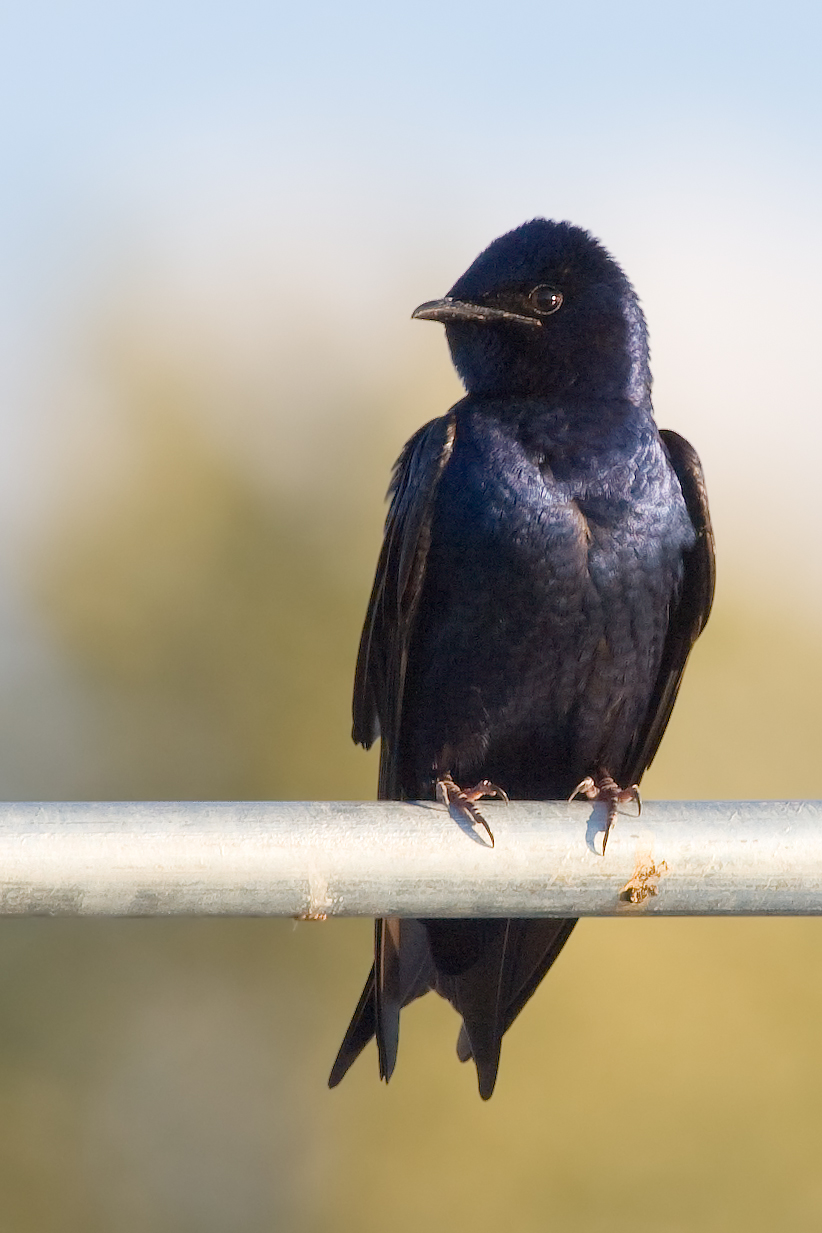
Purple Martin

Purple Martin

Progne subis

JJ Cadiz, Cajay, CC BY 3.0, via Wikimedia Commons

Galápagos Martin

Galápagos Martin

Progne modesta

Charles Darwin, John Gould, Public domain, via Wikimedia Commons

Side by side

Purple MartinGalápagos Martin
Scientific nameProgne subis (Linnaeus, 1758)Progne modesta Gould, 1838
English namePurple MartinGalápagos Martin
GroupBirdsBirds
ClassAves BirdAves Bird
OrderPasseriformes PasserinePasseriformes Passerine
FamilyHirundinidae SwallowHirundinidae Swallow
GenusProgne MartinProgne Martin
Named in17581838
Red List categoryLeast ConcernEndangered
Environmentterrestrialterrestrial
Countries on record25 countries3 countries
GBIF occurrence records2,079,443 records1,820 records

Rows where the two agree are shown in grey.

Where each is found

Both recorded in 1 country

Only Purple Martin (24)

Only Galápagos Martin (2)

From Catalogue of Life checklists and GBIF occurrence records. A country missing from a list means no record is held, which is not proof of absence.

Checked facts

Purple MartinGalápagos Martin
Appearance
  • Adult males have entirely black plumage with a glossy steel-blue sheen. English Wikipedia
  • Adult females have dark upperparts with some steel-blue sheen and lighter underparts. English Wikipedia
  • Adult purple martins have slightly forked tails. English Wikipedia
  • Adult plumage develops over a period of two years in both sexes. English Wikipedia
  • Subadult males develop randomly distributed black chest feathers while moulting into adult plumage. English Wikipedia
  • Adult males have a glossy, dark violaceous steel-blue body. English Wikipedia
  • Adult males have black wings and a black tail with a faint bluish or greenish sheen. English Wikipedia
  • Females have mostly black heads and upperparts, with sooty crowns and rumps. English Wikipedia
  • Females have a strong violaceous steel-blue gloss on their backs and scapulars. English Wikipedia
  • Female underparts are mostly dark sooty gray or grayish sooty, with indistinct pale feather tips. English Wikipedia
  • Both sexes have brown irises and black bills. English Wikipedia
  • Both sexes have brownish-black or dusky-brown legs and feet. English Wikipedia
  • Males are entirely deep bluish black. ebird.org
  • Females and juveniles are mostly brown, with a bluish tinge to their upperparts. ebird.org
Size
Habitat
  • Purple martins breed in open areas throughout eastern North America and at some western coastal locations between British Columbia and Mexico. English Wikipedia
  • Western populations use natural nesting cavities, including old woodpecker holes and cavities in saguaro cacti. English Wikipedia
  • Purple martins in Missouri and the eastern United States depend on artificial nesting sites. extension.missouri.edu
  • Purple martins prefer nesting boxes situated near bodies of water. extension.missouri.edu
  • Purple martins prefer nesting sites near human activity. extension.missouri.edu
  • The species historically inhabited most types of landscapes across the Galápagos Islands, including built-up areas. English Wikipedia
  • The species currently occurs mostly in the highlands, at elevations reaching approximately 1,500 m above sea level. English Wikipedia
Diet
  • Purple martins are insectivores that primarily catch insects while flying. English Wikipedia
  • Their diet includes beetles, moths, dragonflies, butterflies, horseflies, leafhoppers and wasps. extension.missouri.edu
  • Mosquitoes account for less than one percent of the purple martin's diet. extension.missouri.edu
  • Purple martins have been documented feeding on invasive fire ants. English Wikipedia
Behaviour
  • Purple martins are known for fast and agile flight involving both rapid flapping and gliding. English Wikipedia
  • When approaching nesting sites, purple martins dive at high speed with their wings tucked. English Wikipedia
  • Purple martins produce chirping, chortling, rattling and croaking vocalizations. English Wikipedia
  • Outside the breeding season, purple martins form large flocks and roost together. English Wikipedia
  • Purple martins generally migrate over land through Mexico and Central America. English Wikipedia
  • Purple martins exhibit strong fidelity to successful nesting locations and often return annually. English Wikipedia
  • Adult male purple martins arrive at breeding sites before females and establish territories. English Wikipedia
  • The species remains in its range throughout the year. English Wikipedia
  • The species is believed to forage in small flocks, primarily close to the ground. English Wikipedia
  • Its flight consists of alternating flaps and glides. English Wikipedia
  • The species produces a short warbling song, a twittering flight call, and a high-pitched alarm call. English Wikipedia
Reproduction
  • The species is believed to breed during the warm wet season, with breeding activity centered around March. English Wikipedia
  • Two recorded nests were located in cavities on seaside cliffs. English Wikipedia
  • Recorded nests were constructed from grass and lined with feathers. English Wikipedia
  • One recorded nest contained two white eggs, while another contained three. English Wikipedia
Distribution
  • The breeding range includes the eastern United States and southeastern Canada. English Wikipedia
  • The breeding range also includes the coastal Pacific Northwest, Baja California, Arizona and New Mexico. English Wikipedia
  • Purple martins winter in Brazil, Bolivia and parts of Peru. English Wikipedia
  • Purple martins migrate to North America in spring to breed. English Wikipedia
  • The species is endemic to the Galápagos Islands. English Wikipedia
  • The species occurs on the central and southern islands of the Galápagos Archipelago in Ecuador. datazone.birdlife.org
  • The species is absent from the five northernmost Galápagos Islands. English Wikipedia
  • The species is most common on Isabela Island and rare on Española Island. English Wikipedia
Conservation
  • Purple martins are classified as a species of least concern by the IUCN. English Wikipedia
  • Purple martin populations experienced a severe decline during the twentieth century. English Wikipedia
  • Competition for nesting cavities from European starlings and house sparrows is a threat to purple martins. English Wikipedia
  • The species was assessed as Vulnerable by the IUCN in 2005 and has been classified as Endangered since 2012. English Wikipedia
  • The species was most recently assessed for the IUCN Red List in 2020. iucnredlist.org
  • The species has an estimated population of 250 to 1,000 mature individuals. English Wikipedia
  • The species' population is believed to be decreasing. English Wikipedia
  • Introduced diseases and parasites are considered likely contributors to historical and ongoing population declines. English Wikipedia
  • Introduced nest predators, including rats of the genus Rattus, are considered likely contributors to population declines. English Wikipedia
  • Climate change may reduce food availability for the species. English Wikipedia
  • The species is considered uncommon overall, with abundance varying among islands. English Wikipedia
Other
  • The California breeding range of the purple martin is highly localized. nrm.dfg.ca.gov
No checked fact yet

In brief

Purple Martin

Progne subis breeds in eastern North America, southeastern Canada and specified western coastal locations, and winters in Brazil, Bolivia and parts of Peru. It is the largest swallow species in North America and has adult plumage that develops over two years. Full profile

Galápagos Martin

Progne modesta is endemic to the Galápagos Islands and occurs on the central and southern islands of the Galápagos Archipelago in Ecuador. Adult males have glossy, dark violaceous steel-blue bodies, while females have mostly dark sooty-gray underparts and violaceous steel-blue gloss on their backs and scapulars. Full profile

Compare something else

Page built on 27 November 2026 from the data on the two species pages, where every source is listed.

Cite this page

ScientificNames.org. (2026). Purple Martin vs Galápagos Martin. Retrieved November 27, 2026, from https://scientificnames.org/compare/purple-martin-vs-galapagos-martin