Comparison

Brown-chested Martin vs Purple Martin

Brown-chested Martin (Progne tapera) and Purple Martin (Progne subis) both belong to the genus Progne (martin) and part ways below it. Both are recorded in 9 countries.

Brown-chested Martin

Brown-chested Martin

Progne tapera

Charles J. Sharp, CC BY-SA 4.0, via Wikimedia Commons

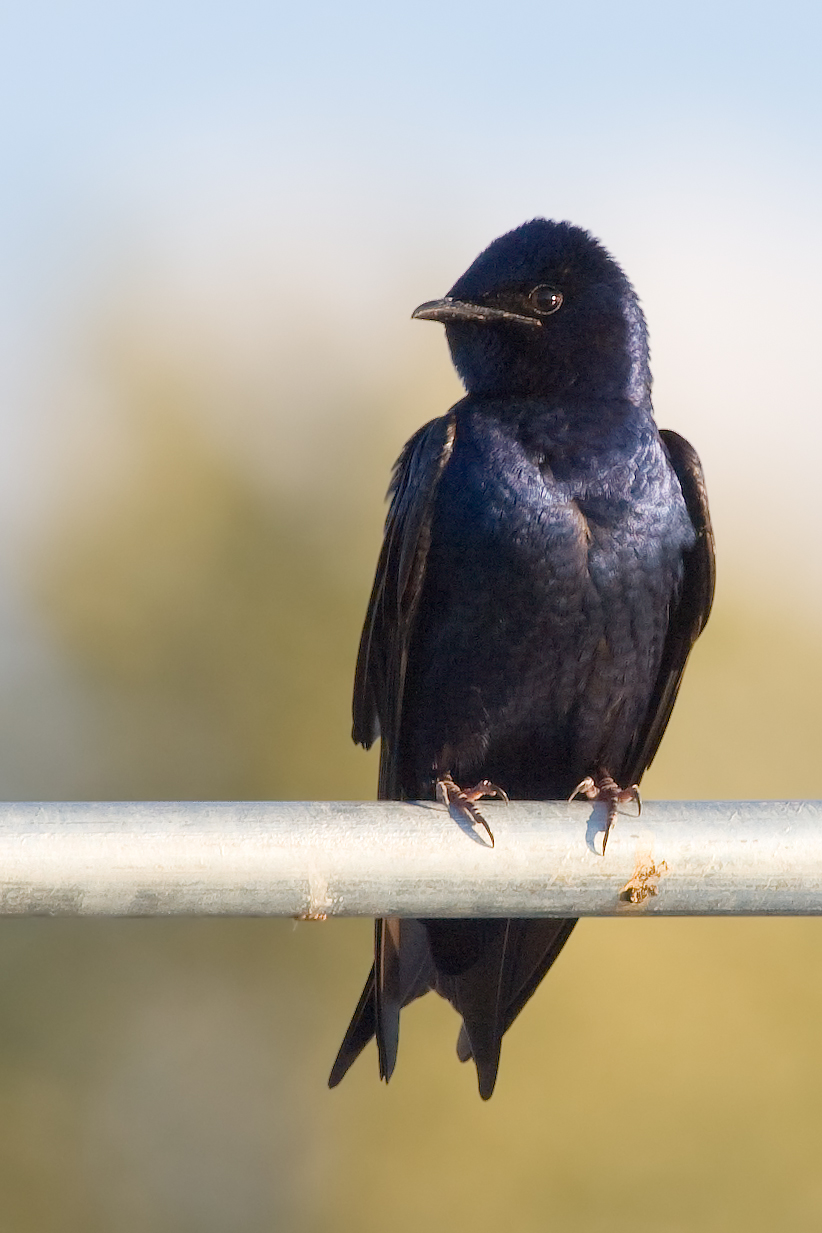
Purple Martin

Purple Martin

Progne subis

JJ Cadiz, Cajay, CC BY 3.0, via Wikimedia Commons

Side by side

Brown-chested MartinPurple Martin
Scientific nameProgne tapera (Linnaeus, 1766)Progne subis (Linnaeus, 1758)
English nameBrown-chested MartinPurple Martin
GroupBirdsBirds
ClassAves BirdAves Bird
OrderPasseriformes PasserinePasseriformes Passerine
FamilyHirundinidae SwallowHirundinidae Swallow
GenusProgne MartinProgne Martin
Named in17661758
Red List categoryLeast ConcernLeast Concern
Environmentterrestrialterrestrial
Countries on record20 countries25 countries
GBIF occurrence records170,817 records2,079,443 records

Rows where the two agree are shown in grey.

Where each is found

Both recorded in 9 countries

Only Brown-chested Martin (11)

Only Purple Martin (16)

From Catalogue of Life checklists and GBIF occurrence records. A country missing from a list means no record is held, which is not proof of absence.

Checked facts

Brown-chested MartinPurple Martin
Appearance
  • Males and females have identical plumage. English Wikipedia
  • Adults of the nominate subspecies have predominantly sandy-brown heads with white chins and throats. English Wikipedia
  • The nominate subspecies has sandy-brown upperparts. English Wikipedia
  • The nominate subspecies has a slightly forked tail and wings that are darker brown than its upperparts. English Wikipedia
  • The nominate subspecies has mostly white underparts with an indistinct brown breast band. English Wikipedia
  • The subspecies P. t. fusca is larger and darker than the nominate subspecies. English Wikipedia
  • The subspecies P. t. fusca has a more distinct breast band and dusky markings on its lower breast and belly. English Wikipedia
  • Juveniles have squarer tails than adults and grey-brown coloration on the sides of the throat. English Wikipedia
  • The species has a distinctive brown chest band that is generally sharply defined but can appear diffuse with spotting along its center. ebird.org
  • Adult males have entirely black plumage with a glossy steel-blue sheen. English Wikipedia
  • Adult females have dark upperparts with some steel-blue sheen and lighter underparts. English Wikipedia
  • Adult purple martins have slightly forked tails. English Wikipedia
  • Adult plumage develops over a period of two years in both sexes. English Wikipedia
  • Subadult males develop randomly distributed black chest feathers while moulting into adult plumage. English Wikipedia
Size
Habitat
  • The species inhabits semi-open and open environments, including grasslands, cultivated areas, forest clearings, and human settlements. English Wikipedia
  • The species favors habitats near water. English Wikipedia
  • In Venezuela, the nominate subspecies occurs below 1,000 m elevation. English Wikipedia
  • In Venezuela, P. t. fusca occurs mostly below 400 m but has been recorded as high as 1,900 m. English Wikipedia
  • In Colombia, the species occurs at elevations up to 2,500 m. English Wikipedia
  • In Ecuador and Peru, the species occurs at elevations up to 600 m. English Wikipedia
  • Purple martins breed in open areas throughout eastern North America and at some western coastal locations between British Columbia and Mexico. English Wikipedia
  • Western populations use natural nesting cavities, including old woodpecker holes and cavities in saguaro cacti. English Wikipedia
  • Purple martins in Missouri and the eastern United States depend on artificial nesting sites. extension.missouri.edu
  • Purple martins prefer nesting boxes situated near bodies of water. extension.missouri.edu
  • Purple martins prefer nesting sites near human activity. extension.missouri.edu
Diet
  • Purple martins are insectivores that primarily catch insects while flying. English Wikipedia
  • Their diet includes beetles, moths, dragonflies, butterflies, horseflies, leafhoppers and wasps. extension.missouri.edu
  • Mosquitoes account for less than one percent of the purple martin's diet. extension.missouri.edu
  • Purple martins have been documented feeding on invasive fire ants. English Wikipedia
Behaviour
  • The nominate subspecies is resident throughout its range year-round. English Wikipedia
  • The subspecies P. t. fusca is a partial migrant. English Wikipedia
  • Populations of P. t. fusca south of an approximate line from southern Bolivia to São Paulo state in Brazil migrate north during the austral winter. English Wikipedia
  • Migrating and wintering populations of P. t. fusca form flocks that can exceed 100,000 individuals. English Wikipedia
  • The species forages alone or in small flocks, flying quickly and low over vegetation and water. English Wikipedia
  • While foraging, the species flies more slowly among trees and over open land. English Wikipedia
  • The species flies higher when feeding on swarms of flying ants and termites. English Wikipedia
  • Purple martins are known for fast and agile flight involving both rapid flapping and gliding. English Wikipedia
  • When approaching nesting sites, purple martins dive at high speed with their wings tucked. English Wikipedia
  • Purple martins produce chirping, chortling, rattling and croaking vocalizations. English Wikipedia
  • Outside the breeding season, purple martins form large flocks and roost together. English Wikipedia
  • Purple martins generally migrate over land through Mexico and Central America. English Wikipedia
  • Purple martins exhibit strong fidelity to successful nesting locations and often return annually. English Wikipedia
  • Adult male purple martins arrive at breeding sites before females and establish territories. English Wikipedia
Reproduction
Distribution
  • The species occurs regularly in Panama and every mainland South American country except Chile. English Wikipedia
  • The breeding range includes the eastern United States and southeastern Canada. English Wikipedia
  • The breeding range also includes the coastal Pacific Northwest, Baja California, Arizona and New Mexico. English Wikipedia
  • Purple martins winter in Brazil, Bolivia and parts of Peru. English Wikipedia
  • Purple martins migrate to North America in spring to breed. English Wikipedia
Conservation
  • Purple martins are classified as a species of least concern by the IUCN. English Wikipedia
  • Purple martin populations experienced a severe decline during the twentieth century. English Wikipedia
  • Competition for nesting cavities from European starlings and house sparrows is a threat to purple martins. English Wikipedia
Other
  • Large flocks roosting on buildings are sometimes regarded as a nuisance by local residents. English Wikipedia
  • The California breeding range of the purple martin is highly localized. nrm.dfg.ca.gov

In brief

Brown-chested Martin

Progne tapera occurs regularly in Panama and every mainland South American country except Chile. It is distinguished by a brown chest band that is generally sharply defined but can appear diffuse with spotting along its center. Full profile

Purple Martin

Progne subis breeds in eastern North America, southeastern Canada and specified western coastal locations, and winters in Brazil, Bolivia and parts of Peru. It is the largest swallow species in North America and has adult plumage that develops over two years. Full profile

Compare something else

Page built on 27 November 2026 from the data on the two species pages, where every source is listed.

Cite this page

ScientificNames.org. (2026). Brown-chested Martin vs Purple Martin. Retrieved November 27, 2026, from https://scientificnames.org/compare/brown-chested-martin-vs-purple-martin