Comparison
Mountain Whitefish vs Bonneville Cisco
Mountain Whitefish (Prosopium williamsoni) and Bonneville Cisco (Prosopium gemmifer) both belong to the genus Prosopium (round whitefishes) and part ways below it. Both are recorded in 1 country.
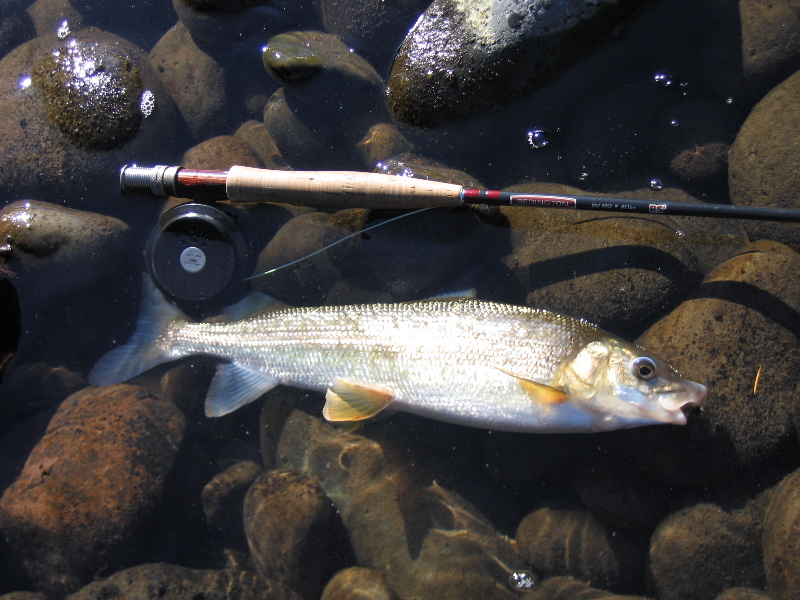
Mountain Whitefish
Prosopium williamsoni
Woostermike at English Wikipedia, Public domain, via Wikimedia Commons


Side by side
| Mountain Whitefish | Bonneville Cisco | |
|---|---|---|
| Scientific name | Prosopium williamsoni (Girard, 1856) | Prosopium gemmifer (Snyder, 1919) |
| English name | Mountain Whitefish | Bonneville Cisco |
| Group | Fishes | Fishes |
| Class | Teleostei Teleost | Teleostei Teleost |
| Order | Salmoniformes | Salmoniformes |
| Family | Salmonidae Trouts | Salmonidae Trouts |
| Genus | Prosopium Round Whitefishes | Prosopium Round Whitefishes |
| Named in | 1856 | 1919 |
| Environment | freshwater | freshwater |
| Countries on record | 2 countries | 1 country |
| GBIF occurrence records | 4,146 records | 66 records |
Rows where the two agree are shown in grey.
Where each is found
Both recorded in 1 country
Only Mountain Whitefish (1)
From Catalogue of Life checklists and GBIF occurrence records. A country missing from a list means no record is held, which is not proof of absence.
Checked facts
| Mountain Whitefish | Bonneville Cisco | |
|---|---|---|
| Appearance |
|
|
| Size |
| No checked fact yet |
| Habitat |
|
|
| Diet |
|
|
| Behaviour |
|
|
| Reproduction |
|
|
| Distribution | No checked fact yet |
|
| Conservation |
|
|
| Uses |
|
|
| Other |
| No checked fact yet |
In brief
Mountain Whitefish
Mountain Whitefish is a salmonid fish and the only native salmonid in many larger intermountain rivers of the western United States. It has a slender, nearly cylindrical silver body, a dusky olive-green dorsal surface, and a small mouth beneath the snout. Full profile
Bonneville Cisco
Prosopium gemmifer is endemic to Bear Lake along the Utah–Idaho border in the United States. Its scales are normally light silver but can become golden, brassy, or yellow during spawning. Full profile
Compare something else
Page built on 28 November 2026 from the data on the two species pages, where every source is listed.
Cite this page
ScientificNames.org. (2026). Mountain Whitefish vs Bonneville Cisco. Retrieved November 28, 2026, from https://scientificnames.org/compare/mountain-whitefish-vs-bonneville-cisco
“Mountain Whitefish vs Bonneville Cisco.” ScientificNames.org, 2026, scientificnames.org/compare/mountain-whitefish-vs-bonneville-cisco. Accessed 28 Nov. 2026.
ScientificNames.org. “Mountain Whitefish vs Bonneville Cisco.” Accessed November 28, 2026. https://scientificnames.org/compare/mountain-whitefish-vs-bonneville-cisco.
@misc{scientificnames_mountain_whitefish_vs_bonneville_cisco,
  author = {{ScientificNames.org}},
  title = {Mountain Whitefish vs Bonneville Cisco},
  year = {2026},
  url = {https://scientificnames.org/compare/mountain-whitefish-vs-bonneville-cisco},
  note = {Accessed 2026-11-28}
}