Comparison

Western Chorus Frog vs California Tree Frog

Western Chorus Frog (Pseudacris triseriata) and California Tree Frog (Pseudacris cadaverina) both belong to the genus Pseudacris (chorus frog) and part ways below it. Both are recorded in 1 country.
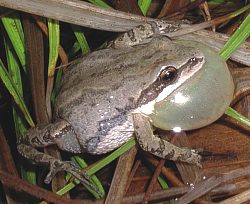
Western Chorus Frog

Western Chorus Frog

Pseudacris triseriata

The original uploader was Pfinge at French Wikipedia., CC BY-SA 3.0, via Wikimedia Commons

California Tree Frog

California Tree Frog

Pseudacris cadaverina

Polyman586, CC0, via Wikimedia Commons

Side by side

Western Chorus FrogCalifornia Tree Frog
Scientific namePseudacris triseriata (Wied-Neuwied, 1838)Pseudacris cadaverina (Cope, 1866)
English nameWestern Chorus FrogCalifornia Tree Frog
GroupAmphibiansAmphibians
ClassAmphibia AmphibiansAmphibia Amphibians
OrderAnura FrogsAnura Frogs
FamilyHylidae HylidsHylidae Hylids
GenusPseudacris Chorus FrogPseudacris Chorus Frog
Named in18381866
Red List categoryLeast ConcernLeast Concern
Countries on record2 countries2 countries
GBIF occurrence records17,666 records9,539 records

Rows where the two agree are shown in grey.

Where each is found

Both recorded in 1 country

Only Western Chorus Frog (1)

Only California Tree Frog (1)

From Catalogue of Life checklists and GBIF occurrence records. A country missing from a list means no record is held, which is not proof of absence.

Checked facts

Western Chorus FrogCalifornia Tree Frog
Appearance
  • Adults have smooth skin and coloration ranging from greenish-grey, reddish, olive, to brown. English Wikipedia
  • Adults typically have three dark longitudinal stripes running down their backs. English Wikipedia
  • The dorsal stripes may be broken, reduced, or absent in some individuals. English Wikipedia
  • The underside is generally white or cream-colored with scattered dark flecks. English Wikipedia
  • A white stripe runs along the upper lip, while a dark stripe extends from the snout across the eye and along each side. English Wikipedia
  • Some individuals have a dark triangular marking on the head. English Wikipedia
  • Tadpoles have rounded gray or brown bodies, transparent tail fins, and dark flecks. English Wikipedia
No checked fact yet
SizeNo checked fact yet
Habitat
  • Adults inhabit open, damp environments including marshes, meadows, forest edges, fallow fields, bottomland swamps, and floodplains. animaldiversity.org
  • The species can occupy rural, urban, and agricultural environments. macalester.edu
  • Tadpoles and froglets occur in shallow ponds, temporary pools, ditches, marshes, swamps, river backwaters, and lake edges. macalester.edu
No checked fact yet
Diet
  • Adults consume small invertebrates including flies, mosquitoes, ants, beetles, moths, caterpillars, grasshoppers, and spiders. English Wikipedia
  • Young froglets feed on small prey including mites, midges, and springtails. English Wikipedia
  • Tadpoles feed on periphyton, filamentous algae, diatoms, and pollen. English Wikipedia
  • Tadpoles can scavenge when food is available. English Wikipedia
No checked fact yet
Behaviour
  • Males and occasionally females produce calls in large choruses. English Wikipedia
  • Male calls attract potential mates to breeding sites. English Wikipedia
  • The call can be heard from approximately half a mile away. English Wikipedia
  • Individual calling bouts typically last 0.5 to 2 seconds. English Wikipedia
  • When disturbed, individuals stop calling and retreat underwater or into nearby terrestrial cover. English Wikipedia
  • Individuals use leaf litter, logs, rocks, and loose soil as winter hibernation shelters. English Wikipedia
  • The species rarely climbs despite belonging to the treefrog family. animaldiversity.org
  • Individuals are largely solitary outside breeding gatherings. animaldiversity.org
  • Individuals can tolerate partial freezing of their body water during winter. animaldiversity.org
  • The species has an average home range of approximately 2,116 square metres, including its breeding pond. animaldiversity.org
No checked fact yet
Reproduction
  • The breeding season generally extends from March through May, depending on geographic location. macalester.edu
  • Females produce approximately 500 to 1,500 eggs per breeding season. English Wikipedia
  • Individual egg clusters generally contain between 20 and 300 eggs. English Wikipedia
  • Females attach gelatinous egg clusters to submerged weeds or grasses near the edges of shallow water bodies. English Wikipedia
  • Eggs generally hatch within 3 to 14 days after being laid. animaldiversity.org
  • Tadpoles generally metamorphose within 40 to 90 days after hatching. animaldiversity.org
  • Males fertilize eggs externally while females lay them. animaldiversity.org
  • There is no known parental involvement after females have deposited their eggs. animaldiversity.org
  • Females generally reach sexual maturity during their second or third year. macalester.edu
No checked fact yet
Distribution
  • The species occurs in Canada and the United States. English Wikipedia
  • The documented range extends from Canada to the Gulf of Mexico and from New Jersey to central Arizona. English Wikipedia
No checked fact yet
Conservation
  • The species is classified as Least Concern on the IUCN list. English Wikipedia
  • The species is listed as threatened in the Great Lakes/St. Lawrence–Canadian Shield region under Canada's Species at Risk Act. English Wikipedia
  • Populations are declining in certain areas despite the species' adaptability to human activity. English Wikipedia
No checked fact yet
Uses
  • The species serves as an indicator of environmental pollution and ecosystem health. English Wikipedia
  • Changes in morphology or reproductive success can indicate environmental pollution or toxic substances. English Wikipedia
  • The species helps control populations of small insects and other prey organisms. animaldiversity.org
No checked fact yet

In brief

Western Chorus Frog

Pseudacris triseriata occurs in Canada and the United States, with a documented range extending from Canada to the Gulf of Mexico and from New Jersey to central Arizona. Adults typically have three dark longitudinal stripes running down their backs, although these may be broken, reduced, or absent in some individuals. Full profile

Compare something else

Page built on 26 November 2026 from the data on the two species pages, where every source is listed.

Cite this page

ScientificNames.org. (2026). Western Chorus Frog vs California Tree Frog. Retrieved November 26, 2026, from https://scientificnames.org/compare/western-chorus-frog-vs-california-tree-frog