Comparison

Charlene's Anthias vs Two-spot Basslet

Charlene's Anthias (Pseudanthias charleneae) and Two-spot Basslet (Pseudanthias bimaculatus) both belong to the genus Pseudanthias (typical indo-pacific anthiases and goldies) and part ways below it.

Charlene's Anthias

Pseudanthias charleneae
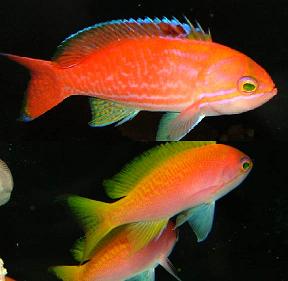
Two-spot Basslet

Two-spot Basslet

Pseudanthias bimaculatus

Jediknight95758 at English Wikipedia, CC BY 3.0, via Wikimedia Commons

Side by side

Charlene's AnthiasTwo-spot Basslet
Scientific namePseudanthias charleneae Allen & Erdmann, 2008Pseudanthias bimaculatus (Smith, 1955)
English nameCharlene's AnthiasTwo-spot Basslet
GroupFishesFishes
ClassTeleostei TeleostTeleostei Teleost
OrderPerciformesPerciformes
FamilyAnthiadidae AnthiasesAnthiadidae Anthiases
GenusPseudanthias Typical Indo-Pacific Anthiases and GoldiesPseudanthias Typical Indo-Pacific Anthiases and Goldies
Named in20081955
Red List categoryLeast ConcernLeast Concern
Environmentmarinemarine
Countries on recordNot recorded5 countries
GBIF occurrence recordsNot recorded59 records

Rows where the two agree are shown in grey.

Where each is found

Only Two-spot Basslet (5)

From Catalogue of Life checklists and GBIF occurrence records. A country missing from a list means no record is held, which is not proof of absence.

Checked facts

Charlene's AnthiasTwo-spot Basslet
Appearance
  • Males have a moderately deep body with a body depth approximately 2.4 times smaller than their standard length. fishbase.se
  • Males have a moderately elongated third dorsal-fin spine measuring 1.8 times the head length. fishbase.se
  • The caudal fin is forked or lunate, with a concavity measuring 1.4 times the head length. fishbase.se
  • Males are predominantly lavender-pink with scattered orange flecks, becoming orange on the head and front upper body. fishbase.se
  • Males have a broad, tapering orange bar below the middle of the spinous dorsal fin that extends to the lower side. fishbase.se
  • Males have a lavender-pink band edged in yellow running from the snout to the lower eye and continuing to the pectoral-fin base. fishbase.se
  • The spinous dorsal fin of males is lavender-pink on its basal half and has a broad yellow outer margin. fishbase.se
  • The soft dorsal fin of males is predominantly reddish-orange, becoming yellow toward its outer edge and bearing a narrow lavender-pink margin. fishbase.se
  • The anal fin of males is predominantly yellow with a lavender-pink anterior margin. fishbase.se
  • The caudal fin of males is reddish-orange with a lavender submarginal band near the tips of its upper and lower lobes, which are yellow-orange. fishbase.se
  • The pelvic fins of males are yellow anteriorly and whitish posteriorly, with a narrow lavender-pink anterior margin. fishbase.se
  • The pectoral fins are translucent or slightly yellowish. fishbase.se
  • The species has 10 dorsal spines and 16 dorsal soft rays. fishbase.se
  • The species has three anal spines and seven anal soft rays. fishbase.se
  • The lateral line has 47 scales. fishbase.se
  • The species lacks papillae along the posterior edge of the orbit. fishbase.se
  • Males lack a fleshy protuberance at the front of the upper lip. fishbase.se
  • The vomerine teeth form a small triangular patch. fishbase.se
  • Males are predominantly red and have jagged pink lines along their bodies. English Wikipedia
  • Male fish have red tails with clear to white tips. English Wikipedia
  • Males typically have yellow markings on their tails, anal fins and heads. English Wikipedia
  • Males have one or two spots on their dorsal fins. English Wikipedia
  • Females are predominantly pink with yellow fins and tails. English Wikipedia
  • Females typically have a yellow line extending across the head and through the eyes. English Wikipedia
  • The species exhibits sexual dimorphism, with males and females having different physical characteristics. English Wikipedia
SizeNo checked fact yet
Habitat
  • The species is benthopelagic and marine. fishbase.se
  • The holotype was collected on a steep rubble slope with abundant sea fans. fishbase.se
DietNo checked fact yet
  • The species is primarily carnivorous. English Wikipedia
  • Its wild diet consists mainly of zooplankton and floating filamentous algae. English Wikipedia
  • In aquariums, its recommended foods include mysis shrimp and vitamin-enriched brine shrimp. English Wikipedia
  • Multiple small feedings throughout the day are recommended for captive individuals. English Wikipedia
Behaviour
  • The species is rarely observed by divers because it inhabits deep waters. fishbase.se
  • The holotype was accompanied by approximately six smaller females. fishbase.se
ReproductionNo checked fact yet
  • When a dominant male dies, the largest female in the group often changes sex to replace him. English Wikipedia
Distribution
  • The species is recorded from the western Pacific, specifically Cenderawasih Bay in Indonesia. fishbase.se
  • The species occurs in the Indo-West Pacific, including East Africa, the Maldives and Indonesia. English Wikipedia
Conservation
  • The conservation assessment was dated 10 June 2022. fishbase.se
No checked fact yet
Similar speciesNo checked fact yet
  • Suggested aquarium tankmates include clownfish, blennies, gobies, Chromis and butterflyfish. English Wikipedia
OtherNo checked fact yet
  • The species is considered compatible with reef aquariums. English Wikipedia
  • The species is considered generally safe to keep with invertebrates. English Wikipedia
  • Aquariums larger than 70 gallons are recommended for this species. English Wikipedia
  • Providing several hiding places is beneficial when keeping this deep-water species in an aquarium. English Wikipedia
  • The species is considered moderately difficult to maintain in an aquarium. English Wikipedia
  • The species has a phylogenetic diversity index of 0.5000. fishbase.se
  • The reported population doubling time category is high, with a minimum doubling time of less than 15 months. fishbase.se

In brief

Charlene's Anthias

Pseudanthias charleneae is a benthopelagic marine species recorded from Cenderawasih Bay in Indonesia. Males are predominantly lavender-pink with orange markings, a forked or lunate caudal fin, and a moderately elongated third dorsal-fin spine. Full profile

Two-spot Basslet

Pseudanthias bimaculatus inhabits marine reefs, typically in deep water near coastal drop-offs, and occurs in the Indo-West Pacific, including East Africa, the Maldives and Indonesia. The species is sexually dimorphic, with males and females having different physical characteristics. Full profile

Compare something else

Page built on 28 November 2026 from the data on the two species pages, where every source is listed.

Cite this page

ScientificNames.org. (2026). Charlene's Anthias vs Two-spot Basslet. Retrieved November 28, 2026, from https://scientificnames.org/compare/charlenes-anthias-vs-two-spot-basslet