Comparison

Orange-headed Anthias vs Two-spot Basslet

Orange-headed Anthias (Pseudanthias heemstrai) and Two-spot Basslet (Pseudanthias bimaculatus) both belong to the genus Pseudanthias (typical indo-pacific anthiases and goldies) and part ways below it.

Orange-headed Anthias

Pseudanthias heemstrai
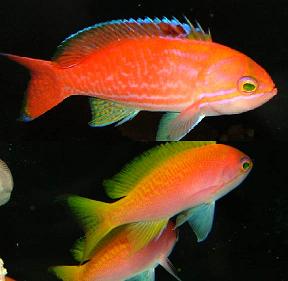
Two-spot Basslet

Two-spot Basslet

Pseudanthias bimaculatus

Jediknight95758 at English Wikipedia, CC BY 3.0, via Wikimedia Commons

Side by side

Orange-headed AnthiasTwo-spot Basslet
Scientific namePseudanthias heemstrai Schuhmacher, Krupp & Randall, 1989Pseudanthias bimaculatus (Smith, 1955)
English nameOrange-headed AnthiasTwo-spot Basslet
GroupFishesFishes
ClassTeleostei TeleostTeleostei Teleost
OrderPerciformesPerciformes
FamilyAnthiadidae AnthiasesAnthiadidae Anthiases
GenusPseudanthias Typical Indo-Pacific Anthiases and GoldiesPseudanthias Typical Indo-Pacific Anthiases and Goldies
Named in19891955
Red List categoryNot recordedLeast Concern
Environmentmarinemarine
Countries on record5 countries5 countries
GBIF occurrence records31 records59 records

Rows where the two agree are shown in grey.

Where each is found

Only Orange-headed Anthias (5)

Only Two-spot Basslet (5)

From Catalogue of Life checklists and GBIF occurrence records. A country missing from a list means no record is held, which is not proof of absence.

Checked facts

Orange-headed AnthiasTwo-spot Basslet
Appearance
  • The species has an elongated body that is just under three times as long as its depth. English Wikipedia
  • The species has a large mouth, with the maxilla extending beyond the centre of the eye and the lower jaw projecting slightly beyond the upper jaw. English Wikipedia
  • The dorsal fin has between 15 and 17 rays. English Wikipedia
  • The anal fin has seven rays and is enlarged and pointed in both sexes. English Wikipedia
  • The male has elongated pelvic fins whose first two rays are enlarged and may extend beyond the base of the anal fin. English Wikipedia
  • The male's upper body is predominantly reddish, with yellow spots and red edges on its scales. English Wikipedia
  • The male's head is dull orange on the sides and reddish pink toward the top, with a golden gill cover. English Wikipedia
  • The male has pale pink lower head and body regions with a scarlet streak along the middle of the throat. English Wikipedia
  • The male's anal and pelvic fins are pale bluish grey with irregular yellow spots. English Wikipedia
  • The male's caudal fin is dark red with a yellow or light blue-grey rear margin. English Wikipedia
  • The female has a yellow back with lavender scales bearing yellow central spots. English Wikipedia
  • The female's lower body is pale purple to white and has a red streak along the centre of the throat. English Wikipedia
  • The female has pinkish-blue pectoral and pelvic fins, while her other fins are yellow. English Wikipedia
  • The female's caudal fin has a slightly truncate or emarginate margin, whereas the male's margin is convex or truncate. English Wikipedia
  • Males are predominantly red and have jagged pink lines along their bodies. English Wikipedia
  • Male fish have red tails with clear to white tips. English Wikipedia
  • Males typically have yellow markings on their tails, anal fins and heads. English Wikipedia
  • Males have one or two spots on their dorsal fins. English Wikipedia
  • Females are predominantly pink with yellow fins and tails. English Wikipedia
  • Females typically have a yellow line extending across the head and through the eyes. English Wikipedia
  • The species exhibits sexual dimorphism, with males and females having different physical characteristics. English Wikipedia
Size
Habitat
Diet
  • The species is primarily carnivorous. English Wikipedia
  • Its wild diet consists mainly of zooplankton and floating filamentous algae. English Wikipedia
  • In aquariums, its recommended foods include mysis shrimp and vitamin-enriched brine shrimp. English Wikipedia
  • Multiple small feedings throughout the day are recommended for captive individuals. English Wikipedia
Behaviour
  • Individuals form small, loosely organized aggregations on fore-reef slopes. English Wikipedia
Reproduction
  • During breeding, the pinkish-red scale margins on males' flanks intensify to scarlet. English Wikipedia
  • Breeding males develop darker yellow spots at the centres of their scales. English Wikipedia
  • Breeding males develop an irregular, diffuse white band along the middle of their sides that broadens toward the tail. English Wikipedia
  • Breeding males develop a dark orange-red band extending from the end of the upper mandible to the origin of the dorsal fin. English Wikipedia
  • The rear margin of the male's caudal fin becomes bright red during breeding. English Wikipedia
  • When a dominant male dies, the largest female in the group often changes sex to replace him. English Wikipedia
Distribution
  • The species occurs in the Indo-West Pacific, including East Africa, the Maldives and Indonesia. English Wikipedia
Uses
  • The species occasionally enters the aquarium trade. English Wikipedia
  • The species can be maintained in aquaria containing rocky caves and strong water movement. English Wikipedia
  • In aquaria, the species schools in the upper third of an unobstructed area. English Wikipedia
  • Aquarium food should be offered at least twice daily. English Wikipedia
  • Fortified live adult brine shrimp may be needed to initiate feeding in aquarium specimens that are reluctant to accept food. English Wikipedia
No checked fact yet
Similar speciesNo checked fact yet
  • Suggested aquarium tankmates include clownfish, blennies, gobies, Chromis and butterflyfish. English Wikipedia
Name originNo checked fact yet
Other
  • The species belongs to the genus Pseudanthias. English Wikipedia
  • The species is also known by the English names Heemstra's anthias and redhead anthias. inaturalist.org
  • The species is considered compatible with reef aquariums. English Wikipedia
  • The species is considered generally safe to keep with invertebrates. English Wikipedia
  • Aquariums larger than 70 gallons are recommended for this species. English Wikipedia
  • Providing several hiding places is beneficial when keeping this deep-water species in an aquarium. English Wikipedia
  • The species is considered moderately difficult to maintain in an aquarium. English Wikipedia
  • The species has a phylogenetic diversity index of 0.5000. fishbase.se
  • The reported population doubling time category is high, with a minimum doubling time of less than 15 months. fishbase.se

In brief

Orange-headed Anthias

The Orange-headed Anthias is a fish of the genus Pseudanthias, family Anthiadidae, order Perciformes and class Teleostei. It inhabits fore-reef slopes, usually at depths of approximately 15–60 metres, and is endemic to the Red Sea. It has distinct male and female colour patterns, and reaches a maximum total length of 13 centimetres. Full profile

Two-spot Basslet

Pseudanthias bimaculatus inhabits marine reefs, typically in deep water near coastal drop-offs, and occurs in the Indo-West Pacific, including East Africa, the Maldives and Indonesia. The species is sexually dimorphic, with males and females having different physical characteristics. Full profile

Compare something else

Page built on 28 November 2026 from the data on the two species pages, where every source is listed.

Cite this page

ScientificNames.org. (2026). Orange-headed Anthias vs Two-spot Basslet. Retrieved November 28, 2026, from https://scientificnames.org/compare/orange-headed-anthias-vs-two-spot-basslet