Comparison
Meadow Grasshopper vs Australian Plague Locust
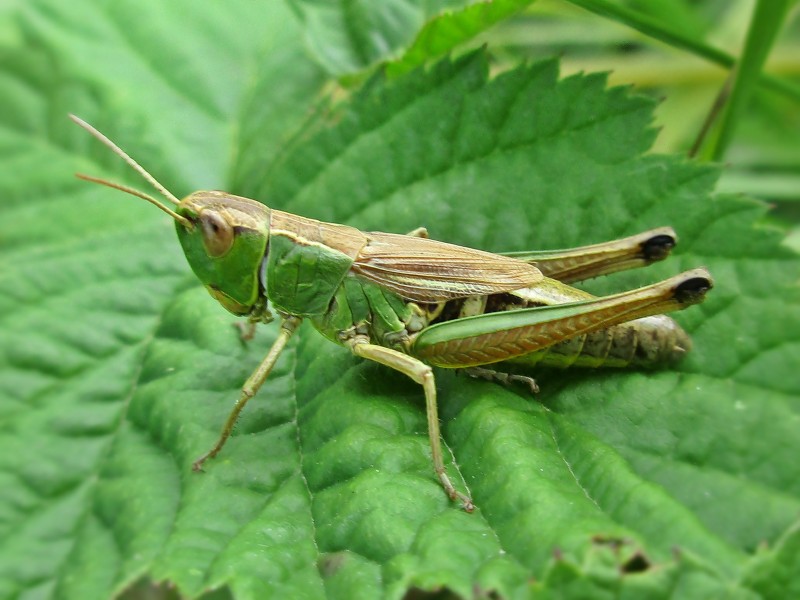
Meadow Grasshopper (Pseudochorthippus parallelus) and Australian Plague Locust (Chortoicetes terminifera) both belong to the family Acrididae (grasshoppers) and part ways below it.


Australian Plague Locust
Chortoicetes terminifera
Image in public domain, per http://www.ento.csiro.au/aicn/image.htm, Public domain, via Wikimedia Commons

Side by side
| Meadow Grasshopper | Australian Plague Locust | |
|---|---|---|
| Scientific name | Pseudochorthippus parallelus (Zetterstedt, 1821) | Chortoicetes terminifera (Walker, 1870) |
| English name | Meadow Grasshopper | Australian Plague Locust |
| Group | Insects | Insects |
| Class | Insecta Insect | Insecta Insect |
| Order | Orthoptera | Orthoptera |
| Family | Acrididae Grasshoppers | Acrididae Grasshoppers |
| Genus | Pseudochorthippus | Chortoicetes |
| Named in | 1821 | 1870 |
| Environment | terrestrial | terrestrial |
| Countries on record | 47 countries | 1 country |
| GBIF occurrence records | 455,681 records | 2,192 records |
Rows where the two agree are shown in grey.
Where each is found
Only Meadow Grasshopper (47)
- Albania
- Andorra
- Armenia
- Austria
- Azerbaijan
- Belarus
- Belgium
- Bosnia and Herzegovina
- Bulgaria
- China
- Croatia
- Czechia
- Denmark
- Estonia
- Finland
- France
- Germany
- Greece
- Hungary
- Italy
- Jersey
- Kazakhstan
- Kosovo
- Kyrgyzstan
- Latvia
- Liechtenstein
- Lithuania
- Luxembourg
- Moldova
- Montenegro
- North Macedonia
- Norway
- Poland
- Portugal
- Romania
- Russia
- Serbia
- Slovakia
- Slovenia
- Spain
- Sweden
- Switzerland
- The Netherlands
- Turkey
- Ukraine
- United Kingdom
- Uzbekistan
Only Australian Plague Locust (1)
From Catalogue of Life checklists and GBIF occurrence records. A country missing from a list means no record is held, which is not proof of absence.
Checked facts
| Meadow Grasshopper | Australian Plague Locust | |
|---|---|---|
| Appearance |
|
|
| Size |
|
|
| Habitat |
|
|
| Diet | No checked fact yet |
|
| Behaviour | No checked fact yet |
|
| Reproduction | No checked fact yet |
|
| Distribution |
|
|
| Conservation | No checked fact yet |
|
| Uses |
| No checked fact yet |
| Similar species | No checked fact yet |
|
| Other |
| No checked fact yet |
In brief
Meadow Grasshopper
Pseudochorthippus parallelus inhabits non-arid grasslands in well-vegetated regions across Europe, from the Atlantic coast to the Ural Mountains. It is distinguished by approximately parallel bars on the sides of its pronotum and occurs in several genetically determined colour forms. Full profile
Australian Plague Locust
Chortoicetes terminifera mainly occurs in Queensland and New South Wales. Full profile
Compare something else
Page built on 27 November 2026 from the data on the two species pages, where every source is listed.
Cite this page
ScientificNames.org. (2026). Meadow Grasshopper vs Australian Plague Locust. Retrieved November 27, 2026, from https://scientificnames.org/compare/meadow-grasshopper-vs-australian-plague-locust
“Meadow Grasshopper vs Australian Plague Locust.” ScientificNames.org, 2026, scientificnames.org/compare/meadow-grasshopper-vs-australian-plague-locust. Accessed 27 Nov. 2026.
ScientificNames.org. “Meadow Grasshopper vs Australian Plague Locust.” Accessed November 27, 2026. https://scientificnames.org/compare/meadow-grasshopper-vs-australian-plague-locust.
@misc{scientificnames_meadow_grasshopper_vs_australian_plague_locust,
  author = {{ScientificNames.org}},
  title = {Meadow Grasshopper vs Australian Plague Locust},
  year = {2026},
  url = {https://scientificnames.org/compare/meadow-grasshopper-vs-australian-plague-locust},
  note = {Accessed 2026-11-27}
}