Comparison
Baton Blue vs Xerces Blue
Baton Blue (Pseudophilotes baton) and Xerces Blue (Glaucopsyche xerces) both belong to the tribe Polyommatini and part ways below it.

Baton Blue
Pseudophilotes baton
Frederic Moore (text); J N Fitch (art), Public domain, via Wikimedia Commons


Side by side
| Baton Blue | Xerces Blue | |
|---|---|---|
| Scientific name | Pseudophilotes baton (Bergstrasser, 1779) | Glaucopsyche xerces (Boisduval, 1852) |
| English name | Baton Blue | Xerces Blue |
| Group | Insects | Insects |
| Class | Insecta Insect | Insecta Insect |
| Order | Lepidoptera | Lepidoptera |
| Family | Lycaenidae Blues | Lycaenidae Blues |
| Genus | Pseudophilotes | Glaucopsyche |
| Named in | 1779 | 1852 |
| Red List category | Least Concern | Extinct |
| Countries on record | 34 countries | 3 countries |
| GBIF occurrence records | 35,544 records | 886 records |
Rows where the two agree are shown in grey.
Where each is found
Only Baton Blue (34)
- Albania
- Andorra
- Austria
- Belarus
- Bosnia and Herzegovina
- Bulgaria
- Croatia
- Cyprus
- Czechia
- Estonia
- Finland
- France
- Germany
- Greece
- Hungary
- Israel
- Italy
- Kosovo
- Lithuania
- Luxembourg
- Montenegro
- North Macedonia
- Poland
- Portugal
- Romania
- Russia
- Serbia
- Slovakia
- Slovenia
- Spain
- Sweden
- Switzerland
- Turkey
- Ukraine
Only Xerces Blue (3)
From Catalogue of Life checklists and GBIF occurrence records. A country missing from a list means no record is held, which is not proof of absence.
Checked facts
| Baton Blue | Xerces Blue | |
|---|---|---|
| Appearance |
|
|
| Size |
|
|
| Habitat |
|
|
| Diet |
|
|
| Behaviour |
|
|
| Reproduction |
|
|
| Distribution |
|
|
| Conservation | No checked fact yet |
|
| Similar species | No checked fact yet |
|
| Other | No checked fact yet |
|
In brief
Baton Blue
Pseudophilotes baton occurs in central and southern Europe and extends eastward across the Palearctic to the Russian Far East. It has a blackish upperwing surface variably dusted with blue and numerous underside ocelli against a leaden-grey background. Full profile
Xerces Blue
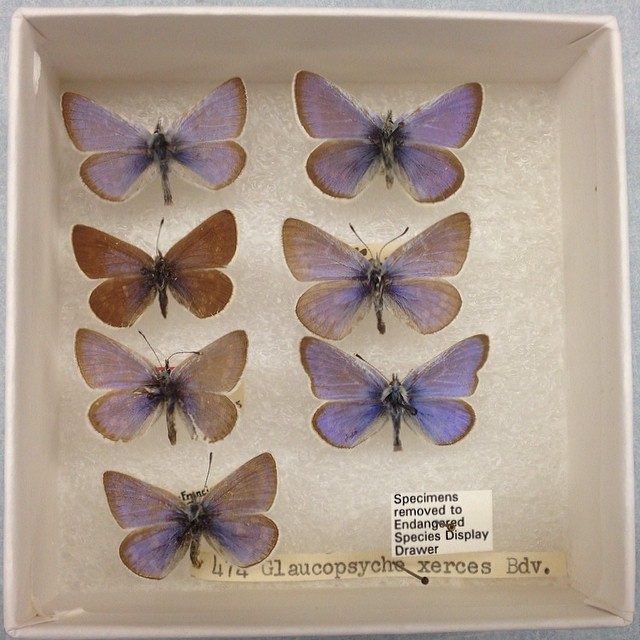
Glaucopsyche xerces inhabited coastal sand dunes on the upper San Francisco Peninsula in California. It was a small butterfly characterized by blue wings with white spots. Full profile
Compare something else
Page built on 27 November 2026 from the data on the two species pages, where every source is listed.
Cite this page
ScientificNames.org. (2026). Baton Blue vs Xerces Blue. Retrieved November 27, 2026, from https://scientificnames.org/compare/baton-blue-vs-xerces-blue
“Baton Blue vs Xerces Blue.” ScientificNames.org, 2026, scientificnames.org/compare/baton-blue-vs-xerces-blue. Accessed 27 Nov. 2026.
ScientificNames.org. “Baton Blue vs Xerces Blue.” Accessed November 27, 2026. https://scientificnames.org/compare/baton-blue-vs-xerces-blue.
@misc{scientificnames_baton_blue_vs_xerces_blue,
  author = {{ScientificNames.org}},
  title = {Baton Blue vs Xerces Blue},
  year = {2026},
  url = {https://scientificnames.org/compare/baton-blue-vs-xerces-blue},
  note = {Accessed 2026-11-27}
}