| Appearance | - The Sinai Baton Blue is described as one of the world's smallest butterflies. English Wikipedia
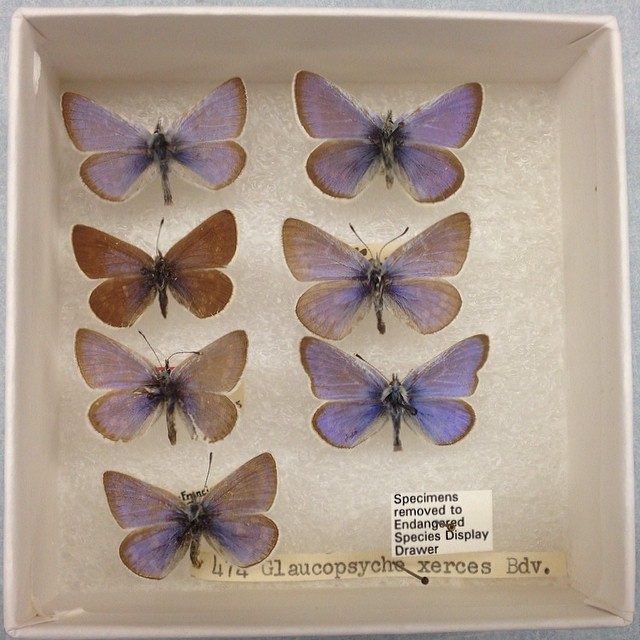
| - Males have iridescent blue coloration on the upper surfaces of their wings and pale spots on the undersides. floridamuseum.ufl.edu
- The species exhibited extensive variation in wing patterns, with several named forms. floridamuseum.ufl.edu
- The species was characterized by blue wings with white spots. English Wikipedia
|
|---|
| Size | - The species is among the smallest butterfly species in the world. impact.ref.ac.uk
| |
|---|
| Habitat | - The species inhabits mountainside patches of Sinai thyme in the arid Saint Katherine area of Egypt's Sinai Peninsula. English Wikipedia
- The species occupies discrete patches of its host plant in mountainous terrain. English Wikipedia
| - The species inhabited coastal sand dunes on the San Francisco Peninsula in California. English Wikipedia
- The species preferred stabilized sandy sites where its low-growing larval host plant grew. floridamuseum.ufl.edu
- The species occupied coastal sand dunes in the upper San Francisco Peninsula, including areas now within the Golden Gate National Recreation Area. floridamuseum.ufl.edu
|
|---|
| Diet | - The larvae feed on the buds and flowers of Sinai thyme (Thymus decussatus). English Wikipedia
| - The caterpillars used Lotus scoparius (Deerweed) as their preferred larval host plant. pmc.ncbi.nlm.nih.gov
- The butterflies fed on plants belonging to the genera Lotus and Lupinus. English Wikipedia
- Lupinus was another recorded vegetative food source, but it was unsuitable for the larval stages. English Wikipedia
|
|---|
| Behaviour | - The larvae maintain an appeasement relationship with the ant species Lepisiota obtusa. English Wikipedia
- The larvae use a dorsal nectary organ to provide Lepisiota obtusa ants with droplets containing simple sugars and amino acids. English Wikipedia
- The larvae produce volatile secretions through a tentacular organ to attract and alert attendant ants when alarmed. English Wikipedia
- Larvae are heavily preyed upon by the ant Crematogaster aegyptiaca. English Wikipedia
- The species is a poor flier, with individuals generally unable to travel more than 100 metres. English Wikipedia
- Male butterflies begin searching for females after emerging as adults. English Wikipedia
| - The species had a major flight period documented in historical biological studies. pmc.ncbi.nlm.nih.gov
|
|---|
| Reproduction | - Females lay approximately 20–30 eggs in spring, one day after mating. English Wikipedia
- Females deposit their eggs on young buds of the host plant Sinai thyme. English Wikipedia
- The eggs hatch after an incubation period of a few days. English Wikipedia
- Larval development takes approximately 21 days. English Wikipedia
- Fully developed larvae descend to the base of the thyme plant before pupating. English Wikipedia
- The pupae remain inside their cocoons throughout autumn and winter. English Wikipedia
- Adult butterflies emerge when temperatures rise in late spring, between April and June. English Wikipedia
| |
|---|
| Distribution | - The species is endemic to Egypt and has a highly localized distribution in the Saint Katherine area of the Sinai Peninsula. English Wikipedia
- The species is one of a small number of plant and animal species endemic to Egypt. impact.ref.ac.uk
| - The species was endemic to the coastal sand dunes of the upper San Francisco Peninsula in California. floridamuseum.ufl.edu
|
|---|
| Conservation | - The species faces habitat loss associated with grazing, over-collection of medicinal plants and global warming. English Wikipedia
- Increased grazing combined with rising temperatures is identified as a major potential cause of extinction. English Wikipedia
- The species may survive even when goats consume up to 60 percent of the Sinai thyme, provided temperatures remain below a critical threshold. English Wikipedia
- A slight increase in average temperature above a critical threshold could cause the entire butterfly population to collapse. English Wikipedia
- Over-collection of Sinai thyme can eliminate individual host-plant patches and threaten associated butterfly populations. English Wikipedia
- The loss of Sinai thyme patches can cause local butterfly populations to become extinct. English Wikipedia
- Recolonization of extinct local populations depends on immigration from other habitat patches. English Wikipedia
- Greater distances between habitat patches reduce the likelihood of recolonization. English Wikipedia
- The long-term survival of the species depends partly on habitat-patch area and the distance between patches. English Wikipedia
| - The Xerces blue is extinct, with its extinction associated with habitat loss caused by urban development. English Wikipedia
- The last known living individuals were observed in the early 1940s. pmc.ncbi.nlm.nih.gov
- Urban development and disturbance of sandy soils caused the local loss of important host plants, contributing to the species' extinction. pmc.ncbi.nlm.nih.gov
- The loss of Lotus plants used by the larvae is considered a contributing factor in the species' extinction. English Wikipedia
- The introduction of the Argentine ant coincided with the species' decline and has been proposed as a possible contributing factor. pmc.ncbi.nlm.nih.gov
- The invasive Argentine ant was proposed as a possible threat because it may have outcompeted native ants that tend and protect the caterpillars. pmc.ncbi.nlm.nih.gov
- The species' extinction inspired the establishment of the Xerces Society for Invertebrate Conservation in 1971. floridamuseum.ufl.edu
- The species is recognized as an important symbol of insect conservation in North America. pmc.ncbi.nlm.nih.gov
|
|---|
| Similar species | No checked fact yet | - The closest relatives of the Xerces blue are Glaucopsyche australis and Glaucopsyche pseudoxerces. English Wikipedia
- The Xerces blue's closest relative group is most closely related to Glaucopsyche lygdamus, commonly called the silvery blue. English Wikipedia
- Historical researchers considered the Xerces blue and Glaucopsyche lygdamus closely related but separate species. pmc.ncbi.nlm.nih.gov
|
|---|
| Other | | - Genetic analyses of museum specimens confirmed that the Xerces blue was a distinct species. pmc.ncbi.nlm.nih.gov
- DNA analysis was conducted using a museum specimen collected in 1928. pmc.ncbi.nlm.nih.gov
- The DNA analysis recovered 210,182,214 nucleotides from the museum specimen. pmc.ncbi.nlm.nih.gov
- Preserved specimens of the species are held by the California Academy of Sciences, Bohart Museum, and Harvard Museum of Natural History. English Wikipedia
- The Florida Museum of Natural History's McGuire Center holds specimens of the species. floridamuseum.ufl.edu
|
|---|