Comparison
Magnificent Brood Frog vs Southern Corroboree Frog
Magnificent Brood Frog (Pseudophryne covacevichae) and Southern Corroboree Frog (Pseudophryne corroboree) both belong to the genus Pseudophryne (crowned toadlets) and part ways below it. Both are recorded in 1 country.

Magnificent Brood Frog
Pseudophryne covacevichae
Jean-Marc Hero, CC BY-SA 2.5, via Wikimedia Commons

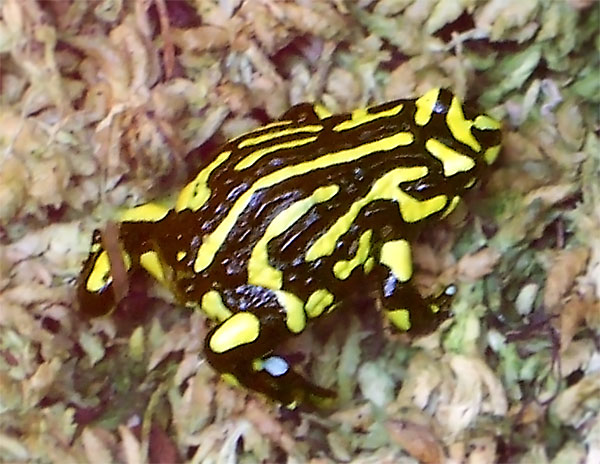
Southern Corroboree Frog
Pseudophryne corroboree
No machine-readable author provided. Andrew c assumed (based on copyright claims)., CC BY-SA 3.0, via Wikimedia Commons

Side by side
| Magnificent Brood Frog | Southern Corroboree Frog | |
|---|---|---|
| Scientific name | Pseudophryne covacevichae Ingram & Corben, 1994 | Pseudophryne corroboree Moore, 1953 |
| English name | Magnificent Brood Frog | Southern Corroboree Frog |
| Group | Amphibians | Amphibians |
| Class | Amphibia Amphibians | Amphibia Amphibians |
| Order | Anura Frogs | Anura Frogs |
| Family | Myobatrachidae Australian Frogs | Myobatrachidae Australian Frogs |
| Genus | Pseudophryne Crowned Toadlets | Pseudophryne Crowned Toadlets |
| Named in | 1994 | 1953 |
| Red List category | Endangered | Critically Endangered |
| Countries on record | 1 country | 1 country |
| GBIF occurrence records | 63 records | 354 records |
Rows where the two agree are shown in grey.
Where each is found
Both recorded in 1 country
From Catalogue of Life checklists and GBIF occurrence records. A country missing from a list means no record is held, which is not proof of absence.
Checked facts
| Magnificent Brood Frog | Southern Corroboree Frog | |
|---|---|---|
| Appearance |
|
|
| Size |
|
|
| Habitat |
|
|
| Diet | No checked fact yet |
|
| Behaviour |
|
|
| Reproduction |
|
|
| Distribution |
|
|
| Conservation |
|
|
| Similar species |
| No checked fact yet |
In brief
Magnificent Brood Frog
Pseudophryne covacevichae is endemic to Queensland, Australia, and has been recorded near Ravenshoe in the southern Atherton Tableland and at Mount Spec in the Paluma Range. It is distinguished by its yellow and rufous-brown dorsal colouring, black flanks and marbled black-and-white underside. Full profile
Southern Corroboree Frog
Pseudophryne corroboree lives in sphagnum bogs at elevations above 1,200 m. Adults have vivid yellow and black stripes across their head, back, and limbs. Full profile
Compare something else
Page built on 27 November 2026 from the data on the two species pages, where every source is listed.
Cite this page
ScientificNames.org. (2026). Magnificent Brood Frog vs Southern Corroboree Frog. Retrieved November 27, 2026, from https://scientificnames.org/compare/magnificent-brood-frog-vs-southern-corroboree-frog
“Magnificent Brood Frog vs Southern Corroboree Frog.” ScientificNames.org, 2026, scientificnames.org/compare/magnificent-brood-frog-vs-southern-corroboree-frog. Accessed 27 Nov. 2026.
ScientificNames.org. “Magnificent Brood Frog vs Southern Corroboree Frog.” Accessed November 27, 2026. https://scientificnames.org/compare/magnificent-brood-frog-vs-southern-corroboree-frog.
@misc{scientificnames_magnificent_brood_frog_vs_southern_corroboree_frog,
  author = {{ScientificNames.org}},
  title = {Magnificent Brood Frog vs Southern Corroboree Frog},
  year = {2026},
  url = {https://scientificnames.org/compare/magnificent-brood-frog-vs-southern-corroboree-frog},
  note = {Accessed 2026-11-27}
}