Comparison

Wild Teak vs Red Sandalwood

Wild Teak (Pterocarpus angolensis) and Red Sandalwood (Pterocarpus santalinus) both belong to the genus Pterocarpus and part ways below it.

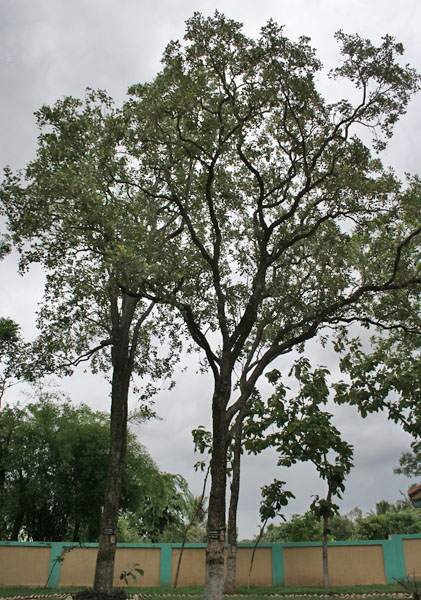
Wild Teak

Wild Teak

Pterocarpus angolensis

SAplants, CC BY-SA 4.0, via Wikimedia Commons

Red Sandalwood

Red Sandalwood

Pterocarpus santalinus

J.M.Garg, CC BY-SA 4.0, via Wikimedia Commons

Side by side

Wild TeakRed Sandalwood
Scientific namePterocarpus angolensis DC.Pterocarpus santalinus L.f.
English nameWild TeakRed Sandalwood
GroupFlowering plantsFlowering plants
ClassMagnoliopsidaMagnoliopsida
OrderFabalesFabales
FamilyFabaceae BeanFabaceae Bean
GenusPterocarpusPterocarpus
Red List categoryLeast ConcernEndangered
Countries on record13 countries5 countries
GBIF occurrence records2,280 records175 records

Rows where the two agree are shown in grey.

Where each is found

Only Wild Teak (13)

Only Red Sandalwood (5)

From Catalogue of Life checklists and GBIF occurrence records. A country missing from a list means no record is held, which is not proof of absence.

Checked facts

Wild TeakRed Sandalwood
Appearance
  • The tree has dark brown bark and a high, wide-crowned canopy of shiny compound leaves. English Wikipedia
  • Its leaves are alternate, deep green and imparipinnate, with 11–19 leaflets. English Wikipedia
  • Its leaflets measure 2.5–7 cm in length and 2–4.5 cm in width. English Wikipedia
  • The species produces scented orange-yellow flowers arranged in panicles measuring 10–20 cm long. English Wikipedia
  • Its fruit is a pod measuring 2–3 cm in diameter, surrounded by a circular wing measuring 8–12 cm in diameter. English Wikipedia
  • The species produces brown, papery and spiky seed pods that remain on the tree after its leaves have fallen. English Wikipedia
  • The tree releases dark red sap when cut, giving it a bleeding appearance. English Wikipedia
  • Trees growing in poorly drained locations develop an open shape with leaves concentrated at the ends of long branches. English Wikipedia
SizeNo checked fact yet
Habitat
  • The species grows in areas characterized by alternating dry and wet seasons. English Wikipedia
  • It grows best in warm locations without frost. English Wikipedia
  • Its preferred soils are deep sandy soils or well-drained rocky slopes receiving more than 500 mm of rainfall annually. English Wikipedia
  • The species grows in open woodland, including the Mashonaland plateau in Zimbabwe and northern KwaZulu-Natal in South Africa. English Wikipedia
  • It acts as a pioneer species along woodland and forest margins. English Wikipedia
  • The species forms its best specimens in seasonal closed woodland in central Mozambique and parts of Malawi. English Wikipedia
  • It sometimes forms pure stands in seasonal closed woodland. English Wikipedia
  • The species is described as a light-demanding tree. English Wikipedia
  • The species can grow on degraded soils. English Wikipedia
  • Red sandalwood with distinctive wavy grain margins grows on shale subsoils at approximately 750 metres elevation in semi-arid climatic conditions. English Wikipedia
DietNo checked fact yet
Behaviour
Reproduction
Distribution
  • The species is native to Angola, Mozambique, Namibia, South Africa, Eswatini, Tanzania, the Democratic Republic of the Congo, Zimbabwe and Zambia. English Wikipedia
  • The species occurs across southern and eastern Africa. English Wikipedia
  • Pterocarpus santalinus is endemic to the southern Eastern Ghats mountain range of South India. English Wikipedia
Conservation
  • The species is a protected tree in South Africa. English Wikipedia
  • Dieback incidence reached 100% across all areas examined in the Chobe Forest Reserves study. academia.edu
  • Elephant damage and fire significantly contribute to the severity of dieback in this species. academia.edu
  • The species was reclassified as Near Threatened in 2018. English Wikipedia
  • The species was previously listed as Endangered by the IUCN because of timber overexploitation in South India. English Wikipedia
  • The species is listed in Appendix II of CITES. English Wikipedia
  • Exporting the species requires a certificate confirming that trade will not harm its survival. English Wikipedia
  • Illegal timber trading remains a problem for the species. English Wikipedia
Uses
  • The species produces durable heartwood that resists borer and termite damage and has a spicy fragrance. English Wikipedia
  • Its wood polishes well and is used to manufacture high-quality furniture. English Wikipedia
  • The wood is used to manufacture curios and implements. English Wikipedia
  • Its wood is suitable for canoe construction because it undergoes little swelling or shrinkage. English Wikipedia
  • The reddish sapwood is used to make furniture and curios. English Wikipedia
  • The wood is used to manufacture musical instruments because it produces a rich, resonant sound. English Wikipedia
  • In Zimbabwe, mukwa wood is traditionally used to make the mbira. English Wikipedia
  • Methanolic bark extracts have demonstrated molluscicidal activity against some freshwater snails. English Wikipedia
  • The species is sometimes planted around chiefs' enclosures as a living fence. English Wikipedia
  • The species is used in traditional herbal medicine as an antipyretic. English Wikipedia
  • The species' timber has historically been valued in China, particularly during the Qing dynasty. English Wikipedia
Similar speciesNo checked fact yet
  • Pterocarpus santalinus should not be confused with aromatic Santalum sandalwood trees native to southern India. English Wikipedia

In brief

Wild Teak

Pterocarpus angolensis is native to Angola, Mozambique, Namibia, South Africa, Eswatini, Tanzania, the Democratic Republic of the Congo, Zimbabwe and Zambia, and occurs across southern and eastern Africa. It releases dark red sap when cut and produces brown, papery, spiky seed pods that remain on the tree after its leaves have fallen. Full profile

Red Sandalwood

Pterocarpus santalinus is endemic to the southern Eastern Ghats mountain range of South India. Full profile

Compare something else

Page built on 27 November 2026 from the data on the two species pages, where every source is listed.

Cite this page

ScientificNames.org. (2026). Wild Teak vs Red Sandalwood. Retrieved November 27, 2026, from https://scientificnames.org/compare/wild-teak-vs-red-sandalwood