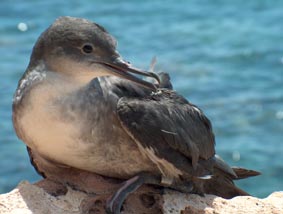
| Appearance | - The Fluttering Shearwater has dark-brown upperparts and predominantly white underparts. English Wikipedia
- The bird has a grey-brown face and neck that gradually become white below the eye. English Wikipedia
- Its underbody is white from the chin to the undertail, apart from a dark thigh patch. English Wikipedia
- Its legs and feet are pinkish-brown with dark webs. English Wikipedia
- Its bill is long, thin and dark-coloured. English Wikipedia
- Its tail is short and fan-shaped, with dark-brown and white colouring. English Wikipedia
- Nestlings have slate-coloured down on their upperparts and white down underneath. English Wikipedia
| No checked fact yet |
|---|
| Size | | |
|---|
| Habitat | - The species inhabits open seas and rocky shores. English Wikipedia
- The species commonly occupies coastal and marine environments, scrubland and forest. English Wikipedia
- It is most commonly found in subtropical waters and warm water averaging 24 °C. English Wikipedia
- The species frequently occupies harbours, inlets, bays and straits. English Wikipedia
- Breeding birds select stony, scrub-covered slopes and rocky cracks or holes for nesting. English Wikipedia
- Most recorded tracking locations were in shallow waters close to the coast. pmc.ncbi.nlm.nih.gov
| - The Balearic shearwater breeds on islands and coastal cliffs in the Balearic Islands. English Wikipedia
|
|---|
| Diet | - The documented diet includes schooling fish such as pilchards, trevally, mackerel and sprats. English Wikipedia
- The species also consumes small pelagic crustaceans, including krill. English Wikipedia
- The species has been observed foraging on surface aggregations of schooling forage fish and euphausiids. pmc.ncbi.nlm.nih.gov
| |
|---|
| Behaviour | - The species captures prey through surface seizing and pursuit diving. English Wikipedia
- During pursuit diving, it uses its wings to propel itself underwater while chasing prey. English Wikipedia
- Its flight involves rapid wingbeats alternating with gliding. English Wikipedia
- The species makes rapid fluttering wing movements and beats its feet when flying away from the sea. English Wikipedia
- Large groups gather in floating rafts during December, January and February. English Wikipedia
- Tracked individuals predominantly foraged during daylight. pmc.ncbi.nlm.nih.gov
- Tracked individuals frequently visited their breeding colonies at night throughout the year. pmc.ncbi.nlm.nih.gov
- Three of eight tracked individuals crossed the Tasman Sea during at least one monitored year. pmc.ncbi.nlm.nih.gov
| - The Balearic shearwater flies low over the sea, dipping from side to side on stiff wings with few wingbeats. English Wikipedia
- The Balearic shearwater is gregarious and can occur in large numbers, particularly in autumn. English Wikipedia
- The species' breeding colonies produce raucous cackling calls at night. English Wikipedia
- The Balearic shearwater does not follow boats while feeding. English Wikipedia
|
|---|
| Reproduction | | |
|---|
| Distribution | - The Fluttering Shearwater is endemic to New Zealand. English Wikipedia
- The species breeds on coastal islands throughout New Zealand. English Wikipedia
- Breeding populations occur on islands in the north-east North Island, including the Aldermen, Moturoa, Bream and Mercury Islands. English Wikipedia
- Breeding populations also occur in the Marlborough Sound and Cook Strait regions of the South Island. English Wikipedia
- Some individuals migrate across the Tasman Sea to coastal waters off eastern Tasmania and southeastern Australia. pmc.ncbi.nlm.nih.gov
- Resident individuals remain in northern and central New Zealand waters throughout the year. pmc.ncbi.nlm.nih.gov
- The species has also been recorded in the Solomon Islands outside its New Zealand breeding range. English Wikipedia
| - Most Balearic shearwaters spend the winter in the Mediterranean Sea. English Wikipedia
- Some Balearic shearwaters enter the Atlantic in late summer and reach Great Britain and Ireland. English Wikipedia
|
|---|
| Conservation | - The species is classified as being of least concern. English Wikipedia
- The species' population is reported to be decreasing steadily. English Wikipedia
- The estimated population is more than 100,000 breeding pairs. pmc.ncbi.nlm.nih.gov
- The species is vulnerable to coastal fisheries and pollution originating from terrestrial sources. pmc.ncbi.nlm.nih.gov
- Introduced mammalian predators, including feral cats and rats, have caused the loss of several major breeding colonies. English Wikipedia
- A fishing-gear incident at Whangaparaoa Peninsula killed 166 Fluttering Shearwaters in May 2009. English Wikipedia
- An oil spill following the grounding of the Rena killed more than 240 Fluttering Shearwaters in October 2011. English Wikipedia
- A translocation project moved 334 chicks from Long Island to Maud Island between 1991 and 1996. English Wikipedia
- Between 2012 and 2014, 237 chicks were transferred from Long Island to Matiu / Somes Island. English Wikipedia
- Approximately one-quarter of the birds translocated to Matiu / Somes Island had returned to breed there by 2019. English Wikipedia
- In January 2022, 50 chicks were moved from Long Island to Wharariki Ecosanctuary at Cape Farewell. English Wikipedia
| - The Balearic shearwater is classified as Critically Endangered by the IUCN. English Wikipedia
- Recent population models estimate a mean annual decline of 7.4% for the Balearic shearwater. English Wikipedia
- Recent models estimate a mean extinction time of 40.4 years for the Balearic shearwater. English Wikipedia
- Population models project a decline exceeding 80% over the next three generations, corresponding to 54 years. English Wikipedia
- Introduced cats and rats threaten the Balearic shearwater through predation. English Wikipedia
- Hybridization with Yelkouan shearwaters may pose a conservation problem for the Balearic shearwater. English Wikipedia
- The Balearic shearwater is covered by the Agreement on the Conservation of Albatrosses and Petrels. English Wikipedia
|
|---|
| Similar species | No checked fact yet | - The Balearic shearwater resembles the Manx and Yelkouan shearwaters, but has less contrasting plumage. English Wikipedia
|
|---|
| Other | No checked fact yet | - A molecular phylogenetic study published in 2021 found very little genetic difference between the Balearic shearwater and the Yelkouan shearwater. English Wikipedia
- A 2021 molecular study suggested that the Balearic and Yelkouan shearwaters might be considered the same species. English Wikipedia
- Scientific identification of the Balearic shearwater may require combining morphological characteristics with DNA sequence data. English Wikipedia
|
|---|