Comparison

Red-footed Falcon vs Gyrfalcon

Red-footed Falcon (Falco vespertinus) and Gyrfalcon (Falco rusticolus) both belong to the genus Falco (falcons) and part ways below it. Both are recorded in 19 countries.

Red-footed Falcon

Red-footed Falcon

Falco vespertinus

Jutta Luft, CC BY-SA 3.0, via Wikimedia Commons

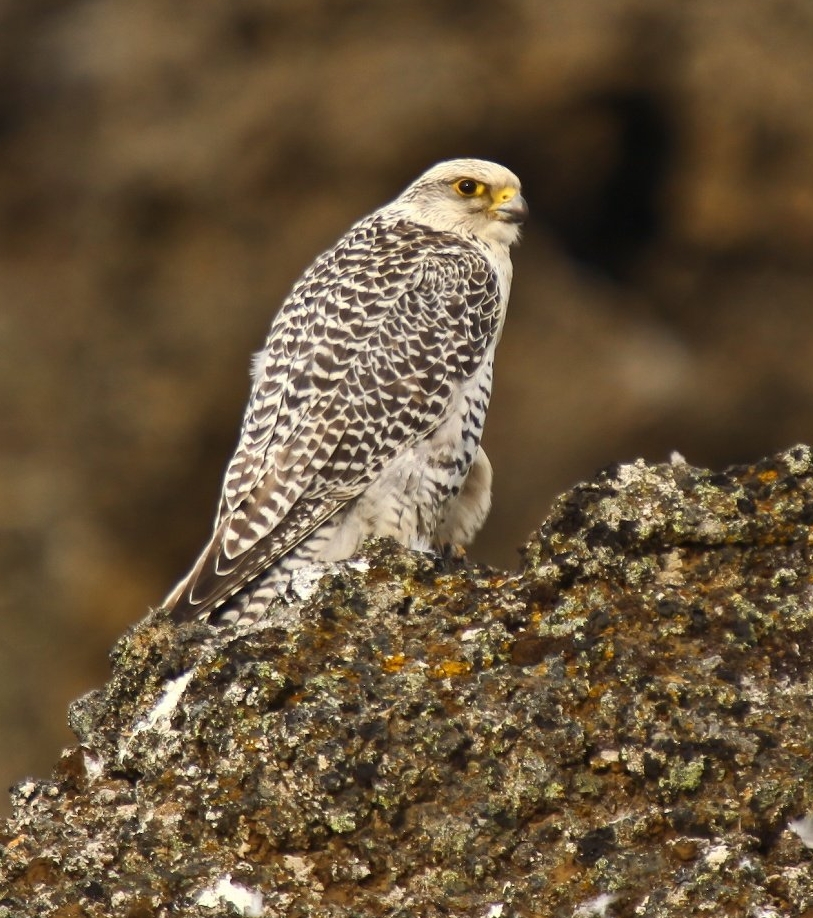
Gyrfalcon

Gyrfalcon

Falco rusticolus

Falco_rusticolus_white.jpg: Ólafur Larsen derivative work: Bogbumper (talk), CC BY-SA 2.0, via Wikimedia Commons

Side by side

Red-footed FalconGyrfalcon
Scientific nameFalco vespertinus Linnaeus, 1766Falco rusticolus Linnaeus, 1758
English nameRed-footed FalconGyrfalcon
GroupBirdsBirds
ClassAves BirdAves Bird
OrderFalconiformes FalconsFalconiformes Falcons
FamilyFalconidae FalconsFalconidae Falcons
GenusFalco FalconsFalco Falcons
Named in17661758
Red List categoryVulnerableLeast Concern
Environmentterrestrialterrestrial
Countries on record89 countries24 countries
GBIF occurrence records107,193 records26,842 records

Rows where the two agree are shown in grey.

Where each is found

Both recorded in 19 countries

Only Red-footed Falcon (70)

Only Gyrfalcon (5)

From Catalogue of Life checklists and GBIF occurrence records. A country missing from a list means no record is held, which is not proof of absence.

Checked facts

Red-footed FalconGyrfalcon
Appearance
  • Adult males have blue-grey plumage, red undertail feathers and legs, and uniformly grey underwings. English Wikipedia
  • Adult females have grey backs and wings, orange heads and underparts, and white faces with black eye stripes and moustaches. English Wikipedia
  • Juveniles are brown above, buff below with dark streaks, and have a facial pattern resembling that of adult females. English Wikipedia
  • The gyrfalcon exhibits plumage colours ranging from entirely white to dark grey-brown. English Wikipedia
  • The species has four principal colour morphs: white, silver, brown and black. English Wikipedia
  • Juvenile gyrfalcons have darker and browner plumage than adults. English Wikipedia
  • Adult gyrfalcons have yellow ceres, eye-rings and legs, whereas juveniles have blue versions of these features. animaldiversity.org
  • The gyrfalcon has long pointed wings, a long tail and a notched bill. animaldiversity.org
  • The Greenland population most commonly exhibits white plumage flecked with grey on the back and wings. English Wikipedia
Size
Habitat
  • The species occupies typical steppe habitats extending from Eastern Europe to Lake Baikal in Central Asia. English Wikipedia
  • It inhabits open country with some trees, often close to water. English Wikipedia
  • Natural grassland increases the probability of red-footed falcon nest-site presence. English Wikipedia
  • An increase in broad-leaved forests negatively affects the probability of nest-site presence. English Wikipedia
  • During winter migration, the species uses open grasslands, farmland, and savannas. birdlife.org
Diet
  • Its diet includes insects, amphibians, reptiles, mammals, and birds. English Wikipedia
  • Recorded prey includes great green bush-crickets, spadefoot toads, sand lizards, common voles, and bird nestlings. English Wikipedia
  • The species regularly hunts by hovering over the ground before making a short, steep dive towards prey. English Wikipedia
  • Nestlings aged zero to three weeks receive larger prey, including toads, lizards, bird nestlings, and great green bush-crickets. English Wikipedia
  • The diet of young nestlings consists mainly of Orthoptera and beetles, supplemented by some vertebrates. English Wikipedia
  • Older nestlings mainly consume Orthoptera and almost never receive vertebrate prey. English Wikipedia
  • Insects are the species' preferred food, supplemented by smaller vertebrates such as frogs and small mammals. birdlife.org
  • The species contributes to locust population control, particularly in African wintering areas. birdlife.org
Behaviour
  • The species is migratory and winters in Africa. English Wikipedia
  • Red-footed falcons breed both in colonies and as solitary pairs. English Wikipedia
  • The species does not construct its own nest. English Wikipedia
  • During migration, individuals often travel in flocks and roost communally. birdlife.org
  • The species forms communal roosts during migration and winter. birdlife.org
  • Some populations can cross the Mediterranean Sea and Sahara Desert in a non-stop flight lasting five days. birdlife.org
  • Gyrfalcons may cache large prey items, including Arctic hares, between feeding periods during nesting. animaldiversity.org
  • Gyrfalcons generally hunt, forage and roost alone outside the breeding season. animaldiversity.org
  • Gyrfalcons are generally non-migratory but may disperse from their breeding range during winter. animaldiversity.org
Reproduction
  • The species reuses abandoned nests constructed by corvids, including rooks. English Wikipedia
  • Females lay between two and four eggs per clutch. English Wikipedia
  • Nest attendance after hatching was recorded only for females in the Serbian study. English Wikipedia
  • Breeding success in the Serbian survey was calculated as the number of offspring per reproductive female. English Wikipedia
  • Gyrfalcons generally nest on cliff faces and frequently reuse abandoned nests belonging to other birds. English Wikipedia
  • Gyrfalcon clutches usually contain two to four eggs. English Wikipedia
  • The average gyrfalcon egg measures approximately 58.46 × 45 mm. English Wikipedia
  • Gyrfalcon eggs have an average incubation period of 35 days. English Wikipedia
  • Gyrfalcon nestlings generally leave the nest at seven to eight weeks of age. English Wikipedia
  • Immature gyrfalcons become independent of their parents at three to four months of age. English Wikipedia
  • Gyrfalcons in the studied northern populations generally lay eggs near the end of April. animaldiversity.org
LifespanNo checked fact yet
Distribution
Conservation
  • The Serbian breeding population in Vojvodina declined from 308 pairs in 1990 to 61 pairs in 2001. English Wikipedia
  • Habitat loss and degradation of natural nesting sites are major threats to the species. English Wikipedia
  • Pesticides threaten the species by depleting its natural food sources. English Wikipedia
  • Electrocution from power lines contributes to mortality. English Wikipedia
  • Shooting at migratory bottlenecks is a substantial human-caused threat. usgs.gov
  • Artificial nest-box colonies have been established to provide additional breeding sites. English Wikipedia
  • An EU-funded conservation programme began on 1 January 2006 to maintain and increase breeding populations in Hungary and western Romania. English Wikipedia
  • The largest known red-footed falcon roost in Angola hosts up to one million birds at a single site. birdlife.org
  • The species faces threats from habitat loss through illegal logging, disturbance, and direct killing for food at large roosting sites. birdlife.org
  • The gyrfalcon is classified as Least Concern on the IUCN Red List. English Wikipedia
  • Pesticide pollution depressed gyrfalcon populations during the mid-twentieth century. English Wikipedia
  • Improved environmental standards in developed countries have contributed to the recovery of gyrfalcon populations. English Wikipedia
UsesNo checked fact yet
  • The gyrfalcon is the official bird of Canada's Northwest Territories. English Wikipedia
Similar species
  • The Amur falcon is identified as the closest relative of the red-footed falcon. English Wikipedia
  • The species has morphological characteristics intermediate between kestrels and hobbies. English Wikipedia
  • The red-footed falcon may associate with Eurasian Hobbies while hunting insects. ebird.org
No checked fact yet

In brief

Red-footed Falcon

Falco vespertinus occurs in eastern Europe and Asia and winters in southern and eastern Africa. Adult males have blue-grey plumage, red undertail feathers and legs, while adult females have grey wings, orange heads and underparts, and white faces with black markings. Full profile

Gyrfalcon

Falco rusticolus has a Holarctic distribution, with most of its breeding range north of 60 degrees latitude. It exhibits four principal colour morphs: white, silver, brown and black. Full profile

Compare something else

Page built on 26 November 2026 from the data on the two species pages, where every source is listed.

Cite this page

ScientificNames.org. (2026). Red-footed Falcon vs Gyrfalcon. Retrieved November 26, 2026, from https://scientificnames.org/compare/red-footed-falcon-vs-gyrfalcon