Comparison
Eurasian Penduline Tit vs White-crowned Penduline Tit
Eurasian Penduline Tit (Remiz pendulinus) and White-crowned Penduline Tit (Remiz coronatus) both belong to the genus Remiz (typical penduline-tits) and part ways below it. Both are recorded in 9 countries.
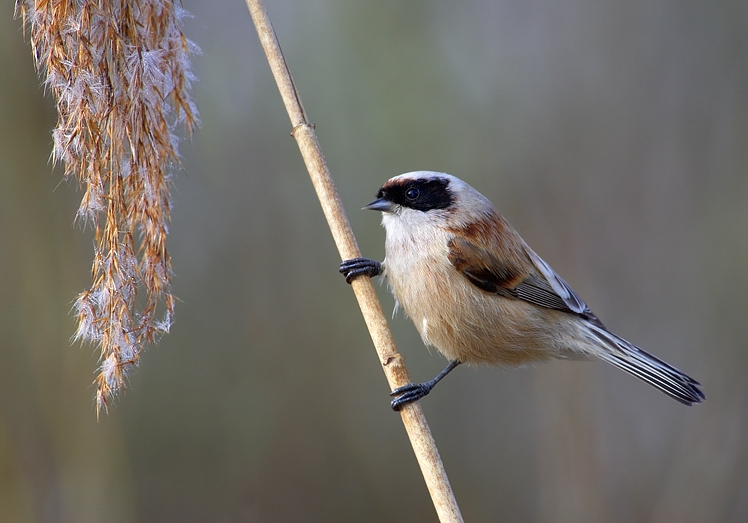
Eurasian Penduline Tit
Remiz pendulinus
Martin Mecnarowski (http://www.photomecan.eu/), CC BY-SA 3.0, via Wikimedia Commons


Side by side
| Eurasian Penduline Tit | White-crowned Penduline Tit | |
|---|---|---|
| Scientific name | Remiz pendulinus (Linnaeus, 1758) | Remiz coronatus (Severtsov, 1873) |
| English name | Eurasian Penduline Tit | White-crowned Penduline Tit |
| Group | Birds | Birds |
| Class | Aves Bird | Aves Bird |
| Order | Passeriformes Passerine | Passeriformes Passerine |
| Family | Remizidae Penduline Tit | Remizidae Penduline Tit |
| Genus | Remiz Typical Penduline-Tits | Remiz Typical Penduline-Tits |
| Named in | 1758 | 1873 |
| Red List category | Least Concern | Least Concern |
| Environment | terrestrial | Not recorded |
| Countries on record | 61 countries | 13 countries |
| GBIF occurrence records | 270,649 records | 2,384 records |
Rows where the two agree are shown in grey.
Where each is found
Both recorded in 9 countries
Only Eurasian Penduline Tit (52)
- Aland Islands
- Albania
- Armenia
- Austria
- Azerbaijan
- Belarus
- Belgium
- Bosnia and Herzegovina
- Bulgaria
- Croatia
- Cyprus
- Czechia
- Denmark
- Estonia
- Finland
- France
- Georgia
- Germany
- Greece
- Hungary
- Iraq
- Ireland
- Israel
- Italy
- Japan
- Jordan
- Kosovo
- Kuwait
- Latvia
- Lebanon
- Lithuania
- Luxembourg
- Moldova
- Montenegro
- North Macedonia
- Norway
- Palestinian Territory
- Poland
- Portugal
- Romania
- Saudi Arabia
- Serbia
- Slovakia
- Slovenia
- South Korea
- Sweden
- Switzerland
- Syria
- The Netherlands
- Turkey
- Ukraine
- United Kingdom
Only White-crowned Penduline Tit (4)
From Catalogue of Life checklists and GBIF occurrence records. A country missing from a list means no record is held, which is not proof of absence.
Checked facts
| Eurasian Penduline Tit | White-crowned Penduline Tit | |
|---|---|---|
| Appearance |
| No checked fact yet |
| Size |
| No checked fact yet |
| Habitat |
|
|
| Diet |
| No checked fact yet |
| Behaviour |
|
|
| Reproduction |
|
|
| Distribution |
|
|
| Conservation |
| No checked fact yet |
| Other |
|
|
In brief
Eurasian Penduline Tit
Remiz pendulinus occurs across much of the western Palearctic. It has a light grey head, a black facial mask, a chestnut-brown back, a sharply pointed bill and a relatively long tail. Full profile
White-crowned Penduline Tit
Remiz coronatus breeds across Central Asia, eastern Kazakhstan, and northern Mongolia, has an isolated year-round population in northern China, and winters in eastern Iran and Pakistan. It constructs intricate, enclosed, pouch-like nests with small tubular entrances, suspended from tree branches. Full profile
Compare something else
Page built on 28 November 2026 from the data on the two species pages, where every source is listed.
Cite this page
ScientificNames.org. (2026). Eurasian Penduline Tit vs White-crowned Penduline Tit. Retrieved November 28, 2026, from https://scientificnames.org/compare/eurasian-penduline-tit-vs-white-crowned-penduline-tit
“Eurasian Penduline Tit vs White-crowned Penduline Tit.” ScientificNames.org, 2026, scientificnames.org/compare/eurasian-penduline-tit-vs-white-crowned-penduline-tit. Accessed 28 Nov. 2026.
ScientificNames.org. “Eurasian Penduline Tit vs White-crowned Penduline Tit.” Accessed November 28, 2026. https://scientificnames.org/compare/eurasian-penduline-tit-vs-white-crowned-penduline-tit.
@misc{scientificnames_eurasian_penduline_tit_vs_white_crowned_penduline_tit,
  author = {{ScientificNames.org}},
  title = {Eurasian Penduline Tit vs White-crowned Penduline Tit},
  year = {2026},
  url = {https://scientificnames.org/compare/eurasian-penduline-tit-vs-white-crowned-penduline-tit},
  note = {Accessed 2026-11-28}
}