Comparison
Rhaponticum nitidum vs Russian Knapweed
Rhaponticum nitidum (Rhaponticum nitidum) and Russian Knapweed (Rhaponticum repens) both belong to the genus Rhaponticum and part ways below it. Both are recorded in 2 countries.
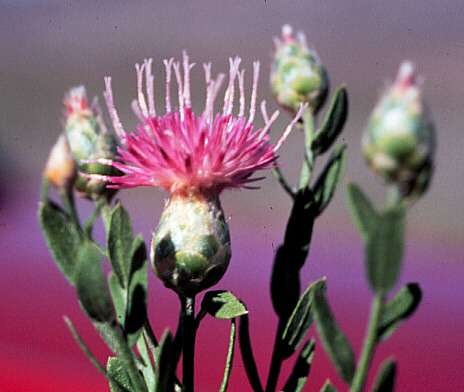

Side by side
| Rhaponticum nitidum | Russian Knapweed | |
|---|---|---|
| Scientific name | Rhaponticum nitidum Fisch. ex DC. | Rhaponticum repens (L.) Hidalgo |
| English name | Not recorded | Russian Knapweed |
| Group | Flowering plants | Flowering plants |
| Class | Magnoliopsida | Magnoliopsida |
| Order | Asterales | Asterales |
| Family | Asteraceae Composite | Asteraceae Composite |
| Genus | Rhaponticum | Rhaponticum |
| Countries on record | 2 countries | 41 countries |
| GBIF occurrence records | 29 records | 9,299 records |
Rows where the two agree are shown in grey.
Where each is found
Both recorded in 2 countries
Only Russian Knapweed (39)
- Afghanistan
- Argentina
- Armenia
- Australia
- Azerbaijan
- Belarus
- Belgium
- Canada
- China
- Denmark
- Finland
- France
- Georgia
- Germany
- India
- Iran
- Iraq
- Italy
- Kyrgyzstan
- Latvia
- Lithuania
- Luxembourg
- Mexico
- Mongolia
- Pakistan
- Poland
- Romania
- Russia
- Slovakia
- South Africa
- Spain
- Sweden
- Tajikistan
- The Netherlands
- Turkey
- Turkmenistan
- Ukraine
- United Kingdom
- United States
From Catalogue of Life checklists and GBIF occurrence records. A country missing from a list means no record is held, which is not proof of absence.
Checked facts
| Rhaponticum nitidum | Russian Knapweed | |
|---|---|---|
| Appearance | No checked fact yet |
|
| Size | No checked fact yet |
|
| Habitat | No checked fact yet |
|
| Reproduction | No checked fact yet |
|
| Distribution | No checked fact yet |
|
In brief
Russian Knapweed
The species forms dense colonies in cultivated fields and is widespread across the United States, particularly in western regions, being absent only from the southeastern region. The plant has a bushy, rhizomatous growth form and produces numerous pink to purplish flower heads at the ends of its branches. Full profile
Compare something else
Page built on 28 November 2026 from the data on the two species pages, where every source is listed.
Cite this page
ScientificNames.org. (2026). Rhaponticum nitidum vs Russian Knapweed. Retrieved November 28, 2026, from https://scientificnames.org/compare/rhaponticum-nitidum-vs-russian-knapweed
“Rhaponticum nitidum vs Russian Knapweed.” ScientificNames.org, 2026, scientificnames.org/compare/rhaponticum-nitidum-vs-russian-knapweed. Accessed 28 Nov. 2026.
ScientificNames.org. “Rhaponticum nitidum vs Russian Knapweed.” Accessed November 28, 2026. https://scientificnames.org/compare/rhaponticum-nitidum-vs-russian-knapweed.
@misc{scientificnames_rhaponticum_nitidum_vs_russian_knapweed,
  author = {{ScientificNames.org}},
  title = {Rhaponticum nitidum vs Russian Knapweed},
  year = {2026},
  url = {https://scientificnames.org/compare/rhaponticum-nitidum-vs-russian-knapweed},
  note = {Accessed 2026-11-28}
}