Comparison
Northern Black Currant vs Gooseberry
Northern Black Currant (Ribes hudsonianum) and Gooseberry (Ribes uva-crispa) both belong to the genus Ribes (currant) and part ways below it. Both are recorded in 2 countries.
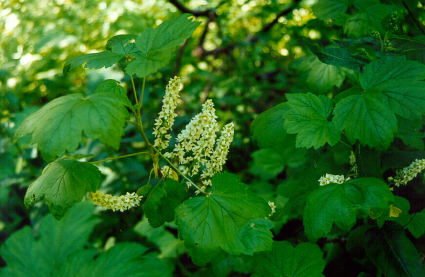
Northern Black Currant
Ribes hudsonianum
Unknown authorUnknown author, Public domain, via Wikimedia Commons


Side by side
| Northern Black Currant | Gooseberry | |
|---|---|---|
| Scientific name | Ribes hudsonianum Richardson | Ribes uva-crispa L. |
| English name | Northern Black Currant | Gooseberry |
| Group | Flowering plants | Flowering plants |
| Class | Magnoliopsida | Magnoliopsida |
| Order | Saxifragales | Saxifragales |
| Family | Grossulariaceae Currant Family | Grossulariaceae Currant Family |
| Genus | Ribes Currant | Ribes Currant |
| Countries on record | 2 countries | 63 countries |
| GBIF occurrence records | 4,282 records | 234,103 records |
Rows where the two agree are shown in grey.
Where each is found
Both recorded in 2 countries
Only Gooseberry (61)
- Afghanistan
- Aland Islands
- Albania
- Algeria
- Andorra
- Armenia
- Australia
- Austria
- Azerbaijan
- Belarus
- Belgium
- Bosnia and Herzegovina
- Bulgaria
- China
- Croatia
- Czechia
- Denmark
- Estonia
- Finland
- France
- Georgia
- Germany
- Greece
- Guernsey
- Hungary
- Iceland
- India
- Iran
- Ireland
- Isle of Man
- Italy
- Japan
- Kazakhstan
- Kosovo
- Latvia
- Liechtenstein
- Lithuania
- Luxembourg
- Moldova
- Montenegro
- Morocco
- New Caledonia
- New Zealand
- North Macedonia
- Norway
- Poland
- Portugal
- Romania
- Russia
- Serbia
- Slovakia
- Slovenia
- South Korea
- Spain
- Sweden
- Switzerland
- Tajikistan
- The Netherlands
- Turkey
- Ukraine
- United Kingdom
From Catalogue of Life checklists and GBIF occurrence records. A country missing from a list means no record is held, which is not proof of absence.
Checked facts
| Northern Black Currant | Gooseberry | |
|---|---|---|
| Appearance |
|
|
| Size |
| No checked fact yet |
| Habitat |
|
|
| Diet |
| No checked fact yet |
| Behaviour | No checked fact yet |
|
| Reproduction | No checked fact yet |
|
| Lifespan | No checked fact yet |
|
| Distribution |
|
|
| Uses |
|
|
| Name origin |
| No checked fact yet |
In brief
Northern Black Currant
Ribes hudsonianum occurs in Canada and the United States, growing in moist wooded areas, rocky areas and humid forests across montane and subalpine environments. It is an upright shrub with an aromatic scent generally considered unpleasant and produces black, waxy berries that are very sour and somewhat bitter. Full profile
Gooseberry
The species is native to Europe, the Caucasus, and northern Africa, and is occasionally naturalized in scattered locations in North America. It is a straggling shrub with sharp spines, deeply crenated leaves, bell-shaped flowers, and berries that occur in several colours. Full profile
Compare something else
Page built on 26 November 2026 from the data on the two species pages, where every source is listed.
Cite this page
ScientificNames.org. (2026). Northern Black Currant vs Gooseberry. Retrieved November 26, 2026, from https://scientificnames.org/compare/northern-black-currant-vs-gooseberry
“Northern Black Currant vs Gooseberry.” ScientificNames.org, 2026, scientificnames.org/compare/northern-black-currant-vs-gooseberry. Accessed 26 Nov. 2026.
ScientificNames.org. “Northern Black Currant vs Gooseberry.” Accessed November 26, 2026. https://scientificnames.org/compare/northern-black-currant-vs-gooseberry.
@misc{scientificnames_northern_black_currant_vs_gooseberry,
  author = {{ScientificNames.org}},
  title = {Northern Black Currant vs Gooseberry},
  year = {2026},
  url = {https://scientificnames.org/compare/northern-black-currant-vs-gooseberry},
  note = {Accessed 2026-11-26}
}