Comparison

Risso's Dolphin vs False Killer Whale

Risso's Dolphin (Grampus griseus) and False Killer Whale (Pseudorca crassidens) both belong to the family Delphinidae (oceanic dolphin) and part ways below it. Both are recorded in 18 countries.

Risso's Dolphin

Risso's Dolphin

Grampus griseus

National Marine Mammal Laboratory, no individual author credit given, Public domain, via Wikimedia Commons
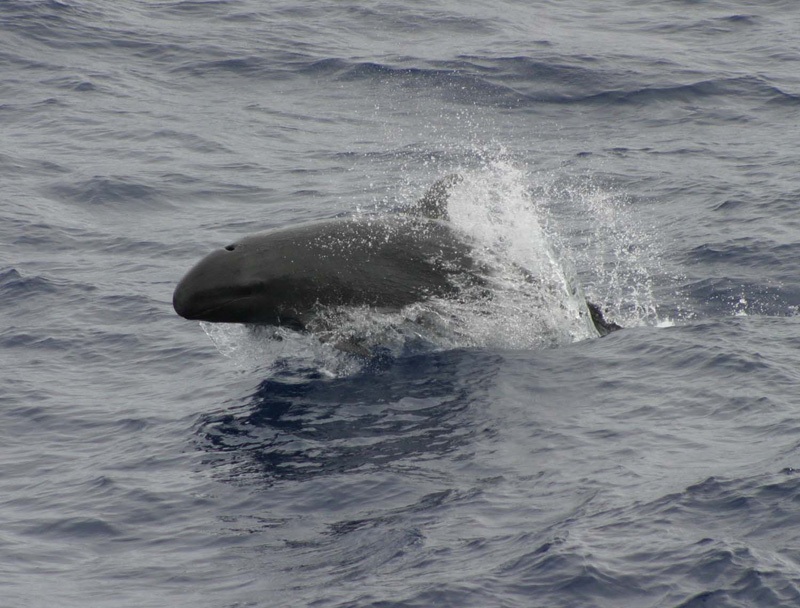
False Killer Whale

False Killer Whale

Pseudorca crassidens

Unknown author, Public domain, via Wikimedia Commons

Side by side

Risso's DolphinFalse Killer Whale
Scientific nameGrampus griseus (G. Cuvier, 1812)Pseudorca crassidens (Owen, 1846)
English nameRisso's DolphinFalse Killer Whale
GroupMammalsMammals
ClassMammalia MammalMammalia Mammal
OrderCetacea CetaceanCetacea Cetacean
FamilyDelphinidae Oceanic DolphinDelphinidae Oceanic Dolphin
GenusGrampusPseudorca False Killer Whales
Named in18121846
Red List categoryLeast ConcernNear Threatened
Environmentmarinemarine
Countries on record40 countries32 countries
GBIF occurrence records41,807 records9,197 records

Rows where the two agree are shown in grey.

Where each is found

Both recorded in 18 countries

Only Risso's Dolphin (22)

Only False Killer Whale (14)

From Catalogue of Life checklists and GBIF occurrence records. A country missing from a list means no record is held, which is not proof of absence.

Checked facts

Risso's DolphinFalse Killer Whale
Appearance
  • Risso's dolphins have a bulbous head with a vertical crease at the front. English Wikipedia
  • The species has a robust anterior body, a relatively large dorsal fin, and a posterior body that tapers toward a narrow tail. English Wikipedia
  • Most individuals have between two and seven pairs of teeth, all located in the lower jaw. English Wikipedia
  • The species has a blunt, squarish head and lacks the beak typical of other delphinids. animaldiversity.org
  • Its dorsal fin is tall and curved, while its flippers are long, pointed, and recurved. animaldiversity.org
  • The species has no teeth in its upper jaw. animaldiversity.org
  • The false killer whale has a slender, dark gray or black body with a slightly lighter underside. English Wikipedia
  • The species has an elongated, tapered head without a distinct beak. English Wikipedia
  • Its dorsal fin is sickle-shaped. English Wikipedia
  • Its flippers are narrow, short and pointed, with a distinctive bulge along their leading edges. English Wikipedia
  • Its teeth are conical, with 14–21 teeth in the upper jaw and 16–24 in the lower jaw. English Wikipedia
  • The melon organ in its forehead is larger in males than in females. English Wikipedia
SizeNo checked fact yet
Habitat
  • Risso's dolphins inhabit pelagic waters with a preference for steep underwater slopes. animaldiversity.org
  • The species is frequently found near continental shelf edges, seamounts, and submarine canyons. animaldiversity.org
  • Risso's dolphins commonly inhabit waters with temperatures between 15 and 20 degrees Celsius. animaldiversity.org
  • The species can inhabit waters as cold as approximately 10 degrees Celsius. animaldiversity.org
  • The species inhabits tropical and subtropical marine waters. English Wikipedia
  • It generally inhabits open-ocean and deep-water environments but sometimes occurs near oceanic islands. English Wikipedia
  • The species prefers deep water in the open ocean away from land. australian.museum
Diet
  • Risso's dolphins feed primarily on cephalopods. English Wikipedia
  • The species feeds almost exclusively on neritic and oceanic squid, mainly at night. English Wikipedia
  • The curled octopus is an important prey species for Risso's dolphins in Scottish waters. English Wikipedia
Behaviour
  • Risso's dolphins use echolocation to locate cephalopods and fish. English Wikipedia
  • Individuals can dive to depths exceeding 600 metres while searching for prey. English Wikipedia
  • Individuals commonly travel in groups containing between 10 and 51 dolphins. English Wikipedia
  • Groups sometimes aggregate into super-pods containing several thousand individuals. English Wikipedia
  • Social groups commonly contain subgroups organized by age or sex. English Wikipedia
  • Risso's dolphins frequently display their tail flukes and pectoral fins at the water surface. English Wikipedia
  • Individuals sometimes perform spy-hopping by vertically raising their heads above the water. English Wikipedia
  • Risso's dolphins spend approximately 77 percent of their time traveling. animaldiversity.org
  • Individuals spend approximately 13 percent of their time engaged in social activity. animaldiversity.org
  • The species is highly social and commonly travels in groups of 10–20 individuals. English Wikipedia
  • Large groups can contain more than 500 individuals. English Wikipedia
  • Feeding groups may divide into smaller family groups containing four to six individuals. English Wikipedia
  • Individuals have been recorded remaining with the same pod for as long as 15 years. English Wikipedia
  • It can interact sexually with bottlenose dolphins and pilot whales. English Wikipedia
  • The species uses echolocation to navigate and locate prey. English Wikipedia
  • The species is an efficient pack hunter. australian.museum
Reproduction
Distribution
  • The species occurs in temperate, subtropical, and tropical waters throughout the world's oceans. animaldiversity.org
  • Risso's dolphins occur in the Indian, Pacific, and Atlantic Oceans, as well as the Mediterranean, North, Red, and Baltic Seas. English Wikipedia
  • Risso's dolphins are commonly found along the western coasts of British Columbia, the United States, and Mexico. English Wikipedia
No checked fact yet
Conservation
  • Risso's dolphins are protected in the United States under the Marine Mammal Protection Act of 1992. English Wikipedia
  • Populations in the North, Baltic, and Mediterranean Seas are listed in Appendix II of the Convention on the Conservation of Migratory Species of Wild Animals. English Wikipedia
  • The IUCN classifies the species as Near Threatened. English Wikipedia
  • The Hawaiian population was recognized as endangered by the United States National Oceanic and Atmospheric Administration in November 2012. English Wikipedia
  • Incidental deaths associated with fishing operations are a threat to the species. australian.museum
  • Some populations, particularly those off Japan and parts of Asia, are deliberately hunted. australian.museum
  • The species is captured for the oceanarium trade. australian.museum
  • Fishing-gear entanglement can cause drowning, restricted circulation and impaired hunting ability. English Wikipedia
  • The species is covered by the Agreement on the Conservation of Small Cetaceans of the Baltic, North East Atlantic, Irish and North Seas. English Wikipedia
UsesNo checked fact yet
  • False killer whales have been kept in public aquariums in Japan, the United States, the Netherlands, Hong Kong and Australia. English Wikipedia
Similar species
  • Risso's dolphins may be confused with bottlenose dolphins, false killer whales, and killer whales. animaldiversity.org
  • The false killer whale's closest living relatives include Risso's dolphin, the melon-headed whale, the pygmy killer whale and pilot whales. English Wikipedia
  • The species can hybridize with the common bottlenose dolphin to produce fertile offspring known as wholphins. English Wikipedia
Name origin
  • The species is named after Antoine Risso, whose research contributed to its recognized description by Georges Cuvier in 1812. English Wikipedia
  • The specific epithet griseus refers to the mottled grey coloration of the species. English Wikipedia
  • The common name refers to the resemblance between the species' skull and that of the killer whale. English Wikipedia
Other
  • Risso's dolphin is the only species belonging to the genus Grampus. English Wikipedia
No checked fact yet

In brief

Risso's Dolphin

Risso's Dolphin (Grampus griseus) is a mammal belonging to the family Delphinidae, order Cetacea, and class Mammalia. It occurs in temperate, subtropical, and tropical waters throughout the world's oceans. Full profile

False Killer Whale

Pseudorca crassidens inhabits tropical and subtropical marine waters, primarily in open-ocean and deep-water environments. It has a slender, dark gray or black body, an elongated tapered head without a distinct beak and a sickle-shaped dorsal fin. Full profile

Compare something else

Page built on 28 November 2026 from the data on the two species pages, where every source is listed.

Cite this page

ScientificNames.org. (2026). Risso's Dolphin vs False Killer Whale. Retrieved November 28, 2026, from https://scientificnames.org/compare/rissos-dolphin-vs-false-killer-whale