Comparison

Rock Kestrel vs Gyrfalcon

Rock Kestrel (Falco rupicolus) and Gyrfalcon (Falco rusticolus) both belong to the genus Falco (falcons) and part ways below it.

Rock Kestrel

Rock Kestrel

Falco rupicolus

The original uploader was Dawidl at English Wikipedia., CC BY 3.0, via Wikimedia Commons

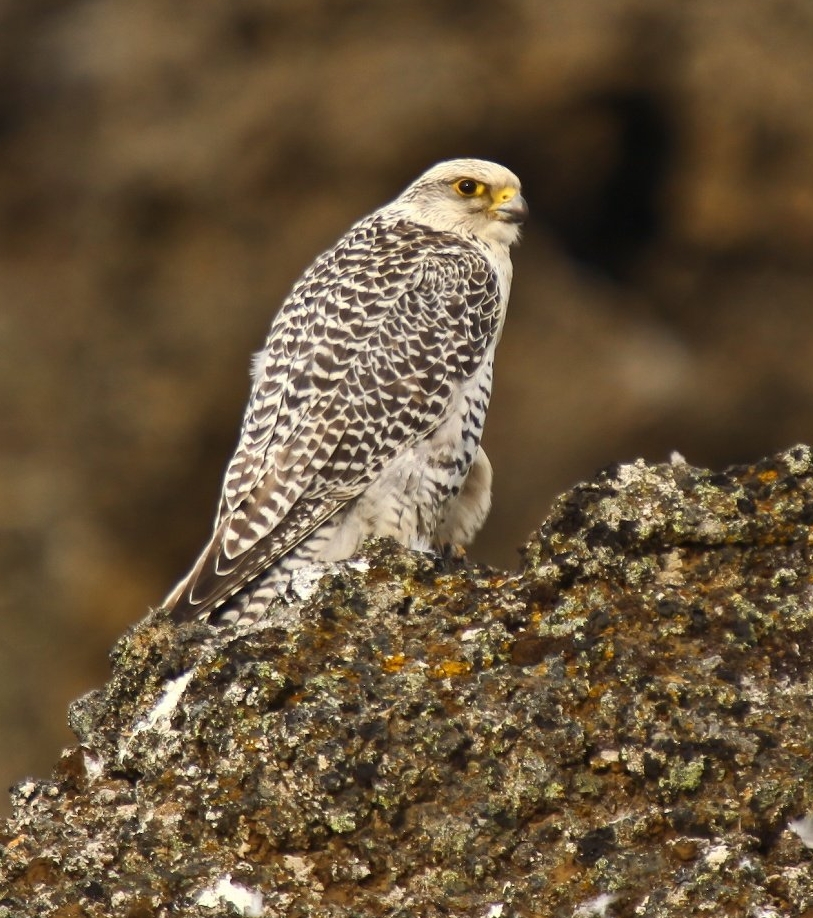
Gyrfalcon

Gyrfalcon

Falco rusticolus

Falco_rusticolus_white.jpg: Ólafur Larsen derivative work: Bogbumper (talk), CC BY-SA 2.0, via Wikimedia Commons

Side by side

Rock KestrelGyrfalcon
Scientific nameFalco rupicolus Daudin, 1800Falco rusticolus Linnaeus, 1758
English nameRock KestrelGyrfalcon
GroupBirdsBirds
ClassAves BirdAves Bird
OrderFalconiformes FalconsFalconiformes Falcons
FamilyFalconidae FalconsFalconidae Falcons
GenusFalco FalconsFalco Falcons
Named in18001758
Red List categoryNot recordedLeast Concern
EnvironmentNot recordedterrestrial
Countries on record13 countries24 countries
GBIF occurrence records96,114 records26,842 records

Rows where the two agree are shown in grey.

Where each is found

Only Rock Kestrel (13)

Only Gyrfalcon (24)

From Catalogue of Life checklists and GBIF occurrence records. A country missing from a list means no record is held, which is not proof of absence.

Checked facts

Rock KestrelGyrfalcon
Appearance
  • The Rock Kestrel has paler underwings than the Eurasian Kestrel. ebird.org
  • The gyrfalcon exhibits plumage colours ranging from entirely white to dark grey-brown. English Wikipedia
  • The species has four principal colour morphs: white, silver, brown and black. English Wikipedia
  • Juvenile gyrfalcons have darker and browner plumage than adults. English Wikipedia
  • Adult gyrfalcons have yellow ceres, eye-rings and legs, whereas juveniles have blue versions of these features. animaldiversity.org
  • The gyrfalcon has long pointed wings, a long tail and a notched bill. animaldiversity.org
  • The Greenland population most commonly exhibits white plumage flecked with grey on the back and wings. English Wikipedia
Size
Habitat
Diet
  • The Rock Kestrel feeds primarily on invertebrates. English Wikipedia
  • The Rock Kestrel also consumes rodents, reptiles, and birds. English Wikipedia
  • The Rock Kestrel catches small prey such as insects while hovering and generally consumes this prey during flight. English Wikipedia
  • The Rock Kestrel has been observed eating insects flushed out by baboons moving through grasslands. English Wikipedia
  • The Rock Kestrel has been reported eating termites on the ground. English Wikipedia
Behaviour
  • The Rock Kestrel uses hovering and perching as two principal hunting methods. English Wikipedia
  • During hover hunting, the Rock Kestrel remains stationary in the air while using updrafts and minimal wing flapping. English Wikipedia
  • The Rock Kestrel generally hunts by hovering when wind speeds are medium to high. English Wikipedia
  • The Rock Kestrel uses natural and artificial elevated perches to search for prey. English Wikipedia
  • The Rock Kestrel gives a harsh repeated chay-chay-chay call, particularly when driving away intruders. English Wikipedia
  • The Rock Kestrel has also been reported raiding nests to take young birds. English Wikipedia
  • The Rock Kestrel produces a high, repeated kreek call. ebird.org
  • Gyrfalcons may cache large prey items, including Arctic hares, between feeding periods during nesting. animaldiversity.org
  • Gyrfalcons generally hunt, forage and roost alone outside the breeding season. animaldiversity.org
  • Gyrfalcons are generally non-migratory but may disperse from their breeding range during winter. animaldiversity.org
Reproduction
  • The Rock Kestrel usually nests in old stick nests or on cliffs. English Wikipedia
  • When nesting on cliffs, the Rock Kestrel may create a depression in the sand. English Wikipedia
  • The Rock Kestrel has occasionally been observed nesting in buildings. English Wikipedia
  • Rock Kestrel clutches contain between one and six eggs. English Wikipedia
  • The female Rock Kestrel incubates the eggs continuously while the male obtains food. English Wikipedia
  • Rock Kestrel eggs hatch after an incubation period of 26 to 32 days. English Wikipedia
  • Rock Kestrel chicks remain in the nest for 31 to 39 days after hatching. English Wikipedia
  • After leaving the nest, young Rock Kestrels often remain nearby for several weeks. English Wikipedia
  • A study in Namibia recorded Rock Kestrel breeding densities of 19.1 to 28.9 pairs per 100 square kilometers. English Wikipedia
  • Gyrfalcons generally nest on cliff faces and frequently reuse abandoned nests belonging to other birds. English Wikipedia
  • Gyrfalcon clutches usually contain two to four eggs. English Wikipedia
  • The average gyrfalcon egg measures approximately 58.46 × 45 mm. English Wikipedia
  • Gyrfalcon eggs have an average incubation period of 35 days. English Wikipedia
  • Gyrfalcon nestlings generally leave the nest at seven to eight weeks of age. English Wikipedia
  • Immature gyrfalcons become independent of their parents at three to four months of age. English Wikipedia
  • Gyrfalcons in the studied northern populations generally lay eggs near the end of April. animaldiversity.org
LifespanNo checked fact yet
Distribution
  • The Rock Kestrel occurs in Africa from northwestern Angola and southern Democratic Republic of Congo to southern Tanzania and southward to South Africa. English Wikipedia
Conservation
  • The gyrfalcon is classified as Least Concern on the IUCN Red List. English Wikipedia
  • Pesticide pollution depressed gyrfalcon populations during the mid-twentieth century. English Wikipedia
  • Improved environmental standards in developed countries have contributed to the recovery of gyrfalcon populations. English Wikipedia
UsesNo checked fact yet
  • The gyrfalcon is the official bird of Canada's Northwest Territories. English Wikipedia
Similar species
  • The Rock Kestrel was previously classified as a subspecies of the Common Kestrel. English Wikipedia
  • The Rock Kestrel is very similar to the Eurasian Kestrel. ebird.org
No checked fact yet

In brief

Rock Kestrel

Falco rupicolus occurs in Africa from northwestern Angola and southern Democratic Republic of Congo to southern Tanzania and southward to South Africa. Full profile

Gyrfalcon

Falco rusticolus has a Holarctic distribution, with most of its breeding range north of 60 degrees latitude. It exhibits four principal colour morphs: white, silver, brown and black. Full profile

Compare something else

Page built on 26 November 2026 from the data on the two species pages, where every source is listed.

Cite this page

ScientificNames.org. (2026). Rock Kestrel vs Gyrfalcon. Retrieved November 26, 2026, from https://scientificnames.org/compare/rock-kestrel-vs-gyrfalcon