Comparison

Rosy-throated Longclaw vs Cape Longclaw

Rosy-throated Longclaw (Macronyx ameliae) and Cape Longclaw (Macronyx capensis) both belong to the genus Macronyx (longclaw) and part ways below it. Both are recorded in 5 countries.
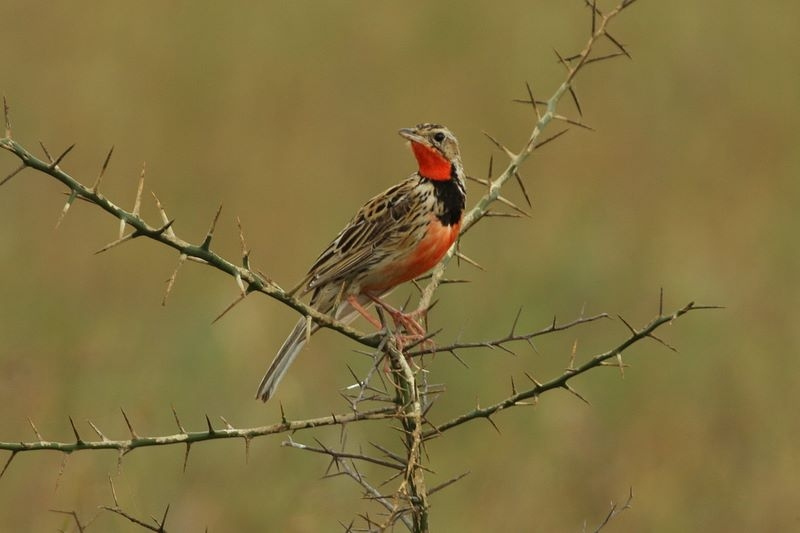
Rosy-throated Longclaw

Rosy-throated Longclaw

Macronyx ameliae

Demetrius John Kessy from Arusha, Tanzania, CC BY 2.0, via Wikimedia Commons

Cape Longclaw

Cape Longclaw

Macronyx capensis

Alan Manson, CC BY-SA 3.0, via Wikimedia Commons

Side by side

Rosy-throated LongclawCape Longclaw
Scientific nameMacronyx ameliae Tarragon, 1845Macronyx capensis (Linnaeus, 1766)
English nameRosy-throated LongclawCape Longclaw
GroupBirdsBirds
ClassAves BirdAves Bird
OrderPasseriformes PasserinePasseriformes Passerine
FamilyMotacillidae PipitsMotacillidae Pipits
GenusMacronyx LongclawMacronyx Longclaw
Named in18451766
Red List categoryLeast ConcernLeast Concern
Countries on record11 countries7 countries
GBIF occurrence records6,297 records46,656 records

Rows where the two agree are shown in grey.

Where each is found

Both recorded in 5 countries

Only Rosy-throated Longclaw (6)

Only Cape Longclaw (2)

From Catalogue of Life checklists and GBIF occurrence records. A country missing from a list means no record is held, which is not proof of absence.

Checked facts

Rosy-throated LongclawCape Longclaw
Appearance
  • Adult birds have greyish-brown upperparts with a scalloped pattern. English Wikipedia
  • Adult males have a pink throat and breast with a broad black band across the chest. English Wikipedia
  • The male's black chest band is not evident outside the breeding season. English Wikipedia
  • Females have pink underparts but lack the black chest band. English Wikipedia
  • Immature birds have mainly pale brown underparts marked with black streaks and some central pink-red colouring. English Wikipedia
  • The species is described as pink below and streaked brown above. ebird.org
  • Females are less heavily marked than males. ebird.org
  • Adult males have grey heads, buff supercilia, and streaked blackish backs. English Wikipedia
  • Adult males have bright orange throats, black breast bands, and otherwise yellow underparts. English Wikipedia
  • Females have duller plumage, yellow throats, and much weaker breast bands than males. English Wikipedia
  • Juveniles have dirty yellow throats, indistinct breast bands, and yellowish-white underparts. English Wikipedia
  • The Cape Longclaw has brown, cryptically coloured upperparts. ebird.org
  • The Cape Longclaw has a deep orange throat bordered by a broad marking. ebird.org
Size
  • Adult rosy-throated longclaws measure 19–20 centimetres in length. English Wikipedia
Habitat
  • The species inhabits subtropical or tropical lowland grasslands that are seasonally wet or flooded. English Wikipedia
  • The species occurs in wet grasslands and flood plains, often where the grasses are shorter. English Wikipedia
  • The species inhabits coastal and mountain grasslands, often near water. English Wikipedia
DietNo checked fact yet
Behaviour
  • The species produces a chiteet call resembling the call of a pipit. English Wikipedia
Reproduction
  • The rosy-throated longclaw breeds during the wet season from September through April. English Wikipedia
No checked fact yet
Distribution
  • The rosy-throated longclaw occurs in Angola, Botswana, the Democratic Republic of the Congo, Kenya, Malawi, Mozambique, Namibia, South Africa, Tanzania, Zambia, and Zimbabwe. English Wikipedia
  • The nominate subspecies Macronyx ameliae ameliae occurs in Mozambique, Eswatini, and eastern South Africa. English Wikipedia
  • Macronyx ameliae wintoni occurs in southwestern Kenya and northern Tanzania. English Wikipedia
  • Macronyx ameliae altanus occurs in Botswana, Angola, Malawi, southwestern Tanzania, Zimbabwe, and Zambia. English Wikipedia
  • In Botswana and Namibia, the species is restricted to the Okavango Delta, Linyanti Marshes, and Chobe floodplains. English Wikipedia
  • In Zimbabwe, the species is restricted to the highveld. English Wikipedia
  • In KwaZulu-Natal, the species occurs in coastal areas. English Wikipedia
  • The Cape Longclaw occurs in Zimbabwe and southern and eastern South Africa. English Wikipedia
  • The subspecies Macronyx capensis capensis occurs in southwestern and southern South Africa. English Wikipedia
  • The subspecies Macronyx capensis colletti occurs from southeastern Botswana and Zimbabwe to Mozambique and eastern South Africa. English Wikipedia
Conservation
  • The species' occurrence in KwaZulu-Natal is threatened by coastal development. English Wikipedia
  • The species has an extremely large geographic range and does not meet the range-size thresholds for Vulnerable status. datazone.birdlife.org
Similar speciesNo checked fact yet
  • The Cape Longclaw closely resembles meadowlarks, although those birds belong to the unrelated icterid family. English Wikipedia
Name origin
  • The species was described by Marquis Léonce de Tarragon in 1845, and its specific name honours either his wife or his mother, both named Amélie. English Wikipedia
  • Richard Bowdler Sharpe introduced the name Macronyx wintoni in 1891 in honour of William Edward de Winton. English Wikipedia
Other
  • Two subspecies of the Cape Longclaw are recognised. English Wikipedia
  • The Cape Longclaw was assessed for the IUCN Red List on 12 June 2024. iucnredlist.org
  • The Cape Longclaw is described as a large ground-dwelling bird with a pipit-like appearance. ebird.org

In brief

Rosy-throated Longclaw

Macronyx ameliae occurs in Angola, Botswana, the Democratic Republic of the Congo, Kenya, Malawi, Mozambique, Namibia, South Africa, Tanzania, Zambia, and Zimbabwe. It is pink below and streaked brown above, with adult males having a broad black band across the chest. Full profile

Cape Longclaw

Macronyx capensis occurs in Zimbabwe and southern and eastern South Africa. Full profile

Compare something else

Page built on 29 November 2026 from the data on the two species pages, where every source is listed.

Cite this page

ScientificNames.org. (2026). Rosy-throated Longclaw vs Cape Longclaw. Retrieved November 29, 2026, from https://scientificnames.org/compare/rosy-throated-longclaw-vs-cape-longclaw