Comparison

Rosy-throated Longclaw vs Sharpe's Longclaw

Rosy-throated Longclaw (Macronyx ameliae) and Sharpe's Longclaw (Macronyx sharpei) both belong to the genus Macronyx (longclaw) and part ways below it. Both are recorded in 1 country.
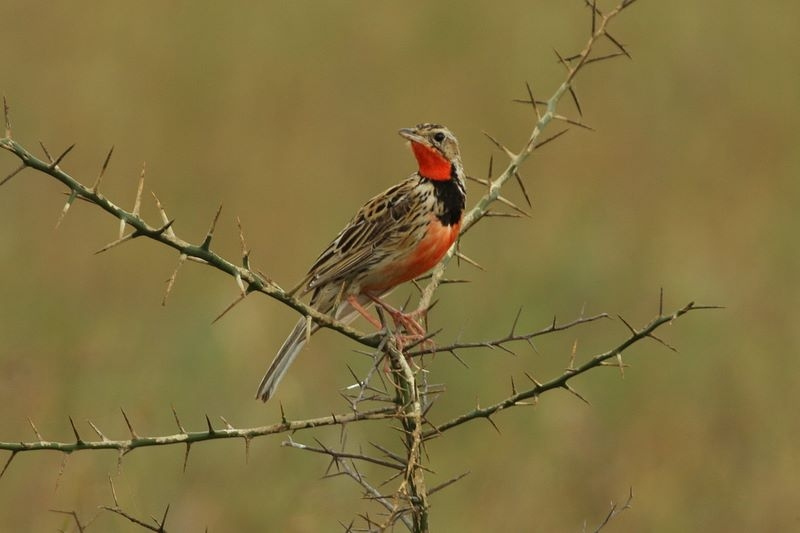
Rosy-throated Longclaw

Rosy-throated Longclaw

Macronyx ameliae

Demetrius John Kessy from Arusha, Tanzania, CC BY 2.0, via Wikimedia Commons

Sharpe's Longclaw

Sharpe's Longclaw

Macronyx sharpei

John Gerrard Keulemans, Public domain, via Wikimedia Commons

Side by side

Rosy-throated LongclawSharpe's Longclaw
Scientific nameMacronyx ameliae Tarragon, 1845Macronyx sharpei Jackson, 1904
English nameRosy-throated LongclawSharpe's Longclaw
GroupBirdsBirds
ClassAves BirdAves Bird
OrderPasseriformes PasserinePasseriformes Passerine
FamilyMotacillidae PipitsMotacillidae Pipits
GenusMacronyx LongclawMacronyx Longclaw
Named in18451904
Red List categoryLeast ConcernEndangered
Countries on record11 countries2 countries
GBIF occurrence records6,297 records1,033 records

Rows where the two agree are shown in grey.

Where each is found

Both recorded in 1 country

Only Rosy-throated Longclaw (10)

Only Sharpe's Longclaw (1)

From Catalogue of Life checklists and GBIF occurrence records. A country missing from a list means no record is held, which is not proof of absence.

Checked facts

Rosy-throated LongclawSharpe's Longclaw
Appearance
  • Adult birds have greyish-brown upperparts with a scalloped pattern. English Wikipedia
  • Adult males have a pink throat and breast with a broad black band across the chest. English Wikipedia
  • The male's black chest band is not evident outside the breeding season. English Wikipedia
  • Females have pink underparts but lack the black chest band. English Wikipedia
  • Immature birds have mainly pale brown underparts marked with black streaks and some central pink-red colouring. English Wikipedia
  • The species is described as pink below and streaked brown above. ebird.org
  • Females are less heavily marked than males. ebird.org
  • The bird has upperparts heavily marked with buff and rufous streaks, yellow underparts, and white outer tail feathers visible in flight. English Wikipedia
  • The species is described as a small, attractive member of the pipit family. ebird.org
Size
  • Adult rosy-throated longclaws measure 19–20 centimetres in length. English Wikipedia
No checked fact yet
Habitat
  • The species inhabits subtropical or tropical lowland grasslands that are seasonally wet or flooded. English Wikipedia
  • The species occurs in wet grasslands and flood plains, often where the grasses are shorter. English Wikipedia
  • The species inhabits open, treeless grasslands with short, often tussocky grasses. English Wikipedia
  • The species occurs at elevations between 1,850 and 3,400 metres, although it is more commonly found below 2,800 metres. English Wikipedia
DietNo checked fact yet
  • The species feeds on insects, particularly grasshoppers and beetles, as well as other invertebrates. English Wikipedia
  • The species has a higher feeding rate in grasslands containing tussocks. English Wikipedia
Behaviour
  • The species produces a chiteet call resembling the call of a pipit. English Wikipedia
  • The species generally does not migrate, but may move short distances when its habitat becomes excessively dry. English Wikipedia
  • The species forages alone, in pairs, or occasionally in small family groups. English Wikipedia
  • The bird produces a song consisting of a series of sharp calls followed by a longer metallic call. ebird.org
Reproduction
  • The rosy-throated longclaw breeds during the wet season from September through April. English Wikipedia
  • The species breeds monogamously and solitarily, defending an individual territory. English Wikipedia
  • The breeding season occurs during or after the rains, in March–June, September–October, and December. English Wikipedia
  • During its breeding display, the bird flies upwards and then descends while singing rapidly. English Wikipedia
  • The nest is a cup made of dried grass and lined with roots, positioned near the ground in a grass tussock or beneath vegetation. English Wikipedia
  • The species lays clutches of two or three eggs. English Wikipedia
Distribution
  • The rosy-throated longclaw occurs in Angola, Botswana, the Democratic Republic of the Congo, Kenya, Malawi, Mozambique, Namibia, South Africa, Tanzania, Zambia, and Zimbabwe. English Wikipedia
  • The nominate subspecies Macronyx ameliae ameliae occurs in Mozambique, Eswatini, and eastern South Africa. English Wikipedia
  • Macronyx ameliae wintoni occurs in southwestern Kenya and northern Tanzania. English Wikipedia
  • Macronyx ameliae altanus occurs in Botswana, Angola, Malawi, southwestern Tanzania, Zimbabwe, and Zambia. English Wikipedia
  • In Botswana and Namibia, the species is restricted to the Okavango Delta, Linyanti Marshes, and Chobe floodplains. English Wikipedia
  • In Zimbabwe, the species is restricted to the highveld. English Wikipedia
  • In KwaZulu-Natal, the species occurs in coastal areas. English Wikipedia
  • The species is endemic to Kenya. English Wikipedia
  • The species occurs in the highlands of western and central Kenya. English Wikipedia
  • Its documented range includes the northern slopes of Mount Kenya, southern slopes of the Aberdares, Gishu, Mau and Kinangop Plateaus, and the Kenyan slopes of Mount Elgon. English Wikipedia
  • The species may also occur on the Ugandan slopes of Mount Elgon. English Wikipedia
Conservation
  • The species' occurrence in KwaZulu-Natal is threatened by coastal development. English Wikipedia
  • The species is classified as endangered. English Wikipedia
  • The estimated population of the species is fewer than 20,000 individuals. English Wikipedia
  • The species' grassland habitat is threatened by replacement with cultivated land and woodlots. English Wikipedia
Similar speciesNo checked fact yet
  • The species is closely related to the yellow-breasted pipit, and the two form a superspecies. English Wikipedia
  • Some ornithologists classify Sharpe's longclaw together with the yellow-breasted pipit in the separate genus Hemimacronyx. English Wikipedia
  • Sharpe's longclaw occurs at higher elevations than the yellow-throated longclaw, with little overlap between their ranges. English Wikipedia
Name origin
  • The species was described by Marquis Léonce de Tarragon in 1845, and its specific name honours either his wife or his mother, both named Amélie. English Wikipedia
  • Richard Bowdler Sharpe introduced the name Macronyx wintoni in 1891 in honour of William Edward de Winton. English Wikipedia
No checked fact yet
OtherNo checked fact yet

In brief

Rosy-throated Longclaw

Macronyx ameliae occurs in Angola, Botswana, the Democratic Republic of the Congo, Kenya, Malawi, Mozambique, Namibia, South Africa, Tanzania, Zambia, and Zimbabwe. It is pink below and streaked brown above, with adult males having a broad black band across the chest. Full profile

Sharpe's Longclaw

Macronyx sharpei inhabits open, treeless grasslands in the highlands of western and central Kenya. It has yellow underparts, heavily streaked upperparts and white outer tail feathers visible in flight. Full profile

Compare something else

Page built on 27 November 2026 from the data on the two species pages, where every source is listed.

Cite this page

ScientificNames.org. (2026). Rosy-throated Longclaw vs Sharpe's Longclaw. Retrieved November 27, 2026, from https://scientificnames.org/compare/rosy-throated-longclaw-vs-sharpes-longclaw