Comparison

Rufous-backed Sibia vs Jungle Babbler

Rufous-backed Sibia (Leioptila annectens) and Jungle Babbler (Argya striata) both belong to the family Leiothrichidae (laughingthrush) and part ways below it. Both are recorded in 2 countries.
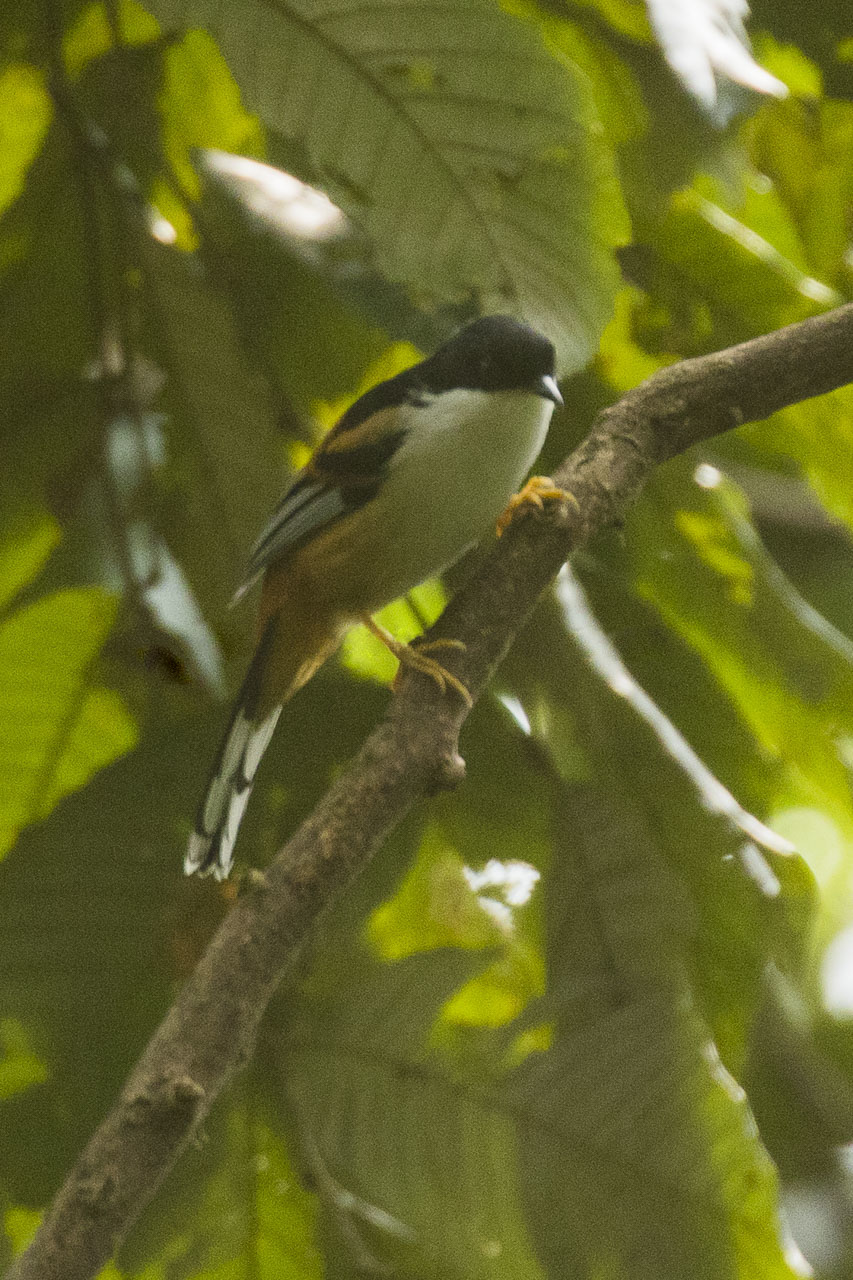
Rufous-backed Sibia

Rufous-backed Sibia

Leioptila annectens

Francesco Veronesi from Italy, CC BY-SA 2.0, via Wikimedia Commons

Jungle Babbler

Jungle Babbler

Argya striata

Dr. Raju Kasambe, CC BY-SA 4.0, via Wikimedia Commons

Side by side

Rufous-backed SibiaJungle Babbler
Scientific nameLeioptila annectens Blyth, 1847Argya striata (Dumont, 1823)
English nameRufous-backed SibiaJungle Babbler
GroupBirdsBirds
ClassAves BirdAves Bird
OrderPasseriformes PasserinePasseriformes Passerine
FamilyLeiothrichidae LaughingthrushLeiothrichidae Laughingthrush
GenusLeioptilaArgya
Named in18471823
Red List categoryLeast ConcernLeast Concern
Countries on record7 countries6 countries
GBIF occurrence records5,684 records455,997 records

Rows where the two agree are shown in grey.

Where each is found

Both recorded in 2 countries

Only Rufous-backed Sibia (5)

Only Jungle Babbler (4)

From Catalogue of Life checklists and GBIF occurrence records. A country missing from a list means no record is held, which is not proof of absence.

Checked facts

Rufous-backed SibiaJungle Babbler
Appearance
  • The species has a proportionally larger head and slightly shorter tail than other sibias. ebird.org
  • The sexes have identical plumage, which is predominantly brownish grey. English Wikipedia
  • The species has a yellow bill. English Wikipedia
  • Its upperparts are generally darker than the rest of its plumage. English Wikipedia
  • Its throat and breast have some mottling. English Wikipedia
  • The Maharashtra subspecies somervillei has a distinctly rufous tail and dark primary flight feathers. English Wikipedia
  • Young individuals have dark irises, whereas older individuals have pale creamy-coloured irises. English Wikipedia
Habitat
  • The species inhabits subtropical or tropical moist lowland forests. English Wikipedia
  • The species inhabits subtropical or tropical moist montane forests. English Wikipedia
  • The species inhabits foothill and montane forests. ebird.org
DietNo checked fact yet
  • The species feeds mainly on insects. English Wikipedia
  • The species also consumes grains, nectar and berries. English Wikipedia
  • A documented observation on October 9, 2018, recorded eight jungle babblers feeding on a house gecko of the genus Hemidactylus. academia.edu
Behaviour
  • The species travels through forests in pairs and flocks. ebird.org
  • The species is non-migratory. English Wikipedia
  • The species is highly social and gregarious. English Wikipedia
  • The species commonly forages in groups of six to ten individuals. English Wikipedia
  • Flocks typically contain seven to ten or more individuals. English Wikipedia
  • The species sometimes forms the core of mixed-species foraging flocks. English Wikipedia
  • Groups maintain territories and defend them against neighbouring groups, although neighbouring groups are sometimes tolerated. English Wikipedia
  • Some individuals act as sentinels from elevated vantage points while the group forages. English Wikipedia
  • Individuals gather and mob potential predators, including snakes. English Wikipedia
  • Members of a group engage in allopreening, play chases and mock fights. English Wikipedia
  • Individuals sometimes feign death when threatened by predators. English Wikipedia
  • Flocks produce harsh mewing calls, chattering, squeaking and chirping. English Wikipedia
ReproductionNo checked fact yet
  • The species breeds throughout the year. English Wikipedia
  • Peak breeding in northern India occurs between March and April and between July and September. English Wikipedia
  • Individuals reach sexual maturity after their third year. English Wikipedia
  • The nest is constructed halfway up a tree and concealed within dense foliage. English Wikipedia
  • The normal clutch contains three or four deep greenish-blue eggs, although clutches can contain as many as seven. English Wikipedia
  • Females generally leave their natal group at approximately two years of age. English Wikipedia
Distribution
  • The species occurs across the South Asian subcontinent. English Wikipedia
  • The nominate subspecies occurs across much of northern India south of the Himalayan foothills. English Wikipedia
  • The nominate subspecies extends into Himachal Pradesh, Uttar Pradesh, Bhutan, Assam, Odisha and northeastern Andhra Pradesh. English Wikipedia
  • The subspecies sindiana occurs in the Indus River plains of Pakistan, Rajasthan and the Rann of Kutch in India. English Wikipedia
  • The subspecies somervillei occurs in the northern Western Ghats. English Wikipedia
  • The subspecies malabarica occurs in the southern Western Ghats. English Wikipedia
  • The subspecies orientalis occurs in peninsular India east of the Western Ghats. English Wikipedia
Similar speciesNo checked fact yet
  • The jungle babbler can be confused with yellow-billed babblers from peninsular India and Sri Lanka. English Wikipedia
  • The jungle babbler differs from the white-headed babbler by having a dark loreal zone and lacking a contrasting light crown. English Wikipedia
  • The jungle babbler can be confused with the large grey babbler in urban areas, but the latter has a long tail with white outer tail feathers. English Wikipedia
Other
  • The species was formerly classified in the genus Heterophasia. English Wikipedia
  • Leioptila annectens is currently the only species in the genus Leioptila. English Wikipedia
  • The species was previously listed under the scientific name Heterophasia annectens. datazone.birdlife.org
No checked fact yet

In brief

Rufous-backed Sibia

Leioptila annectens inhabits subtropical or tropical moist lowland and montane forests, as well as foothill and montane forests. It has a proportionally larger head and slightly shorter tail than other sibias. Full profile

Jungle Babbler

The Jungle Babbler is a non-migratory, highly social bird. It occurs across the South Asian subcontinent and inhabits forests, cultivated areas and gardens within large cities. It has predominantly brownish-grey plumage, a yellow bill and darker upperparts. Full profile

Compare something else

Page built on 28 November 2026 from the data on the two species pages, where every source is listed.

Cite this page

ScientificNames.org. (2026). Rufous-backed Sibia vs Jungle Babbler. Retrieved November 28, 2026, from https://scientificnames.org/compare/rufous-backed-sibia-vs-jungle-babbler