Comparison
Rusty-faced Parrot vs Spix's Macaw
Rusty-faced Parrot (Hapalopsittaca amazonina) and Spix's Macaw (Cyanopsitta spixii) both belong to the family Psittacidae (macaws) and part ways below it.

Rusty-faced Parrot
Hapalopsittaca amazonina
Marc Athanase Parfait Oeillet Des Murs, Public domain, via Wikimedia Commons

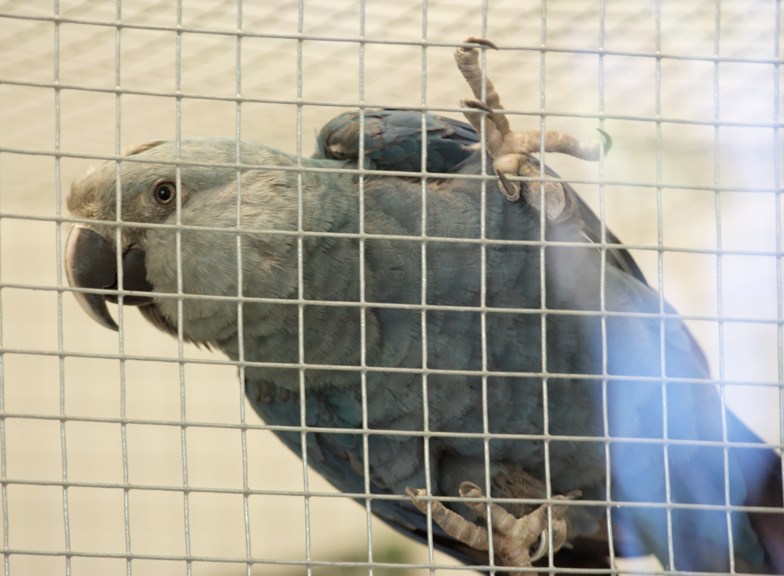
Spix's Macaw
Cyanopsitta spixii
The original uploader was Robert01 at German Wikipedia. (Original text: Robert01), CC BY-SA 2.0 de, via Wikimedia Commons

Side by side
| Rusty-faced Parrot | Spix's Macaw | |
|---|---|---|
| Scientific name | Hapalopsittaca amazonina (des Murs, 1845) | Cyanopsitta spixii (Wagler, 1832) |
| English name | Rusty-faced Parrot | Spix's Macaw |
| Group | Birds | Birds |
| Class | Aves Bird | Aves Bird |
| Order | Psittaciformes Parrot | Psittaciformes Parrot |
| Family | Psittacidae Macaws | Psittacidae Macaws |
| Genus | Hapalopsittaca Andean Parrots | Cyanopsitta Spix's Macaw |
| Named in | 1845 | 1832 |
| Red List category | Near Threatened | Extinct in the Wild |
| Countries on record | 2 countries | 1 country |
| GBIF occurrence records | 1,868 records | 12 records |
Rows where the two agree are shown in grey.
Where each is found
Only Rusty-faced Parrot (2)
Only Spix's Macaw (1)
From Catalogue of Life checklists and GBIF occurrence records. A country missing from a list means no record is held, which is not proof of absence.
Checked facts
| Rusty-faced Parrot | Spix's Macaw | |
|---|---|---|
| Appearance | No checked fact yet |
|
| Size | No checked fact yet |
|
| Habitat | No checked fact yet |
|
| Diet | No checked fact yet |
|
| Behaviour | No checked fact yet |
|
| Reproduction | No checked fact yet |
|
| Conservation | No checked fact yet |
|
| Similar species | No checked fact yet |
|
| Other | No checked fact yet |
|
In brief
Spix's Macaw
The natural habitat was riparian Caraibeira woodland galleries in the Rio São Francisco drainage basin, within the Caatinga dry forest climate of interior northeastern Brazil. Adults have grey-blue heads, pale blue underparts, and vivid blue upperparts, wings, and tails. Full profile
Compare something else
Page built on 26 November 2026 from the data on the two species pages, where every source is listed.
Cite this page
ScientificNames.org. (2026). Rusty-faced Parrot vs Spix's Macaw. Retrieved November 26, 2026, from https://scientificnames.org/compare/rusty-faced-parrot-vs-spixs-macaw
“Rusty-faced Parrot vs Spix's Macaw.” ScientificNames.org, 2026, scientificnames.org/compare/rusty-faced-parrot-vs-spixs-macaw. Accessed 26 Nov. 2026.
ScientificNames.org. “Rusty-faced Parrot vs Spix's Macaw.” Accessed November 26, 2026. https://scientificnames.org/compare/rusty-faced-parrot-vs-spixs-macaw.
@misc{scientificnames_rusty_faced_parrot_vs_spixs_macaw,
  author = {{ScientificNames.org}},
  title = {Rusty-faced Parrot vs Spix's Macaw},
  year = {2026},
  url = {https://scientificnames.org/compare/rusty-faced-parrot-vs-spixs-macaw},
  note = {Accessed 2026-11-26}
}