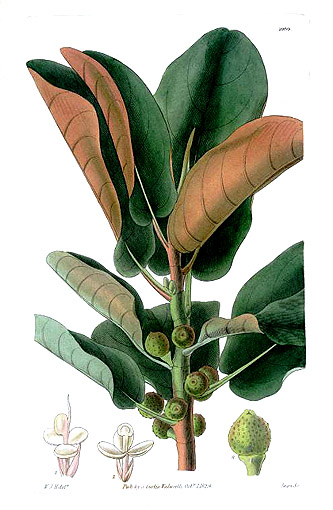
| Appearance | | - Ficus benjamina has gracefully drooping branchlets and glossy, oval leaves with acuminate tips. English Wikipedia
- The bark of Ficus benjamina is light gray and smooth, while the bark of young branches is brownish. English Wikipedia
- The leaves of Ficus benjamina are simple, entire and stalked. English Wikipedia
- Young leaves of Ficus benjamina are light green and slightly wavy, whereas mature leaves are green and smooth. English Wikipedia
- The inflorescences of Ficus benjamina are shiny green and spherical to egg-shaped. English Wikipedia
- The ripe figs of Ficus benjamina are orange-red. English Wikipedia
- Cultivated varieties of Ficus benjamina include leaf colour patterns ranging from light green to dark green and white variegation. English Wikipedia
|
|---|
| Size | No checked fact yet | - Ficus benjamina can reach 30 metres in height under natural conditions. English Wikipedia
- The crown of Ficus benjamina can spread across a diameter of 10 metres. English Wikipedia
- The leaf stalks of Ficus benjamina measure 1–2.5 cm in length. English Wikipedia
- The leaf blades of Ficus benjamina measure 5–12 cm long and 2–6 cm wide. English Wikipedia
- The stipules of Ficus benjamina are generally 6–12 mm long. English Wikipedia
- The inflorescences of Ficus benjamina measure approximately 1.5 cm in diameter. English Wikipedia
- The ripe figs of Ficus benjamina measure 2–2.5 cm in diameter. English Wikipedia
|
|---|
| Habitat | - The species occurs in rainforest and along rainforest margins. English Wikipedia
- It also grows in gullies, riverbanks, vine thickets and rocky hillsides. English Wikipedia
- The species grows on limestone outcrops in Kanangra-Boyd National Park. English Wikipedia
- Its soils are often well-drained and low in nutrients. English Wikipedia
- The species can establish itself in cracks in stone, including cliffs and rock faces. English Wikipedia
- It can grow as a hemiepiphyte on other plants or as a lithophyte on rocks. English Wikipedia
- In the Sydney region, it occurs from sea level to 1,000 metres altitude. English Wikipedia
| |
|---|
| Diet | - The fruits are consumed by numerous bird species, including pigeons, parrots and passerines. English Wikipedia
- Grey-headed flying foxes and spectacled flying foxes consume the fruits. English Wikipedia
- The endangered Coxen's fig parrot uses the species as one of its food plants. English Wikipedia
| - The small fruits of Ficus benjamina are eaten by some bird species. English Wikipedia
- Fourteen bird species were identified in a study examining the use of Ficus benjamina in Depok. academia.edu
|
|---|
| Behaviour | - The fruits can ripen throughout the year, with greater fruiting in spring and summer. English Wikipedia
- Some individual trees simultaneously bear ripe and unripe fruits. English Wikipedia
| - Ficus benjamina tolerates considerable shade but grows best in bright, sunny conditions. English Wikipedia
- Ficus benjamina requires moderate watering during summer and enough winter watering to prevent drying out. English Wikipedia
- Ficus benjamina is sensitive to cold and requires protection from strong drafts. English Wikipedia
- Ficus benjamina may shed many leaves and produce replacements when its position or orientation changes. English Wikipedia
- Ficus benjamina is sensitive to changes in temperature, humidity and location. English Wikipedia
- Seven of the fourteen bird species identified in the Depok study used Ficus benjamina. academia.edu
|
|---|
| Reproduction | - The species is pollinated exclusively by the fig wasp Pleistodontes imperialis. English Wikipedia
- The species is monoecious, with male and female flowers occurring on the same plant and within the same fruit. English Wikipedia
- The male and female flowers within a fruit mature at different times. English Wikipedia
- The fruits are syconia, which contain flowers lining an internal cavity. English Wikipedia
- The species can be propagated through cuttings or aerial layering. English Wikipedia
| - Ficus benjamina is monoecious. English Wikipedia
- Ficus benjamina produces three types of flowers: male, fertile female and sterile female flowers. English Wikipedia
- Ficus benjamina requires a specific type of symbiotic wasp for pollination. English Wikipedia
|
|---|
| Distribution | - The native range extends along Australia's eastern coast from Cape York Peninsula in Queensland to near Bega in southern New South Wales. English Wikipedia
- The species' range extends westward to Porcupine Gorge National Park and the far western plains of New South Wales. English Wikipedia
- The species has naturalised in urban Melbourne and Adelaide, as well as New Zealand, Hawaii and California. English Wikipedia
- The species has also naturalised in parts of Mediterranean Europe. English Wikipedia
| - Ficus benjamina has become naturalized in the West Indies and the US states of Florida and Arizona. English Wikipedia
|
|---|
| Conservation | - The species is listed as invasive in some areas of Hawaii and California. English Wikipedia
| No checked fact yet |
|---|
| Uses | No checked fact yet | - Ficus benjamina is cultivated as a large ornamental tree in parks and urban settings in tropical, subtropical and warm temperate regions. English Wikipedia
- Ficus benjamina is widely cultivated as a houseplant in temperate regions. English Wikipedia
- Ficus benjamina can remove gaseous formaldehyde from indoor air. English Wikipedia
- Ficus benjamina can help eliminate heavy metals, particularly in urban environments. English Wikipedia
- Ficus benjamina has been used as a biomonitor in New Mexico. English Wikipedia
- The fruit of Ficus benjamina is edible, although the species is not generally cultivated for fruit production. English Wikipedia
- The leaves of Ficus benjamina have been reported to possess antioxidant properties. English Wikipedia
- Ficus benjamina is used in indoor bonsai cultivation, particularly through miniature cultivars. English Wikipedia
- Ficus benjamina serves as a feeding tree for urban birds in Depok. academia.edu
|
|---|
| Other | No checked fact yet | - Ficus benjamina is the official tree of Bangkok. English Wikipedia
- Ficus benjamina is capable of substantial carbon sequestration in soil. English Wikipedia
- Ficus benjamina can develop roots that invade gardens and lift paved surfaces. English Wikipedia
- Ficus benjamina is considered at high risk of damage from hurricane-force winds in South Florida. English Wikipedia
- Ficus benjamina is a major source of indoor allergens and ranks third among common causes of indoor allergies. English Wikipedia
- Exposure to Ficus benjamina sap can cause anaphylactic shock in people allergic to latex. English Wikipedia
- Consumption of many parts of Ficus benjamina can cause nausea, vomiting and diarrhea. English Wikipedia
- In a study of workers at four plant-leasing firms, 27% developed antibodies following exposure to Ficus plants. English Wikipedia
|
|---|