Comparison

Rusty Fig vs Indian Laurel

Rusty Fig (Ficus rubiginosa) and Indian Laurel (Ficus microcarpa) both belong to the genus Ficus (fig) and part ways below it. Both are recorded in 6 countries.
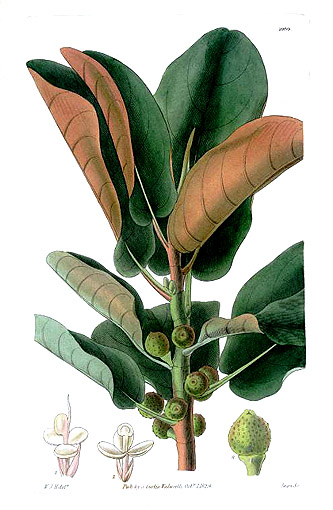
Rusty Fig

Rusty Fig

Ficus rubiginosa

William Jackson Hooker, Public domain, via Wikimedia Commons

Indian Laurel

Indian Laurel

Ficus microcarpa

H. Zell, CC BY-SA 3.0, via Wikimedia Commons

Side by side

Rusty FigIndian Laurel
Scientific nameFicus rubiginosa Desf. ex Vent.Ficus microcarpa L.fil.
English nameRusty FigIndian Laurel
GroupFlowering plantsFlowering plants
ClassMagnoliopsidaMagnoliopsida
OrderRosalesRosales
FamilyMoraceae Mulberry FamilyMoraceae Mulberry Family
GenusFicus FigFicus Fig
Red List categoryLeast ConcernLeast Concern
Countries on record7 countries66 countries
GBIF occurrence records6,261 records11,770 records

Rows where the two agree are shown in grey.

Where each is found

Both recorded in 6 countries

Only Rusty Fig (1)

Only Indian Laurel (60)

From Catalogue of Life checklists and GBIF occurrence records. A country missing from a list means no record is held, which is not proof of absence.

Checked facts

Rusty FigIndian Laurel
Appearance
  • Ficus microcarpa is a large tropical tree with numerous aerial roots that descend from its branches. English Wikipedia
  • Its aerial roots can develop into accessory trunks known as prop roots. English Wikipedia
  • Its leaves range from narrowly to broadly elliptic in shape. English Wikipedia
  • Its leaves are hairless and have 5–9 pairs of main lateral veins on either side of the midrib. English Wikipedia
  • Its lateral leaf veins form distinct loops within the leaf margin. English Wikipedia
  • The species can develop a broad, umbrella-like canopy. plants.ces.ncsu.edu
  • Its trunk can have multiple branches and smooth brown bark. plants.ces.ncsu.edu
SizeNo checked fact yet
  • The tree typically reaches 25 metres in height but can occasionally grow to 35 metres. English Wikipedia
  • Its leaves can reach 12 centimetres in length and 9 centimetres in width. English Wikipedia
Habitat
  • The species occurs in rainforest and along rainforest margins. English Wikipedia
  • It also grows in gullies, riverbanks, vine thickets and rocky hillsides. English Wikipedia
  • The species grows on limestone outcrops in Kanangra-Boyd National Park. English Wikipedia
  • Its soils are often well-drained and low in nutrients. English Wikipedia
  • The species can establish itself in cracks in stone, including cliffs and rock faces. English Wikipedia
  • It can grow as a hemiepiphyte on other plants or as a lithophyte on rocks. English Wikipedia
  • In the Sydney region, it occurs from sea level to 1,000 metres altitude. English Wikipedia
  • The species can initially grow as an epiphyte, lithophyte or terrestrial plant. English Wikipedia
  • Its natural habitats include tropical rainforests, river edges, coastal areas, swamps and mangroves. English Wikipedia
  • The species occurs mainly at low elevations. English Wikipedia
  • In urban environments, the tree can grow in cracks, walls, buildings and other masonry structures. English Wikipedia
  • The species requires a warm climate and humid atmosphere. English Wikipedia
Diet
  • The fruits are consumed by numerous bird species, including pigeons, parrots and passerines. English Wikipedia
  • Grey-headed flying foxes and spectacled flying foxes consume the fruits. English Wikipedia
  • The endangered Coxen's fig parrot uses the species as one of its food plants. English Wikipedia
  • The fruits of Ficus microcarpa are eaten by several bird species in São Paulo, Brazil. English Wikipedia
  • Bird species recorded feeding on its fruits in São Paulo include Turdus rufiventris, Pitangus sulphuratus, Turdus leucomelas, Thraupis sayaca and Celeus flavescens. English Wikipedia
  • The parrot Aratinga leucophthalmus eats the fruits and leaves of this species. English Wikipedia
Behaviour
  • The fruits can ripen throughout the year, with greater fruiting in spring and summer. English Wikipedia
  • Some individual trees simultaneously bear ripe and unripe fruits. English Wikipedia
No checked fact yet
Reproduction
  • The species is pollinated exclusively by the fig wasp Pleistodontes imperialis. English Wikipedia
  • The species is monoecious, with male and female flowers occurring on the same plant and within the same fruit. English Wikipedia
  • The male and female flowers within a fruit mature at different times. English Wikipedia
  • The fruits are syconia, which contain flowers lining an internal cavity. English Wikipedia
  • The species can be propagated through cuttings or aerial layering. English Wikipedia
  • The pollinating fig wasp associated with Ficus microcarpa is Eupristina verticillata. English Wikipedia
  • Nineteen non-pollinating fig wasp species parasitize the figs of Ficus microcarpa. English Wikipedia
  • The species can be propagated using cuttings placed in water or directly in sand or potting soil. English Wikipedia
  • Seeds of Ficus microcarpa are dispersed by fruit-eating birds. English Wikipedia
Distribution
  • The native range extends along Australia's eastern coast from Cape York Peninsula in Queensland to near Bega in southern New South Wales. English Wikipedia
  • The species' range extends westward to Porcupine Gorge National Park and the far western plains of New South Wales. English Wikipedia
  • The species has naturalised in urban Melbourne and Adelaide, as well as New Zealand, Hawaii and California. English Wikipedia
  • The species has also naturalised in parts of Mediterranean Europe. English Wikipedia
  • The native range of Ficus microcarpa extends from India to China and Japan, through Southeast Asia and the western Pacific to Queensland in Australia. English Wikipedia
  • The species is native to tropical Asia, southern China, Taiwan, western Pacific islands and Australia. English Wikipedia
  • Naturalized populations have been recorded in Los Angeles, Orange, Riverside, San Diego and Ventura counties in California. English Wikipedia
Conservation
  • The species is listed as invasive in some areas of Hawaii and California. English Wikipedia
  • Ficus microcarpa is considered a major invasive species in Hawaii, Florida, Bermuda, Central America and South America. English Wikipedia
  • The species is considered invasive in Israel, although it is not widespread there. English Wikipedia
  • Some California cities no longer recommend planting Ficus microcarpa because its roots can lift sidewalks and pavements. English Wikipedia
UsesNo checked fact yet
  • Ficus microcarpa is cultivated as an ornamental tree in gardens, parks and containers, and as an indoor plant and bonsai specimen. English Wikipedia
  • The species is cultivated as a shade tree in Southeast Asia because of its dense foliage. English Wikipedia
  • Ficus microcarpa is widely used as a street tree in warm climates. English Wikipedia
  • The species is traditionally used in medicine in India, Malaysia, China and Japan. English Wikipedia
  • In Japan, the bark, aerial roots and dried leaves are traditionally used to treat pain and fever. English Wikipedia
  • Traditional Chinese medicinal uses include treatment of flu, malaria, bronchitis and rheumatism. English Wikipedia
OtherNo checked fact yet
  • The species can tolerate temperatures close to 0 °C. English Wikipedia
  • High humidity between 70% and 100% is preferable for the species and appears to encourage aerial root development. English Wikipedia
  • The species can tolerate certain urban pollutants in soil moisture, including sulfur dioxide, lead and cadmium. English Wikipedia

In brief

Rusty Fig

Ficus rubiginosa grows naturally along Australia's eastern coast, from Cape York Peninsula in Queensland to near Bega in southern New South Wales, and extends westward to Porcupine Gorge National Park and the far western plains of New South Wales. Full profile

Indian Laurel

The native range extends from India to China and Japan, through Southeast Asia and the western Pacific to Queensland in Australia. It is a large tropical tree distinguished by numerous aerial roots that can develop into accessory trunks called prop roots. Full profile

Compare something else

Page built on 27 November 2026 from the data on the two species pages, where every source is listed.

Cite this page

ScientificNames.org. (2026). Rusty Fig vs Indian Laurel. Retrieved November 27, 2026, from https://scientificnames.org/compare/rusty-fig-vs-indian-laurel