Comparison

North African Fire Salamander vs Alpine Salamander

North African Fire Salamander (Salamandra algira) and Alpine Salamander (Salamandra atra) both belong to the genus Salamandra and part ways below it.

North African Fire Salamander

North African Fire Salamander

Salamandra algira

[Photograph by Daniel Escoriza] Hernandez A, Escoriza D (2019) A new subspecies of African fire salamander Salamandra algira (Urodela, Salamandridae) from the Middle Atlas Mountains, Morocco. ZooKeys , CC BY 4.0, via Wikimedia Commons

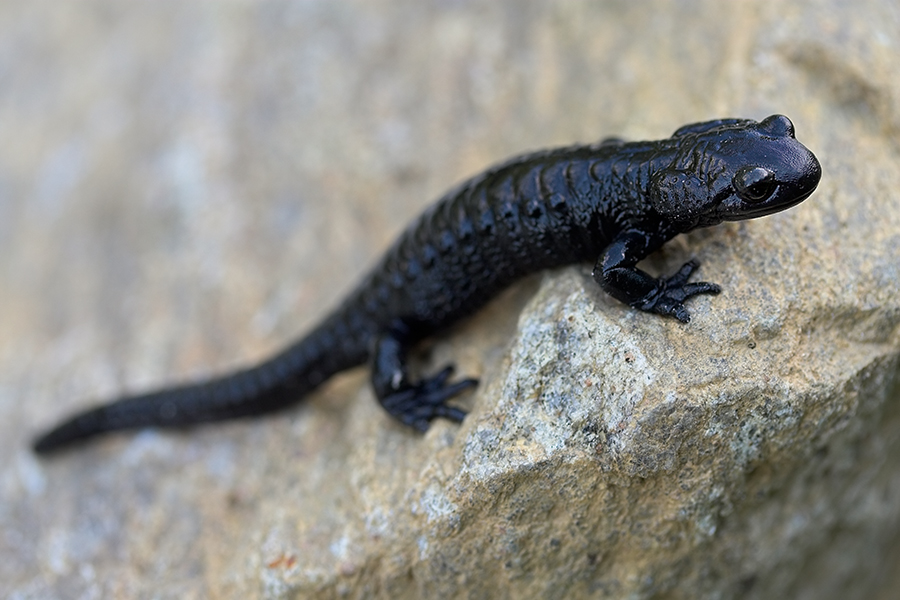
Alpine Salamander

Alpine Salamander

Salamandra atra

Thomas Huntke, Germany (der Uploader) http://www.huntke.de, CC BY-SA 3.0 de, via Wikimedia Commons

Side by side

North African Fire SalamanderAlpine Salamander
Scientific nameSalamandra algira Bedriaga, 1883Salamandra atra Laurenti, 1768
English nameNorth African Fire SalamanderAlpine Salamander
GroupAmphibiansAmphibians
ClassAmphibia AmphibiansAmphibia Amphibians
OrderCaudata SalamandersCaudata Salamanders
FamilySalamandridae NewtsSalamandridae Newts
GenusSalamandraSalamandra
Named in18831768
Red List categoryVulnerableLeast Concern
Countries on record3 countries11 countries
GBIF occurrence records235 records30,360 records

Rows where the two agree are shown in grey.

Where each is found

Only North African Fire Salamander (3)

Only Alpine Salamander (11)

From Catalogue of Life checklists and GBIF occurrence records. A country missing from a list means no record is held, which is not proof of absence.

Checked facts

North African Fire SalamanderAlpine Salamander
AppearanceNo checked fact yet
  • The Alpine Salamander is generally black or dark brown in colour. English Wikipedia
  • The subspecies Salamandra atra aurorae has bright yellow, white, or grey markings on its back and head. English Wikipedia
  • Females can grow larger than males. English Wikipedia
  • Males have more slender bodies and visibly swollen cloacae compared with females. English Wikipedia
  • Individuals generally have 11–13 costal grooves along each side of the body. English Wikipedia
  • Two rows of dorsal glands extend along the back beside the spine and continue to the tail tips. English Wikipedia
SizeNo checked fact yet
  • Females can reach 151 mm in total length, including the tail. English Wikipedia
  • Males can reach approximately 144 mm in total length, including the tail. English Wikipedia
Habitat
  • The species typically inhabits moist oak and cedar forests, where it shelters beneath roots and stones. English Wikipedia
  • The species is also known to inhabit caves. English Wikipedia
  • The species is predominantly restricted to humid habitats in mountainous areas. pmc.ncbi.nlm.nih.gov
  • The species inhabits mountainous terrestrial environments. English Wikipedia
  • Individuals commonly shelter beneath stones, logs, and in rocky crevices. English Wikipedia
  • The species inhabits forested environments, particularly mixed deciduous and coniferous forests. English Wikipedia
  • Mountain meadows and grasslands also provide habitat for the species. English Wikipedia
  • Forests containing silver fir and beech trees provide suitable habitat. English Wikipedia
  • Forests dominated by Norway spruce and European larch can also support the species. English Wikipedia
  • The species generally inhabits elevations above 700 metres and can occur at elevations reaching 2,000 metres. English Wikipedia
  • Rainy or post-rain conditions at temperatures between 3 and 18 °C are described as ideal for the species. English Wikipedia
DietNo checked fact yet
  • The species feeds on terrestrial invertebrates including beetles, snails, millipedes, and spiders. English Wikipedia
  • Coleoptera and Mollusca are particularly important components of its diet. English Wikipedia
  • The species tends to select larger prey, consistent with its own relatively large body size. English Wikipedia
BehaviourNo checked fact yet
  • The species is primarily active during daylight hours and generally rests or sleeps at night. English Wikipedia
  • Individuals may also become active at night depending on weather conditions. English Wikipedia
  • The species is relatively sedentary, with a maximum observed summer movement distance of 12 metres for one individual. English Wikipedia
  • Individuals frequently return to the same terrestrial refuge sites throughout their lives. English Wikipedia
  • The species uses faecal pellets for scent-based territorial marking. English Wikipedia
Reproduction
  • Most populations of the species reproduce by retaining eggs internally until they hatch. English Wikipedia
  • Females in most populations retain between eight and 50 eggs per reproductive batch. English Wikipedia
  • In most populations, developing young receive nourishment from their egg yolks. English Wikipedia
  • The Tingitana population is considered viviparous because developing young apparently receive some nourishment from fluids secreted by the female. English Wikipedia
  • Females of the Tingitana population deposit approximately 15 larvae in streams or pools. English Wikipedia
  • The species reproduces through internal fertilisation following mating on land. English Wikipedia
  • The species is viviparous and gives birth to live young. English Wikipedia
  • Females generally give birth to two offspring, although litters of three or four can occur. English Wikipedia
  • Newborn individuals can measure up to 50 mm in length. English Wikipedia
  • Pregnancy generally lasts approximately two years at elevations of 650–1,000 metres. English Wikipedia
  • Pregnancy generally lasts approximately three years at elevations of 1,400–1,700 metres. English Wikipedia
LifespanNo checked fact yet
Distribution
  • Salamandra algira occurs in Algeria, Morocco, and the Spanish enclave of Ceuta. English Wikipedia
  • The species occurs at elevations ranging from approximately 80 to 2,450 metres. English Wikipedia
  • The species is endemic to northwestern Africa. English Wikipedia
  • The species occurs from the France–Switzerland border eastward through Switzerland and Austria to the Dinaric Alps. English Wikipedia
Conservation
  • The species is classified as vulnerable by the International Union for Conservation of Nature. English Wikipedia
  • Habitat destruction, particularly the loss of forest habitat, is the principal threat to the species. English Wikipedia
  • Additional threats include diversion of forest streams for irrigation, livestock overgrazing, and collection for the pet trade. English Wikipedia
  • The species has a fragmented distribution and is locally rare in some parts of its range. English Wikipedia
  • The Alpine Salamander is classified as Least Concern on the IUCN Red List in the document's account. English Wikipedia
  • The population of the species is reported to be decreasing. English Wikipedia
  • Commercial deforestation is identified as a major threat to the species. English Wikipedia
  • Forestry machinery can damage habitat by compacting soil and eliminating small prey and potential shelters. English Wikipedia
  • The Golden Alpine Salamander is classified as Endangered because of its restricted distribution and declining population trend. pmc.ncbi.nlm.nih.gov
  • The Golden Alpine Salamander is designated a priority taxon under the European Union Habitats Directive. pmc.ncbi.nlm.nih.gov
  • The Golden Alpine Salamander is threatened by forestry practices that compact soil and remove cavities and potential refuges. pmc.ncbi.nlm.nih.gov
Similar species
  • Salamandra algira is the only representative of the genus Salamandra in North Africa. pmc.ncbi.nlm.nih.gov
  • Salamandra lanzai is described as a similar species inhabiting the western Alps. English Wikipedia

In brief

North African Fire Salamander

Salamandra algira is endemic to northwestern Africa, occurring in Algeria, Morocco, and the Spanish enclave of Ceuta, at elevations ranging from approximately 80 to 2,450 metres. Most populations retain eggs internally until hatching, while the Tingitana population deposits larvae in streams or pools. Full profile

Alpine Salamander

Salamandra atra occurs from the France–Switzerland border eastward through Switzerland and Austria to the Dinaric Alps. It is generally black or dark brown, although the subspecies Salamandra atra aurorae has bright yellow, white, or grey markings on its back and head. Full profile

Compare something else

Page built on 27 November 2026 from the data on the two species pages, where every source is listed.

Cite this page

ScientificNames.org. (2026). North African Fire Salamander vs Alpine Salamander. Retrieved November 27, 2026, from https://scientificnames.org/compare/north-african-fire-salamander-vs-alpine-salamander