Comparison

Masked Saltator vs Bluish-grey Saltator

Masked Saltator (Saltator cinctus) and Bluish-grey Saltator (Saltator coerulescens) both belong to the genus Saltator (forest saltators) and part ways below it. Both are recorded in 3 countries.
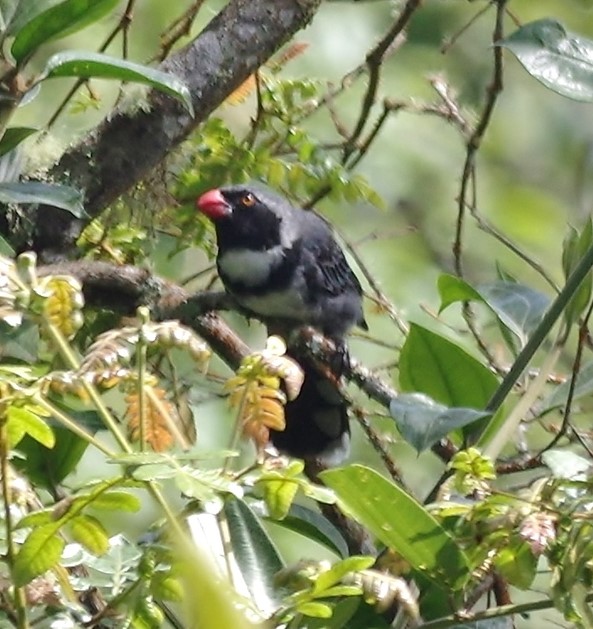
Masked Saltator

Masked Saltator

Saltator cinctus

iNaturalist user: thibaudaronson, CC BY-SA 4.0, via Wikimedia Commons

Bluish-grey Saltator

Bluish-grey Saltator

Saltator coerulescens

Hector Bottai, CC BY-SA 4.0, via Wikimedia Commons

Side by side

Masked SaltatorBluish-grey Saltator
Scientific nameSaltator cinctus J. T. Zimmer, 1943Saltator coerulescens Vieillot, 1817
English nameMasked SaltatorBluish-grey Saltator
GroupBirdsBirds
ClassAves BirdAves Bird
OrderPasseriformes PasserinePasseriformes Passerine
FamilyThraupidae TanagerThraupidae Tanager
GenusSaltator Forest SaltatorsSaltator Forest Saltators
Named in19431817
Red List categoryLeast ConcernLeast Concern
EnvironmentNot recordedterrestrial
Countries on record3 countries12 countries
GBIF occurrence records1,754 records106,249 records

Rows where the two agree are shown in grey.

Where each is found

Both recorded in 3 countries

Only Bluish-grey Saltator (9)

From Catalogue of Life checklists and GBIF occurrence records. A country missing from a list means no record is held, which is not proof of absence.

Checked facts

Masked SaltatorBluish-grey Saltator
Appearance
  • Adult Masked Saltators from Ecuador and Peru have slate-gray crowns, napes, and upperparts. English Wikipedia
  • Adults have black faces and throats bordered by a thin white line that widens below the black area. English Wikipedia
  • Adults have a black breast band beneath a white band. English Wikipedia
  • The underparts are mostly white, with gray flanks and broad black barring on the vent. English Wikipedia
  • The wings are black with broad dark-gray edges on the coverts and flight feathers. English Wikipedia
  • The tail is black, with small white tips on its inner two feather pairs and broad white tips on its other four pairs. English Wikipedia
  • Adults have orange or golden irises with red inner rings. English Wikipedia
  • The bill is mostly red on the upper mandible and black and red on the lower mandible. English Wikipedia
  • Juveniles are duller than adults and have smaller black masks and pale-yellow bills. English Wikipedia
  • The Colombian population has a minimal pale streak behind the face and a creamy-white belly. English Wikipedia
  • The Colombian population has a red eye and an entirely red bill. English Wikipedia
  • The sexes have the same plumage. English Wikipedia
  • The species generally has grey or greyish-olive upperparts, a white stripe above the eye, a narrow white throat, a grey breast, and a buff or cinnamon belly. English Wikipedia
Size
Habitat
  • The Colombian population primarily inhabits Podocarpus forest. English Wikipedia
  • In Ecuador and Peru, the species inhabits humid montane forest in subtropical and lower temperate zones. English Wikipedia
  • The Colombian population inhabits elevations between 2,000 and 3,000 m. English Wikipedia
  • In Ecuador, the species occurs at elevations between 2,000 and 2,700 m. English Wikipedia
  • In Peru, the species occurs at elevations between 1,700 and 3,000 m. English Wikipedia
Diet
Behaviour
  • The species is generally resident throughout the year but appears to be somewhat nomadic. English Wikipedia
  • Its apparent nomadism may be associated with variation in the abundance of fruiting trees. English Wikipedia
  • Individual birds and pairs from both populations occasionally join mixed-species feeding flocks. English Wikipedia
Reproduction
  • The breeding season apparently includes April in Colombia. English Wikipedia
  • The only documented egg was laid in captivity and was blue with dark-brown blotches. English Wikipedia
Distribution
  • The species occurs in Colombia, Ecuador, and Peru. English Wikipedia
  • One population occurs intermittently along both slopes of Colombia's Central Andes, from southern Antioquia to northern Valle del Cauca. English Wikipedia
  • Another population occurs intermittently along the eastern Andean slope from Napo Province in north-central Ecuador south to Huánuco Department in Peru. English Wikipedia
  • The species occurs widely in Brazil, although the olive-grey saltator replaces it in the extreme north near the Guianas and Venezuela. English Wikipedia
  • The species occurs in southeastern Colombia, while the olive-grey saltator replaces it in central and northern Colombia. English Wikipedia
Conservation
  • The species has been classified as Least Concern by the IUCN since 2020. English Wikipedia
  • The estimated population is 30,000 mature individuals. English Wikipedia
  • The species' population is believed to be decreasing. English Wikipedia
  • Podocarpus and northern Andean montane forests face threats from agricultural and cattle-pasture conversion, mining, and logging. English Wikipedia
  • The known Colombian localities are situated on the most deforested cordillera. English Wikipedia
  • The species is considered uncommon in Colombia. English Wikipedia
  • The species is considered rare and apparently local in Ecuador. English Wikipedia
  • The species is considered rare and perhaps local in Peru. English Wikipedia
  • The species was most recently assessed for the IUCN Red List in 2022. iucnredlist.org
Similar species
  • The disjunct Colombian population differs from other populations in plumage and bill color. English Wikipedia
No checked fact yet
Name originNo checked fact yet
  • The specific epithet coerulescens derives from Latin and means bluish. English Wikipedia
OtherNo checked fact yet

In brief

Masked Saltator

Saltator cinctus occurs in Colombia, Ecuador, and Peru, in two intermittently distributed Andean populations. Adults are distinguished by black facial and throat markings, a black breast band, and predominantly white underparts. Full profile

Bluish-grey Saltator

Saltator coerulescens generally has grey or greyish-olive upperparts, a white stripe above the eye, a narrow white throat, a grey breast, and a buff or cinnamon belly. Full profile

Compare something else

Page built on 29 November 2026 from the data on the two species pages, where every source is listed.

Cite this page

ScientificNames.org. (2026). Masked Saltator vs Bluish-grey Saltator. Retrieved November 29, 2026, from https://scientificnames.org/compare/masked-saltator-vs-bluish-grey-saltator