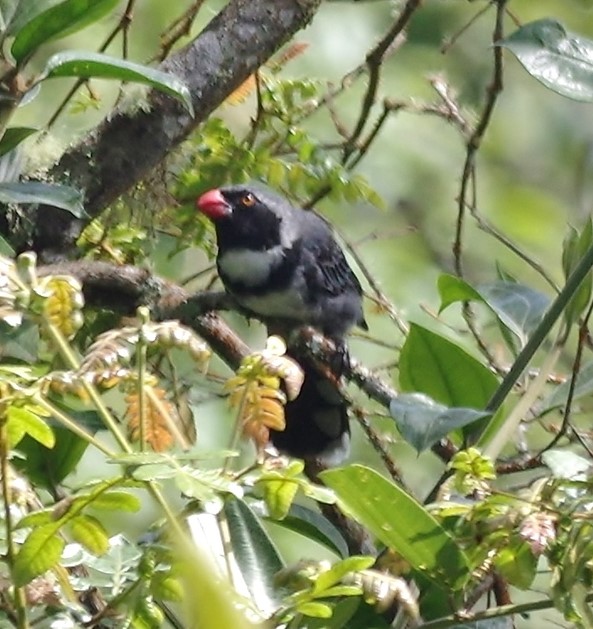
| Appearance | - Adult Masked Saltators from Ecuador and Peru have slate-gray crowns, napes, and upperparts. English Wikipedia
- Adults have black faces and throats bordered by a thin white line that widens below the black area. English Wikipedia
- Adults have a black breast band beneath a white band. English Wikipedia
- The underparts are mostly white, with gray flanks and broad black barring on the vent. English Wikipedia
- The wings are black with broad dark-gray edges on the coverts and flight feathers. English Wikipedia
- The tail is black, with small white tips on its inner two feather pairs and broad white tips on its other four pairs. English Wikipedia
- Adults have orange or golden irises with red inner rings. English Wikipedia
- The bill is mostly red on the upper mandible and black and red on the lower mandible. English Wikipedia
- Juveniles are duller than adults and have smaller black masks and pale-yellow bills. English Wikipedia
- The Colombian population has a minimal pale streak behind the face and a creamy-white belly. English Wikipedia
- The Colombian population has a red eye and an entirely red bill. English Wikipedia
- The sexes have the same plumage. English Wikipedia
| - Male and female individuals have the same plumage. English Wikipedia
- Adults of the nominate subspecies have predominantly deep brownish-gray heads with broad white supercilia extending beyond the eyes. English Wikipedia
- The nominate subspecies has deep brownish-gray upperparts with an olive tinge on the rump and upper tail coverts. English Wikipedia
- The nominate subspecies has a white or pale buffy chin and throat with a grayish-black or dusky stripe along the sides. English Wikipedia
- The breast, sides, and flanks of the nominate subspecies are grayish or grayish olive, with a strong buffy tinge on the flanks. English Wikipedia
- The nominate subspecies has a deep buff or cinnamon-buff belly, vent, and undertail coverts. English Wikipedia
- All subspecies have brown to gray-brown irises, blackish bills, and blackish to leaden-gray legs and feet. English Wikipedia
- The subspecies S. g. vigorsii has somewhat grayer underparts than the nominate subspecies. English Wikipedia
- The subspecies S. g. plumbiceps has an ashy-gray head and more olive coloration on its upperparts than the nominate subspecies. English Wikipedia
- The subspecies S. g. yucatanensis differs little in appearance from the nominate subspecies. English Wikipedia
- The subspecies S. g. hesperis is larger than the nominate subspecies and has darker, more slaty upperparts and underparts. English Wikipedia
- The subspecies S. g. brevicaudus is smaller than the nominate subspecies and has a shorter tail and darker, grayer underparts. English Wikipedia
|
|---|
| Size | | |
|---|
| Habitat | - The Colombian population primarily inhabits Podocarpus forest. English Wikipedia
- In Ecuador and Peru, the species inhabits humid montane forest in subtropical and lower temperate zones. English Wikipedia
- The Colombian population inhabits elevations between 2,000 and 3,000 m. English Wikipedia
- In Ecuador, the species occurs at elevations between 2,000 and 2,700 m. English Wikipedia
- In Peru, the species occurs at elevations between 1,700 and 3,000 m. English Wikipedia
| - The species inhabits landscapes ranging from dry semideciduous or deciduous vegetation to humid evergreen habitats. English Wikipedia
- The species is commonly found along forest edges, watercourses, plantations, gardens, and urban parks. English Wikipedia
- The species generally occurs from sea level to elevations of 1,500 m. English Wikipedia
|
|---|
| Diet | | |
|---|
| Behaviour | - The species is generally resident throughout the year but appears to be somewhat nomadic. English Wikipedia
- Its apparent nomadism may be associated with variation in the abundance of fruiting trees. English Wikipedia
- Individual birds and pairs from both populations occasionally join mixed-species feeding flocks. English Wikipedia
| - The species is a year-round resident throughout its range. English Wikipedia
- The species forages individually or in small groups and sometimes joins mixed-species feeding flocks. English Wikipedia
- The species forages at all levels of its habitat. English Wikipedia
|
|---|
| Reproduction | - The breeding season apparently includes April in Colombia. English Wikipedia
- The only documented egg was laid in captivity and was blue with dark-brown blotches. English Wikipedia
| - The species is known to breed between April and August throughout its range. English Wikipedia
- The species builds a large cup-shaped nest from twigs and leaves, lined with rootlets and plant fibers. English Wikipedia
- The nest is typically concealed in a shrub or tree between 1.5 and 4 m above the ground. English Wikipedia
- The species lays clutches containing two to five eggs. English Wikipedia
- Eggs recorded in Mexico and Costa Rica are bright blue with black markings. English Wikipedia
- One recorded nest fledged its brood 15 days after hatching. English Wikipedia
|
|---|
| Distribution | - The species occurs in Colombia, Ecuador, and Peru. English Wikipedia
- One population occurs intermittently along both slopes of Colombia's Central Andes, from southern Antioquia to northern Valle del Cauca. English Wikipedia
- Another population occurs intermittently along the eastern Andean slope from Napo Province in north-central Ecuador south to Huánuco Department in Peru. English Wikipedia
| |
|---|
| Conservation | - The species has been classified as Least Concern by the IUCN since 2020. English Wikipedia
- The estimated population is 30,000 mature individuals. English Wikipedia
- The species' population is believed to be decreasing. English Wikipedia
- Podocarpus and northern Andean montane forests face threats from agricultural and cattle-pasture conversion, mining, and logging. English Wikipedia
- The known Colombian localities are situated on the most deforested cordillera. English Wikipedia
- The species is considered uncommon in Colombia. English Wikipedia
- The species is considered rare and apparently local in Ecuador. English Wikipedia
- The species is considered rare and perhaps local in Peru. English Wikipedia
| |
|---|
| Similar species | - The disjunct Colombian population differs from other populations in plumage and bill color. English Wikipedia
| - The species can be distinguished from other saltators in Mexico and Central America by its grayish upperparts, prominent white eyebrow, and plain breast. ebird.org
|
|---|
| Other | | - The species was formally described in 1830 under the scientific name Tanagra grandis. English Wikipedia
- The species was reassigned to the genus Saltator by 1938. English Wikipedia
|
|---|