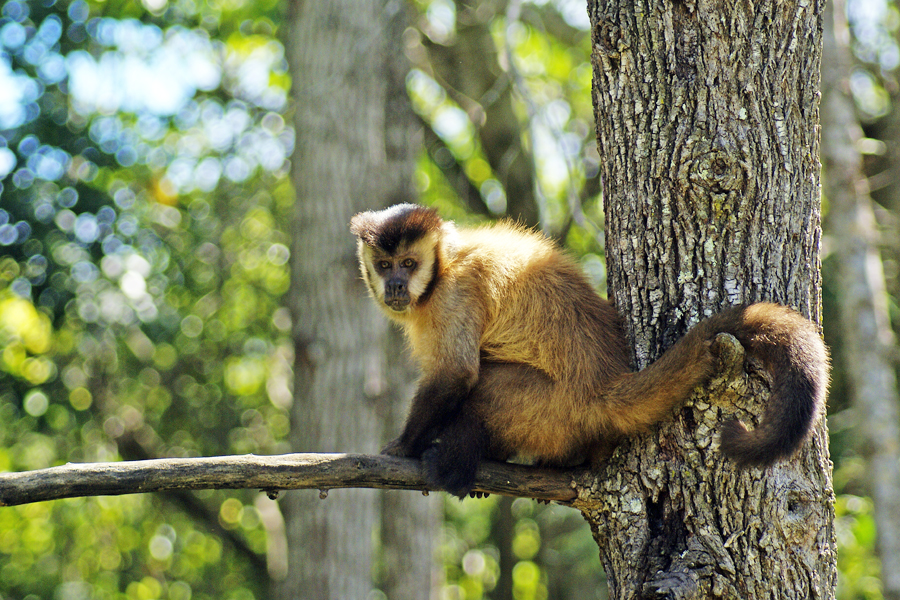
| Appearance | - The species has medium-length fur with varying shades of brown across its body. English Wikipedia
- Its limbs and head tuft are generally darker than the rest of its body. English Wikipedia
- Individuals have a dark hair stripe at the front of their ears that resembles sideburns. English Wikipedia
- The head tuft develops fully only after an individual reaches adulthood. English Wikipedia
- Males are larger in body size than females. English Wikipedia
- The species exhibits morphological variation between and within populations, between sexes, and across different ages. English Wikipedia
| - The blond capuchin has an almost uniformly golden-yellow coat with a whitish cap covering the front half of its head. English Wikipedia
- Its face is pink, its eyes are light brown, and its throat has a dark, hairless flap. English Wikipedia
- The hair on its head grows backwards and does not form a tuft. English Wikipedia
- Its palms and foot soles are black and hairless. English Wikipedia
|
|---|
| Size | | |
|---|
| Habitat | - The species inhabits subtropical, humid, semi-deciduous forests and gallery forests. English Wikipedia
- The species also inhabits forested regions of the Pantanal. birdnet.cornell.edu
- The species occurs in the humid semi-deciduous Alto Parana Atlantic Forest in Paraguay. English Wikipedia
- The species can occupy bushlands and savannas. English Wikipedia
| - The species inhabits both Atlantic Forest and Caatinga biomes. English Wikipedia
- Blond capuchins in the Caatinga spend more time on the ground than populations in the Atlantic Forest. English Wikipedia
|
|---|
| Diet | - The species is described as a frugivore-insectivore whose diet includes fruits, seeds, arthropods, frogs, and small mammals. birdnet.cornell.edu
- Fruits constitute the largest part of the species' diet, followed by seeds. English Wikipedia
- Plant parts and invertebrates make up the remainder of the diet after fruits and seeds. English Wikipedia
- Large males have been observed eating small vertebrates. English Wikipedia
- Males tend to consume larger food items than females. English Wikipedia
| - The blond capuchin is omnivorous and eats fruits, other plant parts, small vertebrates, arthropods, and sugarcane. English Wikipedia
- Sugarcane accounted for 50% of the diet in one study, although fruit remained the preferred food when available. English Wikipedia
- Blond capuchins obtain sugarcane by raiding agricultural fields surrounding their forest fragments. English Wikipedia
- The species sucks sugarcane rather than eating it. English Wikipedia
- Blond capuchins in the Caatinga have been observed cracking Manihot nuts using a small rock as a hammer and a larger rock as an anvil. English Wikipedia
|
|---|
| Behaviour | - The species is diurnal and opportunistically omnivorous. English Wikipedia
- Individuals live in social communities and travel through their territory while searching for food. English Wikipedia
- Individuals spend most of their time resting, travelling, and foraging. English Wikipedia
- Females spend more time browsing and eating in the canopy of sleeping trees than males. English Wikipedia
- Males spend more time resting and surveying the area on or near the ground. English Wikipedia
- Group sizes range from fewer than twelve individuals to as many as 44. English Wikipedia
- Groups consist of multiple males and multiple females. English Wikipedia
- The alpha male is generally the largest and most ferocious group member. English Wikipedia
- The alpha male protects the group, controls access to food, and has priority in mating with females. English Wikipedia
- Groups normally remain within their home-range boundaries while travelling. English Wikipedia
- Individuals may rub leaves from certain citrus trees against their fur. English Wikipedia
- Individuals use tree branches as anvils to smash hard-shelled fruits and seeds held in both hands. English Wikipedia
| - The species is diurnal and conducts most of its foraging in the early morning. English Wikipedia
- Blond capuchins form complex social groups that can contain more than 150 males and females. English Wikipedia
- Males typically lead group movements and sometimes divide into subgroups while foraging. English Wikipedia
- Blond capuchins communicate using multiple calls and behaviours, with one study identifying 29 call types. English Wikipedia
- Millipede anointing has been observed in both solitary and social contexts, with adult males participating more actively. pmc.ncbi.nlm.nih.gov
- Researchers recorded 34 millipede-anointing bouts in one group of blond capuchins. pmc.ncbi.nlm.nih.gov
- Millipede anointing occurred at a rate of eight episodes per 100 observation hours. pmc.ncbi.nlm.nih.gov
- The millipedes used during anointing belong to species that produce benzoquinone. pmc.ncbi.nlm.nih.gov
- Anointing was observed more frequently in lower vegetation strata and around midday. pmc.ncbi.nlm.nih.gov
- Millipede anointing occurred more frequently during periods of higher rainfall and high fruit productivity. pmc.ncbi.nlm.nih.gov
|
|---|
| Reproduction | - Females are estimated to reach sexual maturity at four to five years of age. English Wikipedia
- Males are estimated to reach sexual maturity at approximately eight years of age. English Wikipedia
| - Blond capuchins do not have a defined mating season. English Wikipedia
- Females are the primary infant caregivers, although males and females both exhibit parental care. English Wikipedia
- Female blond capuchins have been observed carrying infants of different ages throughout the year. English Wikipedia
|
|---|
| Distribution | - The species occurs in eastern Paraguay, southeastern Bolivia, northern Argentina, and the Brazilian states of Mato Grosso and Mato Grosso do Sul. birdnet.cornell.edu
- In Brazil, the species also occurs in the southeast of Goiás state. English Wikipedia
| - The species occurs in northeastern Brazil, including the states of Paraíba, Pernambuco, and Alagoas. English Wikipedia
- The species has also been recorded in the Caatinga biome of Rio Grande do Norte, Brazil. English Wikipedia
- Rediscovered populations were documented at the Camaratuba Experimental Station and Engenho Gargaú Private Natural Heritage Reserve in Paraíba. English Wikipedia
- The species has also been observed at Pau-Brasil Ecological Station in Paraíba. English Wikipedia
|
|---|
| Conservation | - The species is protected in Argentina's El Rey National Park. English Wikipedia
- The species is protected in Bolivia's Kaa-Iya National Park. English Wikipedia
- The species is protected in Brazil's Pantanal Matogrossense National Park. English Wikipedia
- Forest loss from human activities and natural disasters is identified as a threat to the species in Paraguay. English Wikipedia
- Agricultural habitat conversion and illegal hunting threaten populations in Argentina. English Wikipedia
- Deforestation, fires, agriculture, livestock keeping, urban expansion, hunting, and pet capture are among the threats reported in Brazil. English Wikipedia
| - The blond capuchin is classified as an endangered species in the source document. English Wikipedia
- Agricultural habitat loss, particularly from sugarcane cultivation, threatens the species. English Wikipedia
- Deforestation in the Atlantic Forest and desertification in the Caatinga are major habitat-related threats. English Wikipedia
- Hunting and capture for the illegal pet trade also threaten the species. English Wikipedia
- Habitat loss has increased the risk of infectious diseases among populations living in small forest fragments. English Wikipedia
|
|---|
| Uses | | No checked fact yet |
|---|