Comparison
Semigenetta qiae vs African Civet
Semigenetta qiae (Semigenetta qiae) and African Civet (Civettictis civetta) both belong to the family Viverridae (oyans) and part ways below it.
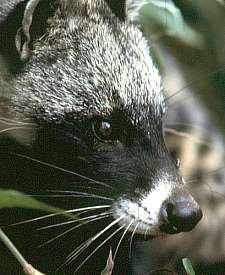
African Civet
Civettictis civetta
The original uploader was Baldhur at German Wikipedia. (Original text: http://www.atourhands.com/civet.html), Public domain, via Wikimedia Commons

Side by side
| Semigenetta qiae | African Civet | |
|---|---|---|
| Scientific name | Semigenetta qiae Wang, Jiangzuo, Grohé, Bonis, Chaimanee & Jaeger, 2024 | Civettictis civetta (Schreber, 1776) |
| English name | Not recorded | African Civet |
| Group | Mammals | Mammals |
| Class | Mammalia Mammal | Mammalia Mammal |
| Order | Carnivora Carnivores | Carnivora Carnivores |
| Family | Viverridae Oyans | Viverridae Oyans |
| Genus | Semigenetta | Civettictis African Civets |
| Named in | 2024 | 1776 |
| Red List category | Not recorded | Least Concern |
| Environment | Not recorded | terrestrial |
| Countries on record | Not recorded | 35 countries |
| GBIF occurrence records | Not recorded | 4,288 records |
Rows where the two agree are shown in grey.
Where each is found
Only African Civet (35)
- Angola
- Benin
- Botswana
- Burkina Faso
- Burundi
- Cameroon
- Central African Republic
- Chad
- Democratic Republic of the Congo
- Equatorial Guinea
- Ethiopia
- Gabon
- Gambia
- Ghana
- Guinea
- Guinea-Bissau
- Ivory Coast
- Kenya
- Liberia
- Malawi
- Mozambique
- Niger
- Nigeria
- Republic of the Congo
- Rwanda
- Sao Tome and Principe
- Senegal
- Sierra Leone
- South Africa
- South Sudan
- Sudan
- Tanzania
- Uganda
- Zambia
- Zimbabwe
From Catalogue of Life checklists and GBIF occurrence records. A country missing from a list means no record is held, which is not proof of absence.
Checked facts
| Semigenetta qiae | African Civet | |
|---|---|---|
| Appearance | No checked fact yet |
|
| Size | No checked fact yet |
|
| Habitat | No checked fact yet |
|
| Diet | No checked fact yet |
|
| Behaviour | No checked fact yet |
|
| Reproduction | No checked fact yet |
|
| Distribution | No checked fact yet |
|
| Conservation | No checked fact yet |
|
| Uses | No checked fact yet |
|
In brief
African Civet
Civettictis civetta is native to sub-Saharan Africa and occurs in central and southern Africa. It is the largest viverrid in Africa. Full profile
Compare something else
Page built on 27 November 2026 from the data on the two species pages, where every source is listed.
Cite this page
ScientificNames.org. (2026). Semigenetta qiae vs African Civet. Retrieved November 27, 2026, from https://scientificnames.org/compare/semigenetta-qiae-vs-african-civet
“Semigenetta qiae vs African Civet.” ScientificNames.org, 2026, scientificnames.org/compare/semigenetta-qiae-vs-african-civet. Accessed 27 Nov. 2026.
ScientificNames.org. “Semigenetta qiae vs African Civet.” Accessed November 27, 2026. https://scientificnames.org/compare/semigenetta-qiae-vs-african-civet.
@misc{scientificnames_semigenetta_qiae_vs_african_civet,
  author = {{ScientificNames.org}},
  title = {Semigenetta qiae vs African Civet},
  year = {2026},
  url = {https://scientificnames.org/compare/semigenetta-qiae-vs-african-civet},
  note = {Accessed 2026-11-27}
}