Comparison
Standardwing Bird-of-paradise vs Wilson's Bird-of-paradise
Standardwing Bird-of-paradise (Semioptera wallacii) and Wilson's Bird-of-paradise (Diphyllodes respublica) both belong to the family Paradisaeidae (bird-of-paradise) and part ways below it. Both are recorded in 3 countries.
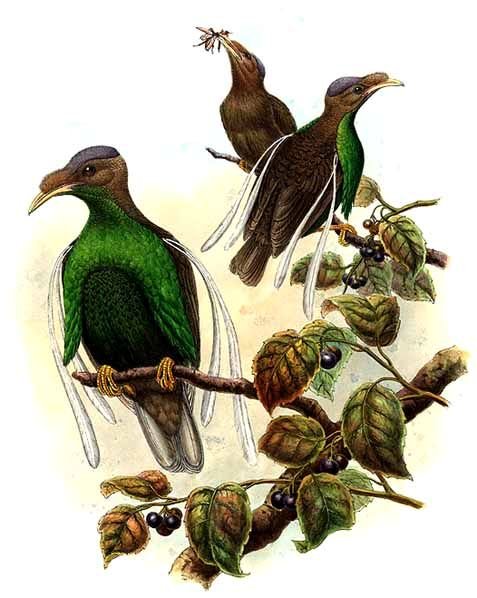
Standardwing Bird-of-paradise
Semioptera wallacii
Richard Bowdler Sharpe, Public domain, via Wikimedia Commons


Side by side
| Standardwing Bird-of-paradise | Wilson's Bird-of-paradise | |
|---|---|---|
| Scientific name | Semioptera wallacii G. R. Gray, 1859 | Diphyllodes respublica (Bonaparte, 1850) |
| English name | Standardwing Bird-of-paradise | Wilson's Bird-of-paradise |
| Group | Birds | Birds |
| Class | Aves Bird | Aves Bird |
| Order | Passeriformes Passerine | Passeriformes Passerine |
| Family | Paradisaeidae Bird-of-paradise | Paradisaeidae Bird-of-paradise |
| Genus | Semioptera Wallace's Standardwing | Diphyllodes Magnificent and Wilson's Birds-of-Paradise |
| Named in | 1859 | 1850 |
| Red List category | Least Concern | Near Threatened |
| Countries on record | 3 countries | 3 countries |
| GBIF occurrence records | 1,334 records | 1,402 records |
Rows where the two agree are shown in grey.
Where each is found
Both recorded in 3 countries
From Catalogue of Life checklists and GBIF occurrence records. A country missing from a list means no record is held, which is not proof of absence.
Checked facts
| Standardwing Bird-of-paradise | Wilson's Bird-of-paradise | |
|---|---|---|
| Appearance |
|
|
| Size |
|
|
| Habitat |
|
|
| Diet |
|
|
| Behaviour |
|
|
| Reproduction | No checked fact yet |
|
| Distribution |
|
|
| Conservation |
|
|
| Similar species |
| No checked fact yet |
In brief
Standardwing Bird-of-paradise
Semioptera wallacii inhabits lowland tropical rainforests and hilly habitats, and occasionally occurs in woodland. Adult males have glossy violet-and-lilac crowns, emerald-green breast shields and two pairs of long white wing plumes that they can raise or lower voluntarily. Full profile
Wilson's Bird-of-paradise
Diphyllodes respublica is endemic to Indonesia and occurs on Waigeo and Batanta Islands off West Papua. The male is distinguished by a bare blue head with a black double-cross pattern and two curved violet tail feathers. Full profile
Compare something else
Page built on 29 November 2026 from the data on the two species pages, where every source is listed.
Cite this page
ScientificNames.org. (2026). Standardwing Bird-of-paradise vs Wilson's Bird-of-paradise. Retrieved November 29, 2026, from https://scientificnames.org/compare/standardwing-bird-of-paradise-vs-wilsons-bird-of-paradise
“Standardwing Bird-of-paradise vs Wilson's Bird-of-paradise.” ScientificNames.org, 2026, scientificnames.org/compare/standardwing-bird-of-paradise-vs-wilsons-bird-of-paradise. Accessed 29 Nov. 2026.
ScientificNames.org. “Standardwing Bird-of-paradise vs Wilson's Bird-of-paradise.” Accessed November 29, 2026. https://scientificnames.org/compare/standardwing-bird-of-paradise-vs-wilsons-bird-of-paradise.
@misc{scientificnames_standardwing_bird_of_paradise_vs_wilsons_bird_of_paradise,
  author = {{ScientificNames.org}},
  title = {Standardwing Bird-of-paradise vs Wilson's Bird-of-paradise},
  year = {2026},
  url = {https://scientificnames.org/compare/standardwing-bird-of-paradise-vs-wilsons-bird-of-paradise},
  note = {Accessed 2026-11-29}
}