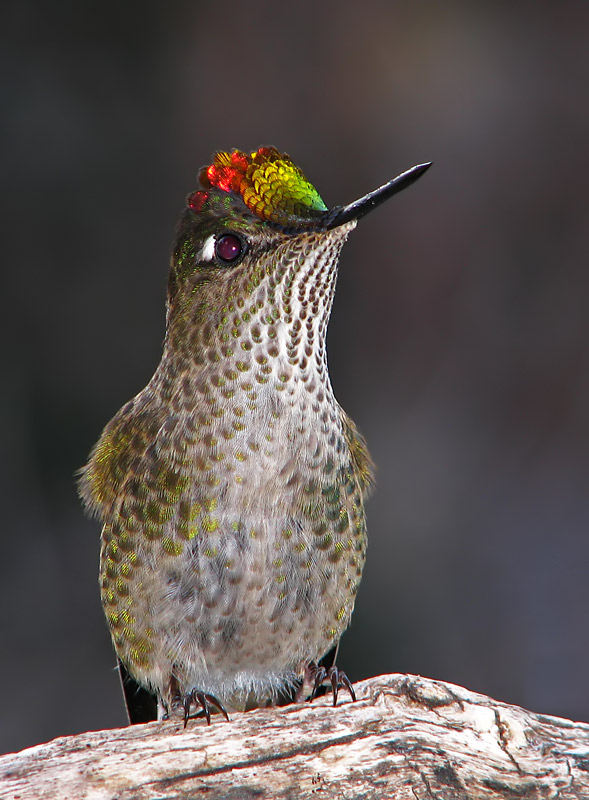
| Appearance | - The species exhibits sexual dimorphism, with males being larger and having shorter bills than females. English Wikipedia
- Adults of both sexes have bronzy green upperparts, slaty green wings and tails, and pale buff underparts marked with black and green spots. English Wikipedia
- Adult males have an iridescent red-yellow crown. English Wikipedia
- Juveniles of both sexes have rusty feather edges on their heads and cinnamon-toned underparts. English Wikipedia
- Juveniles are sexually monochromatic, making their sex difficult to determine. English Wikipedia
- The species often appears simply dark and green overall. ebird.org
| - Adult males have a white breast, rufous face, flanks and tail, and an iridescent orange-red throat patch. English Wikipedia
- Some adult males have green feathers on their back or crown. English Wikipedia
- Females have green, white and iridescent orange feathers in the center of their throat. English Wikipedia
- Female Rufous Hummingbirds have dark tails with white tips and rufous bases. English Wikipedia
- Females are slightly larger than males. English Wikipedia
|
|---|
| Size | | - The Rufous Hummingbird measures 7–9 cm in length and has a wingspan of approximately 11 cm. English Wikipedia
- The Rufous Hummingbird weighs between 2 and 5 grams. English Wikipedia
|
|---|
| Habitat | - The species inhabits forest edges, introduced Eucalyptus plantations, clearings, thickets, and gardens. English Wikipedia
- Its elevational range extends from sea level to above 2,000 m. English Wikipedia
| - The species primarily breeds in open areas, mountainsides and forest edges in western North America. English Wikipedia
|
|---|
| Diet | - The species feeds on nectar from native and introduced flowering plants. English Wikipedia
- Its favored nectar sources include plants belonging to the genera Abutilon, Embothrium, and Fuchsia. English Wikipedia
| - Rufous Hummingbirds consume flower nectar using an extendable tongue. English Wikipedia
- Rufous Hummingbirds catch insects while flying. English Wikipedia
- Rufous Hummingbirds obtain protein and fat from insects, particularly gnats, midges and flies. ecos.fws.gov
|
|---|
| Behaviour | - The species is resident in the Chilean matorral south of the Atacama Region to approximately the Los Lagos Region and in adjoining western Argentina. English Wikipedia
- During the non-breeding season, mainland birds winter in the lowlands of central Argentina as far east as the Atlantic coast. English Wikipedia
- The Juan Fernández Islands population is believed to be sedentary. English Wikipedia
- The species sometimes perches on flowers while feeding instead of hovering. English Wikipedia
- The species can remember nectar locations among identical flowers and distinguish the most rewarding nectar locations among less rewarding flowers. English Wikipedia
- The species is intensely territorial and has been observed chasing birds as large as caracaras. English Wikipedia
- The typical song consists of high-pitched notes interspersed with gravelly trills and squeaky notes. English Wikipedia
- The species' call is a single psee or skee note. English Wikipedia
| - Some migrating individuals remain in one local region throughout the summer. English Wikipedia
- Migrating and breeding Rufous Hummingbirds frequently defend feeding locations aggressively. English Wikipedia
- Adult males generally migrate earlier than females and juveniles. English Wikipedia
- Rufous Hummingbirds require frequent feeding while active during daylight. English Wikipedia
- Rufous Hummingbirds enter a state of torpor at night to conserve energy. English Wikipedia
- During hovering, Rufous Hummingbirds generate approximately 75% of their lift through wing downstrokes. English Wikipedia
- During fasting while hovering, Rufous Hummingbirds oxidize fatty acids to support metabolism and energy requirements. English Wikipedia
- Rufous Hummingbirds can switch to carbohydrate metabolism within 40 minutes of consuming flower nectar. English Wikipedia
- Both male and female Rufous Hummingbirds defend territories. English Wikipedia
- Males defend areas with dense flower concentrations and aggressively exclude females from these feeding areas. English Wikipedia
- Females generally defend larger territories containing more sparsely distributed flowers. English Wikipedia
- Male Rufous Hummingbirds have generally shorter wings than females. English Wikipedia
- Rufous Hummingbirds can migrate distances exceeding 3,200 kilometres. English Wikipedia
|
|---|
| Reproduction | | - Female Rufous Hummingbirds construct nests in protected locations within shrubs or conifers. English Wikipedia
- Male Rufous Hummingbirds mate with multiple females. English Wikipedia
|
|---|
| Distribution | - The species occurs in Argentina, mainland Chile, and the Juan Fernández Islands. English Wikipedia
- In Chile, the species occurs from south of the Atacama Region to the southern tip of South America. English Wikipedia
- Its mainland range extends into adjoining southern Argentina and eastward across central Argentina to the Atlantic coast. English Wikipedia
- An isolated population occurs on Robinson Crusoe and Alejandro Selkirk Islands in the Juan Fernández group. English Wikipedia
- The Juan Fernández Islands population is located approximately 770 km off the Chilean coast. English Wikipedia
- The species has been recorded as a vagrant on the Falkland Islands. English Wikipedia
- The species nests from the Los Lagos Region to the southern tip of South America in Chile and adjoining Argentina. English Wikipedia
| - Rufous Hummingbirds migrate through the Rocky Mountains and adjacent lowlands between May and September. English Wikipedia
- The species breeds in western North America from southern Alaska through British Columbia and the Pacific Northwest to California. English Wikipedia
- Most individuals winter in wooded areas of Guerrero, Mexico. English Wikipedia
|
|---|
| Conservation | - The species is classified as Least Concern by the IUCN. English Wikipedia
- The population size is unknown and is believed to be decreasing. English Wikipedia
- The species is locally common and does well in human-altered landscapes such as city parks and gardens. English Wikipedia
- The Juan Fernández Islands population is estimated at approximately 5,000 birds. English Wikipedia
- The species occurs in several protected areas on the mainland. English Wikipedia
- No immediate threats have been identified for the species. English Wikipedia
| - The Rufous Hummingbird was uplisted from Least Concern to Near Threatened on the IUCN Red List in 2018. English Wikipedia
- The species is considered vulnerable to declines in insect populations caused by pesticides and intensified agriculture. English Wikipedia
- Climate change has caused some flowers used by the species during breeding to bloom approximately two weeks before the birds arrive. English Wikipedia
|
|---|
| Similar species | - The only other species in its genus is the Juan Fernandez firecrown (Sephanoides fernandensis). English Wikipedia
| - Females and green-backed males can be difficult to distinguish from Allen's Hummingbird. English Wikipedia
|
|---|
| Name origin | - The specific epithet is sometimes misspelled as sephanoides to match the genus name. English Wikipedia
| No checked fact yet |
|---|
| Other | - The green-backed firecrown is a hummingbird belonging to the tribe Lesbiini and subfamily Lesbiinae. English Wikipedia
- The species is monotypic. English Wikipedia
- The species is an important pollinator in the temperate rainforest regions of southern South America. English Wikipedia
- The species can be fairly common in some locations. inaturalist.org
| No checked fact yet |
|---|