Comparison

Greater Hedgehog Tenrec vs Large-eared Tenrec

Greater Hedgehog Tenrec (Setifer setosus) and Large-eared Tenrec (Geogale aurita) both belong to the family Tenrecidae and part ways below it. Both are recorded in 1 country.
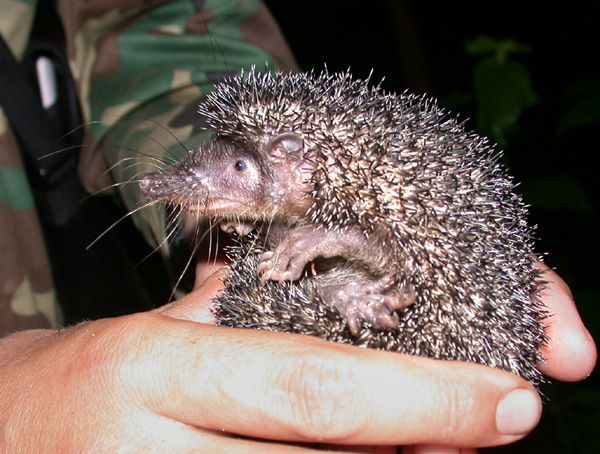
Greater Hedgehog Tenrec

Greater Hedgehog Tenrec

Setifer setosus

Tom Junek, CC BY-SA 3.0, via Wikimedia Commons

Large-eared Tenrec

Geogale aurita

Side by side

Greater Hedgehog TenrecLarge-eared Tenrec
Scientific nameSetifer setosus (Schreber, 1778)Geogale aurita A. Milne-Edwards & A. Grandidier, 1872
English nameGreater Hedgehog TenrecLarge-eared Tenrec
GroupMammalsMammals
ClassMammalia MammalMammalia Mammal
OrderAfrosoricida TenrecsAfrosoricida Tenrecs
FamilyTenrecidaeTenrecidae
GenusSetiferGeogale Large-eared Tenrec
Named in17781872
Red List categoryLeast ConcernLeast Concern
Countries on record1 country1 country
GBIF occurrence records722 records231 records

Rows where the two agree are shown in grey.

Where each is found

Both recorded in 1 country

From Catalogue of Life checklists and GBIF occurrence records. A country missing from a list means no record is held, which is not proof of absence.

Checked facts

Greater Hedgehog TenrecLarge-eared Tenrec
Appearance
  • The large-eared tenrec has a small, shrew-like body covered in short, soft fur, with a hairy tail and large projecting ears. English Wikipedia
  • Its dorsal fur ranges from greyish brown to reddish brown, while its underside is buffish white. English Wikipedia
  • The species has 34 teeth, compared with 36 teeth in most other tenrecs. animaldiversity.org
Size
Habitat
  • The species inhabits dry deciduous forests in southern and southwestern Madagascar. animaldiversity.org
  • Its recorded habitats include gallery forests and spiny bush in southern and southwestern Madagascar. animaldiversity.org
  • The species has also been recorded in southeastern Madagascar's rainforest. animaldiversity.org
  • The species has been recorded in grassland as well as dry deciduous forest. English Wikipedia
  • Individuals commonly shelter in hollow logs and holes during the heat of the day. English Wikipedia
Diet
Behaviour
  • Greater hedgehog tenrecs forage primarily at ground level but can also climb. English Wikipedia
  • The species is nocturnal. animaldiversity.org
  • The species undergoes both daily torpor and seasonal torpor or hibernation. animaldiversity.org
  • During daylight, individuals nest in shallow ground holes or tree cavities. animaldiversity.org
  • Individuals can curl into a ball and enclose themselves in a protective shield of spines. animaldiversity.org
  • Males have an average home range of 13.7 hectares, with a standard deviation of 4.9 hectares. animaldiversity.org
  • Females have an average home range of 6.7 hectares, with a standard deviation of 2.0 hectares. animaldiversity.org
  • The species may communicate through grunts, squeaks, and chirps. animaldiversity.org
  • Individuals may use hissing and puffing sounds during offensive and defensive interactions. animaldiversity.org
  • When disturbed, individuals may curl into a spiny ball or jump and scratch with their spines. animaldiversity.org
  • Individuals may mark territory by placing feces and urine outside their burrows. animaldiversity.org
  • The species is nocturnal and relies on auditory and olfactory senses despite having poor eyesight. animaldiversity.org
  • Individuals are mostly solitary, although male-female pairs occasionally live near one another. animaldiversity.org
Reproduction
  • The species is promiscuous and breeds seasonally. animaldiversity.org
  • The breeding season begins shortly after emergence from hibernation between late September and mid-October. animaldiversity.org
  • The breeding season continues until shortly before hibernation resumes in April. animaldiversity.org
  • Females produce between one and five young during a breeding season. animaldiversity.org
  • Gestation lasts between 51 and 65 days. animaldiversity.org
  • In captivity, young weigh approximately 20 grams and measure 75 millimetres three days after birth. animaldiversity.org
  • In captivity, lactation continues until approximately three weeks after birth. animaldiversity.org
  • Young begin accompanying their mothers outside the nest at approximately 14 days of age. animaldiversity.org
  • Females increase nest-building activity during the week of parturition. animaldiversity.org
  • Maternal care includes licking and huddling over the young while they nurse. animaldiversity.org
  • Females can enter oestrus while lactating, allowing them to nurse one litter while another develops in the uterus. animaldiversity.org
  • The mating season extends from late September through March. animaldiversity.org
  • The gestation period varies from approximately 54 to 69 days because embryonic development can be temporarily arrested. English Wikipedia
  • Females produce litters containing between one and five offspring. animaldiversity.org
  • Newborn offspring weigh between 0.5 and 0.8 grams. animaldiversity.org
  • Young are weaned between 21 and 33 days of age, shortly after their eyes open. English Wikipedia
Distribution
  • Setifer setosus is endemic to Madagascar and occurs throughout the island. English Wikipedia
Conservation
  • The large-eared tenrec is classified as Least Concern on the IUCN Red List. English Wikipedia
  • Some populations occur within national parks and nature reserves in Madagascar. English Wikipedia
UsesNo checked fact yet
Similar species
  • Despite its hedgehog-like appearance, the greater hedgehog tenrec is not closely related to true hedgehogs. English Wikipedia
  • The greater hedgehog tenrec resembles the lesser hedgehog tenrec, Echinops telfairi, in having a spiny back and hedgehog-like appearance. nhm.ac.uk
No checked fact yet
OtherNo checked fact yet

In brief

Greater Hedgehog Tenrec

Setifer setosus is endemic to Madagascar and occurs throughout the island. It has sharp, white-tipped spines covering its back, sides, and tail. Full profile

Large-eared Tenrec

Geogale aurita is endemic to Madagascar and occurs in its southern and southwestern regions. It is the sole living species in the genus Geogale and the only member of the subfamily Geogalinae. Full profile

Compare something else

Page built on 28 November 2026 from the data on the two species pages, where every source is listed.

Cite this page

ScientificNames.org. (2026). Greater Hedgehog Tenrec vs Large-eared Tenrec. Retrieved November 28, 2026, from https://scientificnames.org/compare/greater-hedgehog-tenrec-vs-large-eared-tenrec