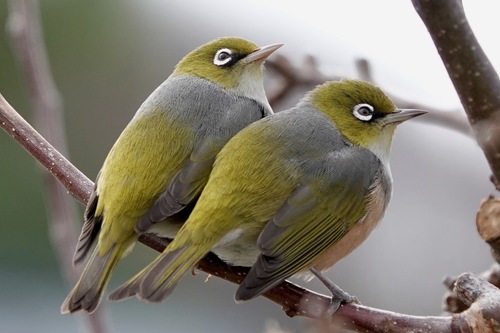
| Appearance | - The Seychelles White-eye has olive-grey upperparts and dull-coloured underparts. English Wikipedia
- The species has a narrow white eye-ring, a long dark-grey tail and a small sharp bill. English Wikipedia
- The bird has conspicuous white spectacles and dull olive-brown coloration. ebird.org
| |
|---|
| Size | - The Seychelles White-eye measures between 10 and 11 centimetres in length. English Wikipedia
| |
|---|
| Habitat | - The species inhabits terrestrial forest and shrubland environments. iucnredlist.org
- The species occurs locally in forest and woodland. ebird.org
| - The silvereye occurs in vegetated habitats other than open grasslands within its distribution range. English Wikipedia
- Its habitats include forests, scrub, horticultural blocks and urban gardens. English Wikipedia
|
|---|
| Diet | | - The silvereye feeds on small insects and spiders, as well as fruit and nectar. English Wikipedia
- Its diet includes berries in addition to insects, spiders, fruit and nectar. English Wikipedia
- In New Zealand, the silvereye consumes fruit from kahikatea and rimu trees. English Wikipedia
- Silvereyes consume insects that are harmful to garden and orchard produce, including aphids, scale insects and diamondback moths. English Wikipedia
|
|---|
| Behaviour | - The Seychelles White-eye produces a melodious and complex song composed of nasal tones. English Wikipedia
- The species is difficult to observe because it forages in the canopy of tall trees. English Wikipedia
- The species exhibits a cooperative breeding system involving changing compositions of nesting groups within breeding territories. English Wikipedia
- Individuals sometimes contribute to nests located in territories other than their own. English Wikipedia
| - Silvereyes gather into flocks in late summer. English Wikipedia
- Many Australian silvereyes migrate northwards along the coast and mountain ranges. English Wikipedia
- Migrating silvereyes forage during the day and undertake long-distance flights at night. English Wikipedia
- Most of the Tasmanian population crosses Bass Strait and disperses into Victoria, New South Wales and south-eastern Queensland. English Wikipedia
- Northernmost populations of silvereyes in Australia remain resident throughout the year. English Wikipedia
- In western Australia, silvereyes have been recorded moving between the mainland and offshore islands. English Wikipedia
|
|---|
| Reproduction | - The breeding season extends from September through April. English Wikipedia
- The species lays clutches containing between two and seven eggs in cup-shaped nests. English Wikipedia
- Incubation lasts between 13 and 15 days. English Wikipedia
- Young birds become fully fledged between 11 and 16 days after hatching. English Wikipedia
- Adults continue caring for their young for approximately two months after fledging. English Wikipedia
| - Silvereyes breed during spring and early summer, mainly between September and December. English Wikipedia
- Silvereyes construct small cup-shaped nests from grass, moss, hair, spiderweb and thistledown. English Wikipedia
- Silvereyes suspend their nests from branch forks in the outer portions of small trees or shrubs. English Wikipedia
- A silvereye clutch contains two to four pale blue eggs. English Wikipedia
- Silvereyes may raise two or three broods during one breeding season. English Wikipedia
- Silvereye eggs hatch after approximately 11 days of incubation. English Wikipedia
- Silvereye nestlings fledge approximately 10 days after hatching. English Wikipedia
- Juvenile silvereyes become independent at approximately three weeks of age. English Wikipedia
|
|---|
| Distribution | - The Seychelles White-eye is endemic to the Seychelles. English Wikipedia
- The species was rediscovered in the highlands of Mahé after being considered extinct. English Wikipedia
- A population of approximately 250 individuals was rediscovered on Conception Island in 1997. English Wikipedia
- In 1998, the population on Mahé was estimated at approximately 50 individuals. English Wikipedia
- The Conception Island population was reported to contain between 244 and 336 individuals. English Wikipedia
- In 2001, 31 individuals were transferred to Frégate Island. English Wikipedia
- The species has also been transferred to North Island and Cousine Island. English Wikipedia
| - The silvereye is native to Australia, New Zealand and several south-west Pacific island groups. English Wikipedia
- The silvereye is common to abundant in the relatively fertile south-western and south-eastern regions of Australia. English Wikipedia
- Its Australian distribution includes Tasmania and the Bass Strait islands. English Wikipedia
- The silvereye occurs along the well-watered coastal region of tropical Queensland, including Cape York Peninsula. English Wikipedia
- The species was first recorded in New Zealand in 1832 and arrived in greater numbers in 1856. English Wikipedia
|
|---|
| Conservation | - The species was considered extinct between 1935 and 1960. English Wikipedia
- The population was estimated at only 25–35 individuals in 1996. English Wikipedia
- Historical population decline was attributed to extensive forest clearance, competition from introduced birds and predation by rats. English Wikipedia
- The population on Frégate Island subsequently increased to more than 60 birds. English Wikipedia
- The transferred population on Cousine Island subsequently died out. English Wikipedia
- Transfers to other islands contributed to an estimated global population of approximately 500 individuals. English Wikipedia
| |
|---|
| Uses | No checked fact yet | - Silvereyes provide a beneficial service in gardens and orchards by consuming insects that damage produce. English Wikipedia
- Silvereyes can be regarded as agricultural and horticultural pests because they consume fruit crops and pass through bird netting. English Wikipedia
- Silvereyes are attracted to apples, citrus, feijoas, figs, grapes, pears and persimmons. English Wikipedia
|
|---|